ZippyDB and Async have existed for years. This is nothing really new.
How meta built the infrastructure for Threads
121–130 of 184 posts
Re: How meta built the infrastructure for Threads
#122Offtopic but here we go: Once Threads became available in the EU I, like I assume many others, made an Instagram account from my FB account in order to check it out. 2 days later, and without having posted anything except perhaps a "Hello world", my Insta account was banned for generic reason (breaking the TOS, nothing concrete). I only found out 2 weeks later, as I hadn't even visited the site(s) again. Their "Appea…
This is true for all Meta/Google/Twitter properties. No phone number results in a high chance of suspension irrespective of your usage.
But I did give them my phone number. I'm pretty sure they already had it from Facebook anyway, I've had a FB account for 15 years.
They just were unable to send the code to it, so I could not proceed with whatever appeal process they have in place. That said, if the next step was asking for my face, I'd have probably stopped right there like a poster said. They do have photos of me (Facebook) but it would just be too much.
Re: How meta built the infrastructure for Threads
#123(This is performance evaluation week at Meta) I can only dream of being able to cite an article like this on my impacc...
CQ and Laine are directors. ZDB and Async have existed for a while, nothing really new here. I guess they need to claim something on PSC.
Re: How meta built the infrastructure for Threads
#124Cloudflare Overall Ranking for Threads: https://blog.cloudflare.com/content/images/2023/12/pasted-im...
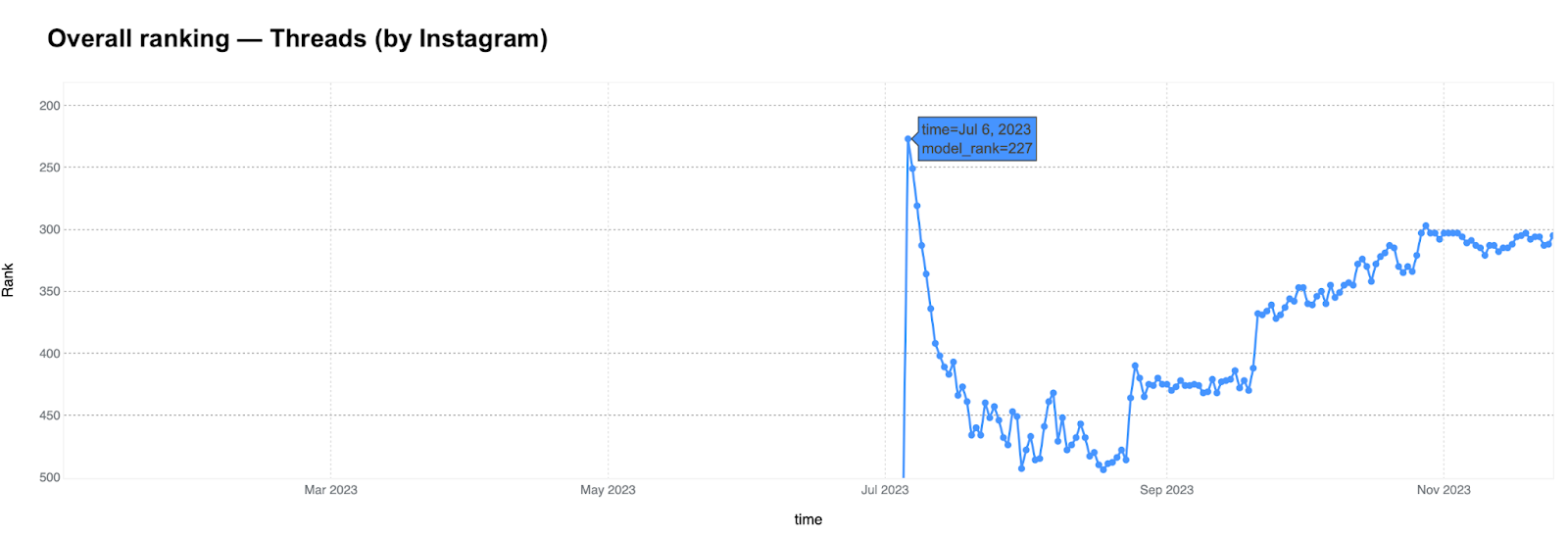
(source: https://blog.cloudflare.com/radar-2023-year-in-review-intern...)
Re: How meta built the infrastructure for Threads
#125Earlier quoted context omitted.
> My guess is that you signed up through a VPN Your guess is wrong. I don't use any VPN. Why is everyone trying to find reasons to blame the victims?
> Why is everyone trying to find reasons to blame the victims? Victims of what?
Social network auto-banning
Re: How meta built the infrastructure for Threads
#126Earlier quoted context omitted.
Honestly, I can't believe any real person still uses Twitter. I haven't subscribed to anyone and have no subscribers. Nevertheless, whenever I open it, I'm swamped with US Neo-Nazi tweets, as well as pro-Russia and pro-Hamas content. I'm not saying it's the only content I see, but enough to make Twitter look like the front page of a terrorist organization. Apparently, the Twitter algorithm has learned that I'm using…
> I'm swamped with US Neo-Nazi tweets, as well as pro-Russia and pro-Hamas content. > adjusted its content accordingly to convince me of a hundred times more radical positions Globally, these positions are not radical (sans Neo-Nazi). The average human is (strongly) opposed to American foreign policy, if not outright pro-Russian/pro-Palestinian. That said, these topics are also great engagement bait and X does push t…
They are common but not majority opinion. The average Indian is more supportive of Israel for example. That's the most populous country in the world and you definitely see them on X as well. The average Chinese doesn't care about either and doesn't use any foreign social media apps.
Many of us have a very selective view of the world. When you have a platform that allows most speech from anyone on the planet, such an open platform may seem extremely biased to people used to their bubbles, where their own opinion is the "normal" one and few people disagree with them.
Re: How meta built the infrastructure for Threads
#127What do folks use for something like Meta’s Async? RabbitMQ? > The workloads commonly executed on Async are those that do not require blocking an active user’s experience with a product and can be performed anywhere from a few seconds to several hours after a user’s action.
Sounds like something you could do with SQS and Lambda. They just have massive datacenter infra and compute at disposal.
Yeah but what about something that won't make my wallet cry?
Re: How meta built the infrastructure for Threads
#128Earlier quoted context omitted.
Pretty sure there was (and still is) a very obvious button in Instagram, they didn't spend money on advertising is what I understood. At 1.2 billion monthly users that's a pretty average CTR for that kind of thing. A little extra because threads still isn't available worldwide so some traffic was just lost.
> they didn't spend money on advertising is what I understood They didn't have to, though - the news outlets were running stories on Threads and its impending arrival nearly every day. To claim, as GP does, it was entirely "organic" is nonsense.
Press mentions are generally considered "organic".
Re: How meta built the infrastructure for Threads
#129ZippyDB and Async have existed for years. This is nothing really new.
[deleted]
Re: How meta built the infrastructure for Threads
#130Earlier quoted context omitted.
Sounds like something you could do with SQS and Lambda. They just have massive datacenter infra and compute at disposal.
Yeah but what about something that won't make my wallet cry?
Pretty much any queue and a compute will do. SQS paired with lambda an event bridge (I forget if that's the service to trigger the lambda or not) would be solid. I lean towards compute that's a bit easier to run in different settings so just any old code checking the queue and executing as expected also works. SQS is cheap and it's pretty damn solid. I believe it was the first AWS service.
But in reality, any managed queue or even a well structured DB table can be fine, depending on your scale.