Live data from Hacker News

First new U.S. nuclear reactor since 2016 is now in operation

eia.gov

251–260 of 1001 posts

Re: First new U.S. nuclear reactor since 2016 is now in operation

#251

Earlier quoted context omitted.

> One kilogram of uranium-235 (50 cm^3) can theoretically produce about 20 terajoules of energy. One square kilometer of solar panels can theoretically produce the same amount (as 50cm^3 U235) in a day. Does the US have more 50cm^3 sized blocks of U235, or more square kilometers of land with low land values and high annual insolation? There's an estimated 6 million tonnes of mineable uranium reserves in the world [0]…

I want to make clear that I am not arguing against solar. My belief is that nuclear is an important piece of a much larger puzzle. Wind is not reliable, and for solar to match the figures you provided, we would need to figure out storage, so lets diversify our portfolio :)

Figuring out storage is hard if you think in terms of Lithium Ion grid-scale batteries, or mountains for pumped hydro, but[1] puts forward the idea of synthetic natural gas generated by solar panels. That can be pumped into existing national gas grids, existing gas storage, and sent into existing gas power stations to generate power in quiet times. The article says that solar power has dropped from $100/Watt in 1976 to $0.50/Watt by 2016, and that instead of slowing down as the low hanging fruit has been picked, that process is speeding up since 2011 when Solar started to become cheaper than other forms of power generation, which changed the feedback loops and is bringing in much more demand which brings more investment, research and production, than before when it was an expensive little-used alternative.

This is a linked graph of solar growth compared to International Energy Agency's World Energy Outlook predictions: https://rameznaam.com/wp-content/uploads/2020/05/IEA-Solar-G...
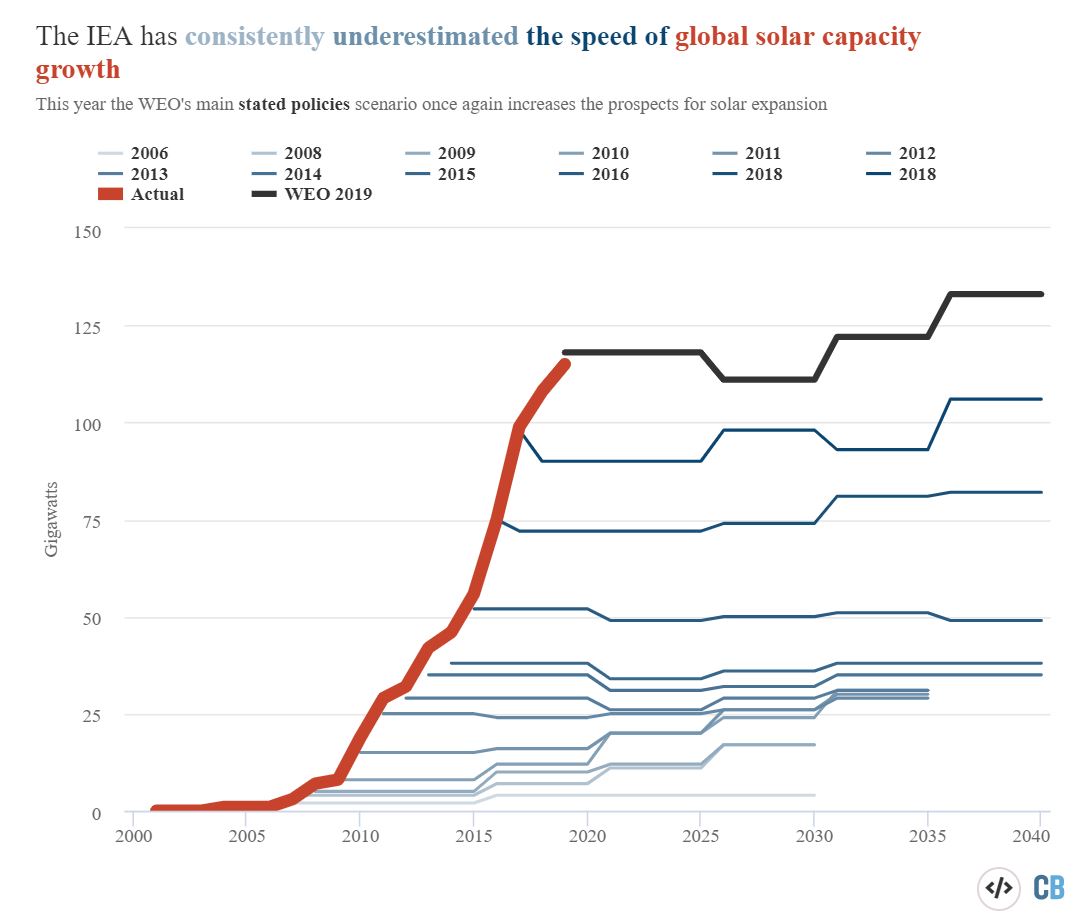
In each of 2006, 2008, 2009, 2010, 2011, 2012, 2013, 2014, 2015, 2016, 2018, the IEA predicted deployment of solar would stop accelerating (line going up) and steady off into consistant growth (flatline on that graph). Every year they have been very quickly wrong, and the 2019 predition of flatline is so wrong that by 2021 actual production of 190GW was WAYYYY off the top of that chart. At this rate we may not need to figure out storage nearly as much as we think.

> "What people have missed is that reaching cost parity on fuel synthesis will unlock huge new demand centers [and trigger an acceleration in demand/investment/research/cost decline of solar created synthetic fuels]."

[1] https://news.ycombinator.com/item?id=32197012 (article rather than comments)

Re: First new U.S. nuclear reactor since 2016 is now in operation

#252

Earlier quoted context omitted.

One kilogram of uranium-235 (50 cm^3) can theoretically produce about 20 terajoules of energy. One square kilometer of solar panels can theoretically produce the same amount (as 50cm^3 U235) in a day. I'll take this bet. Edit: Tried to edit the edit but somehow deleted the rest of the edit. It was something to the tune of how a big problem with renewables is the fact that peak solar production does not match peak ene…

> One kilogram of uranium-235 (50 cm^3) can theoretically produce about 20 terajoules of energy. One square kilometer of solar panels can theoretically produce the same amount (as 50cm^3 U235) in a day. Does the US have more 50cm^3 sized blocks of U235, or more square kilometers of land with low land values and high annual insolation? There's an estimated 6 million tonnes of mineable uranium reserves in the world [0]…

There is way way more uranium than that. It is surprisingly common. And harvesting it from seawater opens up a supply that dwarfs any mining concept.

https://en.wikipedia.org/wiki/Uranium_in_the_environment

>> Uranium is a naturally occurring element found in low levels within all rock, soil, and water. This is the highest-numbered element to be found naturally in significant quantities on earth. According to the United Nations Scientific Committee on the Effects of Atomic Radiation the normal concentration of uranium in soil is 300 μg/kg to 11.7 mg/kg. ... It is considered to be more plentiful than antimony, beryllium, cadmium, gold, mercury, silver, or tungsten and is about as abundant as tin, arsenic or molybdenum.

How uranium ore becomes fuel rods: (Actually a rather simple process imho.)

https://youtu.be/9x7DozCqLxU

https://youtu.be/c7ehyxRBMbw

Re: First new U.S. nuclear reactor since 2016 is now in operation

#253
post #48

Earlier quoted context omitted.

Nuclear is extremely dependent on long distance power transmission. Nobody wants a reactor in the middle of a city, and 1-5 GW of power needs to be sent long distances before it’s used. Solar on the other hand scales down to 50MW instillations just fine so you can put it near substations etc. Huge solar parks make sense in locations with lots of sunlight and cheap land, but they aren’t the only option just a trade of…

Chicago is mostly on nuclear and the reactor is quite close to the city, just over the Indiana border.

Closest is Braidwood which is ~60 miles from downtown.

NYC has large power plants in Manhattan (East River 1, 2, 6, and 7), Queens (650MW Astoria Energy II power station), and Brooklyn (Narrows 1–1 to 2-8) plus a few more.

Re: First new U.S. nuclear reactor since 2016 is now in operation

#254
post #147

This caught my eye: "Prior to Vogtle Unit 3, the last nuclear reactor to start in the United States was Watts Bar Unit 2 in Tennessee. Construction on Watts Bar 2 began in 1973 but was suspended in 1985. Work resumed in 2007, and the reactor came online in 2016." More on that here: https://en.wikipedia.org/wiki/Watts_Bar_Nuclear_Plant#Unit_2

> Construction on Watts Bar 2 began in 1973 but was suspended in 1985. Work resumed in 2007, and the reactor came online in 2016.

That seems to be common with nuclear power plants. The latest one near where I live (Angra 3) has been under construction since 1984, and it should be complete in a few more years if it doesn't pause again; construction of the previous one (Angra 2), according to Wikipedia, started in 1976 and came online in 2001.

Re: First new U.S. nuclear reactor since 2016 is now in operation

#255
post #66
post #58

Earlier quoted context omitted.

Aside from the environmental benefit right? Don’t lots of large ships burn cheaper fuel higher in pollutants when on unregulated wafers?

Ships and planes together account for single digit percentages of global fossil fuel use and emissions. It’s almost all cars, trucks, and electric power, so those are the things it makes the most sense to worry about as opposed to things that are much harder to decarbonize and account for less emissions.

Is ship pollution really that negligible?[0] To be clear though the entire world is dependent on trans ocean shipping, it cannot be kneecapped for environmental purposes, but that doesn’t mean it’s not a relevant part of the issue.

[0] https://www.transportenvironment.org/wp-content/uploads/2023...

Re: First new U.S. nuclear reactor since 2016 is now in operation

#256

Seems to me the people saying solar and battery only future do not live in areas that can be cloudy for multiple weeks. I didn’t run the math but I’m guessing it’s not feasible to build a battery pack large enough to ride out winter in some areas. The SF Bay Area, sure, but I suspect blackouts will be common in solar+battery only areas. A preferred solution would be a mix of both with nuclear handling disruptions due…

I think solar+battery usually also involves overbuilding the solar capacity by a lot and running some HVDC lines. A mix with nuclear and wind seems smart to me, but I wouldn't be shocked if some cloudy places successfully manage solar+batteries in combination with HVDC and/or having some easily-curtailed industries in the area.

Re: First new U.S. nuclear reactor since 2016 is now in operation

#257

Earlier quoted context omitted.

It’s worth noting that the dichotomy you set up isn’t quite right. The land use for solar and wind isn’t an exclusionary zone. The area around a wind turbine can be used same as before (most often as farmland) without a negative impact on its productivity. And the same is true for solar. In fact, a growing number of agro-voltaic projects are seeing a net positive on crop yields from solar panels due to the increased…

Is it possible for solar panels to be semi-transparent so crops can still thrive underneath?

That's not needed, just have gaps between the panels so they provide partial shade. Many food crops can't tolerate "full sun" well, and will grow perfectly fine even with partial illumination.

Re: First new U.S. nuclear reactor since 2016 is now in operation

#258

Earlier quoted context omitted.

Nuclear might not be able to compete in the U.S. and Europe, but that’s largely because of a ridiculous regulatory regime and has very little to do with the actual tech.

China has installed more renewable energy than the rest of the world put together last year. I'm pretty sure we can rule out any "ridiculous regulatory regime" issues there.

If you’re going to try to determine how China is approaching nuclear power, it’s probably more useful to look at data related to that [0], instead of drawing conclusions from tangential data.

[0] https://en.wikipedia.org/wiki/Nuclear_power_in_China

Re: First new U.S. nuclear reactor since 2016 is now in operation

#259
post #187
post #7

Earlier quoted context omitted.

Problem is that we don't build the damn things anymore, so each one is bespoke and expensive. Ideally we'd keep building them and develop the expertise and make it a more repeatable scalable process. I worry instead that the lesson taken from this will be "nuclear is too expensive and ineffective".

MIT found that reusing a design made plants more expensive to build, not less, because of costly on-site last minute design changes. Taking your point more charitably, it is indeed the lack of a sustainable nuclear energy industry that routinely builds plants that causes costs to skyrocket. There is a chicken and egg situation: nuclear projects don’t get funded because they’re too expensive, so there is no chance to…

> costly on-site last minute design changes

I clicked through to the actual study ( https://www.cell.com/joule/fulltext/S2542-4351(20)30458-X?_r... ) and I couldn't find a single sentence mentioning on-site last-minute design changes. I searched for "change" and tabbed through all of the results. The closest thing was mention of Westinghouse changing construction standards halfway through an ongoing project, which required many changes to the project design. But, that's one project.

So my question is: Is it possible that the MIT News Office can't understand MIT journal articles?

Re: First new U.S. nuclear reactor since 2016 is now in operation

#260

Earlier quoted context omitted.

Nuclear power seems like a good option for non-military boats too, like container ships and oil tankers. It's already a very well proven maritime technology.

That was tried, nuclear reactors on civilian ships, and found to be a stupid idea. Too expensive and no real benefit over ship engines. By the way, tha vast majority of military ships and boats are not nuclear powered.

There needs to be nuclear powered "oiler ships" that stay out at sea indefinitely and recharge passing by electric ships.
Post reply on HN