Earlier quoted context omitted.
> One kilogram of uranium-235 (50 cm^3) can theoretically produce about 20 terajoules of energy. One square kilometer of solar panels can theoretically produce the same amount (as 50cm^3 U235) in a day. Does the US have more 50cm^3 sized blocks of U235, or more square kilometers of land with low land values and high annual insolation? There's an estimated 6 million tonnes of mineable uranium reserves in the world [0]…
I want to make clear that I am not arguing against solar. My belief is that nuclear is an important piece of a much larger puzzle. Wind is not reliable, and for solar to match the figures you provided, we would need to figure out storage, so lets diversify our portfolio :)
This is a linked graph of solar growth compared to International Energy Agency's World Energy Outlook predictions: https://rameznaam.com/wp-content/uploads/2020/05/IEA-Solar-G...
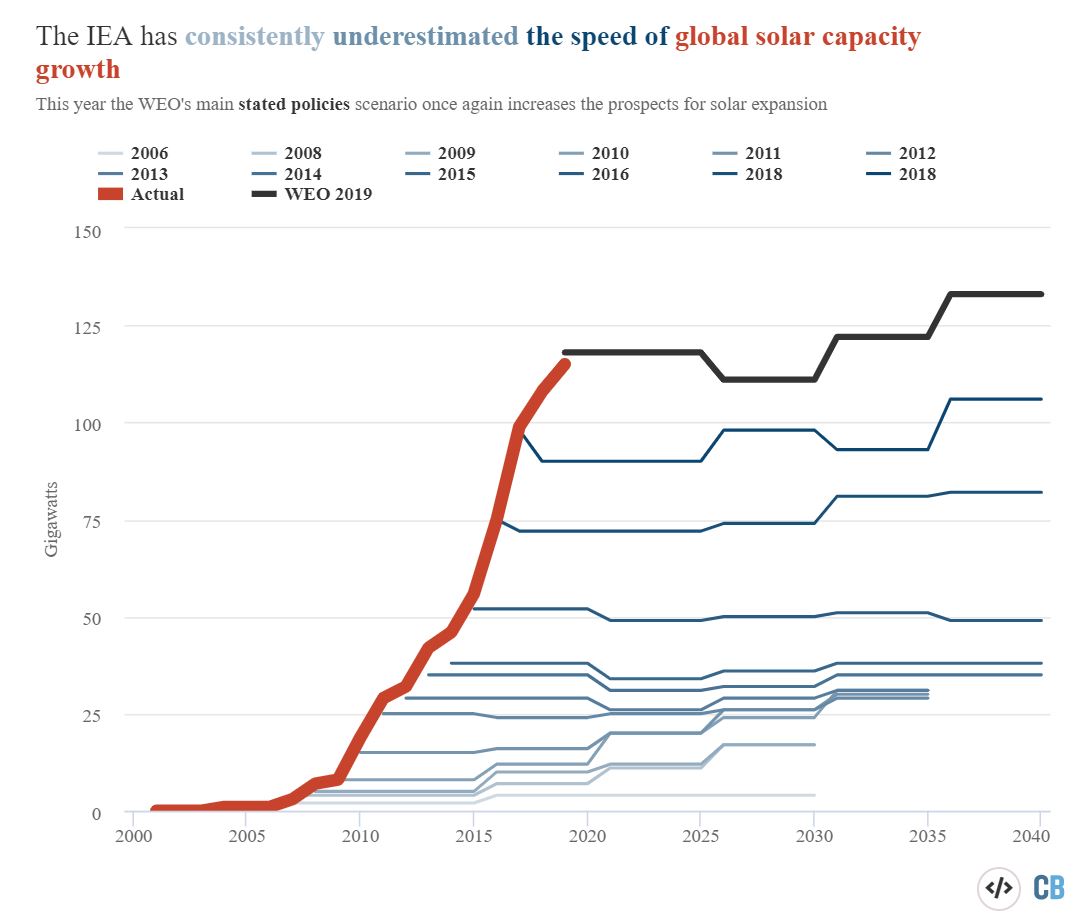
In each of 2006, 2008, 2009, 2010, 2011, 2012, 2013, 2014, 2015, 2016, 2018, the IEA predicted deployment of solar would stop accelerating (line going up) and steady off into consistant growth (flatline on that graph). Every year they have been very quickly wrong, and the 2019 predition of flatline is so wrong that by 2021 actual production of 190GW was WAYYYY off the top of that chart. At this rate we may not need to figure out storage nearly as much as we think.
> "What people have missed is that reaching cost parity on fuel synthesis will unlock huge new demand centers [and trigger an acceleration in demand/investment/research/cost decline of solar created synthetic fuels]."
[1] https://news.ycombinator.com/item?id=32197012 (article rather than comments)