Live data from Hacker News

Paper vs. devices: Brain activation differences during memory retrieval (2021)

frontiersin.org

91–100 of 120 posts

Re: Paper vs. devices: Brain activation differences during memory retrieval (2021)

#91
post #83

One thing I love about my reMarkable tablet is that I get all the benefits of manual handwriting and sketches, enhanced by and combined with digital flexibility (copy/paste, resize, undo/redo, tags/metadata, search, retrieval, PKB integ and interop, etc).

How does an iPad with an Apple Pencil compare?

They both have pretty good palm rejection and stylus pressure sensitivity.

For writing feel, the iPad gives you a lot of options from slick glass (the default) to many different screen protectors with different trade offs for writing friction, glare, and screen clarity. The Remarkable screen doesn't have as many options, but you might not miss them. The screen is very nice to write on.

For functionality, the iPad is much more advanced. It's faster (less pen latency), has fantastic text recognition, built in camera (which is great for capturing whiteboards), color, slightly higher resolution, etc... You also have more options for note taking apps. I personally use GoodNotes and Procreate for almost everything.

The biggest drawback for me with the Remarkable is the small screen. The big iPad has a screen close to A4 size which is fantastic for reading and marking up documents. The smaller Remarkable screen forces you to either shrink the document or do a lot of panning. There are 13" eink screens (like the Quaderno) and I hope the next generation of Remarkable devices offer it as an option.
Re: Paper vs. devices: Brain activation differences during memory retrieval (2021)

#92
post #61

One thing I love about my reMarkable tablet is that I get all the benefits of manual handwriting and sketches, enhanced by and combined with digital flexibility (copy/paste, resize, undo/redo, tags/metadata, search, retrieval, PKB integ and interop, etc).

Interesting. How is the integration of the reMarkable into other ecosystems? Can notes be converted to text and used elsewhere easily? (e.g. Nextcloud or Markdown docs)?

I self-host rmfakecloud. Let’s me back it up and not share the data. Lots you can do with it from there, though I mainly do it for privacy.

https://github.com/ddvk/rmfakecloud

Re: Paper vs. devices: Brain activation differences during memory retrieval (2021)

#93

I once wrote out a job hunting goal on a sheet of paper and read it 3x per day for a few months, with “crazy” salary and everything. And then, I got it. I did similar thing later with multiple goals in Google docs. Found that I’m not as consistent with it and haven’t achieved those same goals. Could be consistency, more goals vs fewer, or the paper vs digital There’s something about paper that feels more real. It als…

I'm sorry, are you saying putting "get a great job" on paper and reading it repeatedly does anything at all to actually getting the job?

Could it be that such a huge goal as "be successful in my career" is just more important than the ones you put in Google docs?

Re: Paper vs. devices: Brain activation differences during memory retrieval (2021)

#95
post #80
post #42

NB: this is a Japanese study. The participants wrote their notes in Japanese. If you write on paper, you need to write out each character by hand. In contrast, if you write on a tablet or other device, the input system will sort of "autocomplete" for you. Therefore, more cognitive effort is required to write on paper than on device. It is fairly accepted that greater cognitive effort (either to encode or to retrieve)…

> If you write on paper, you need to write out each character by hand. Exactly like English or French. You also need to remember the correct sequence of letters (see my remark below). > In contrast, if you write on a tablet or other device, the input system will sort of "autocomplete" for you. Exactly like English or French. I didn't write half of the letters used to type this comment. I think you are searching for J…

I've been slowly learning Japanese, mostly with Duolingo, and that's a conclusion I've noted as well. People get hung up on the "complexity" of even hiragana and katakana, complaining about there being two many or those two scripts being duplicates.

There are fewer total hiragana and katakana than there are English digrams and trigrams in lower-case and capital letters. (Because Japanese uses fewer overall phonemes...and the characters are consistent in terms of pronunciation, unlike English.)

I'm not very far into kanji (just some basic ones like 水 or 人 that stick) but the principles are solid: they have shared stroke components (radicals) that related kanji share, much like similar collections of letters, and studying them as you study vocabulary isn't really any different than knowing what an English word looks like on sight, without "sounding it out."

Re: Paper vs. devices: Brain activation differences during memory retrieval (2021)

#97

One side issue on these studies is there's currently no control group who spent their life solely on electronic devices. Even as tablets are distributed in school from the primary cycle, note taking and exams are all done on paper. This is not a value judgment on wether it's good or bad, just that any further study will be on subjects that spent their formative years writing on paper, they better learn to be good at…

> Even as tablets are distributed in school from the primary cycle, note taking and exams are all done on paper. My kid takes tests on the computer. And when I was in law school almost 20 years ago, students mostly took notes on computers, and tests were computerized as well. I will note that when I was studying for the bar I found it incredibly helpful to re-write my daily lecture notes by hand.

The general hypothesis is that increases in the count of modalities used and intensity of use within each modality for a task is, by definition, an increased engagement, more completely triggering the adaptive mechanisms such as memory and providing a more pervasive context into which the learning can be woven.

Re: Paper vs. devices: Brain activation differences during memory retrieval (2021)

#98
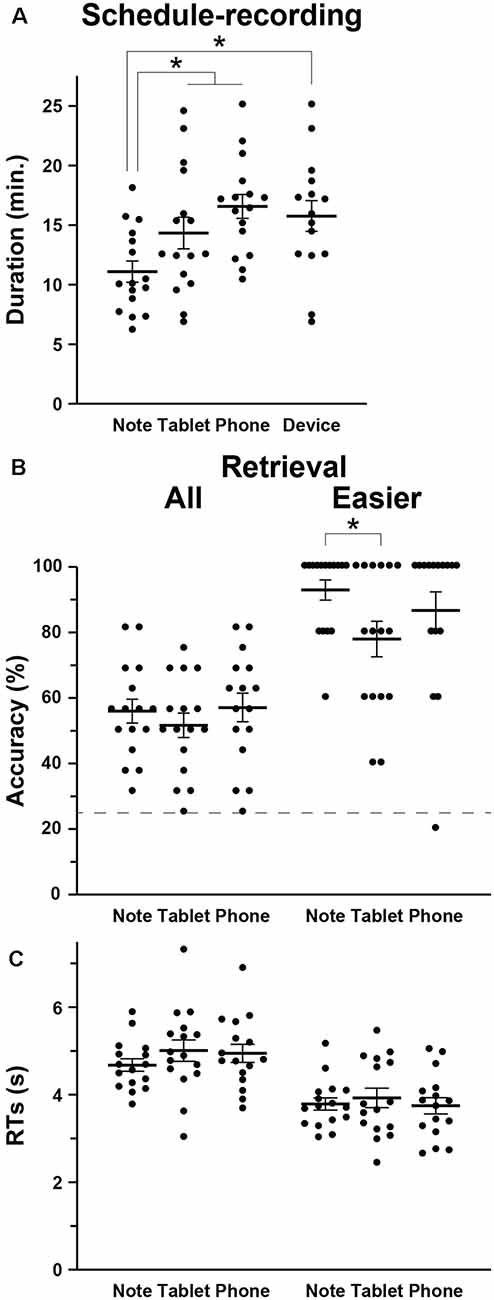
Personally, I'm not convinced it is a good idea to make any conclusions about reality from any fMRI study (I'm not convinced what is being measured is all that important plus even intrepreting what is being measured relies on complex statistics). Also, for this kind of thing the outliers are very important in tring to figure out what is going on. They show individual data points and eyeballing them I don't really see a lot of difference in the accuracy, with the tablet in particular being slightly worse than nearly identical phone or notes (but they had to pop out "easy questions" to make that difference look interesting). Saying there is a difference between device and paper just because the tablet condition did worse is misleading.

https://www.frontiersin.org/files/Articles/634158/fnbeh-15-6...

They mention the difference in terms of location cues in the conclusion section. I would guess UI choices affect the ability to use location sense to recall information and I could easily imagine the small menus of phones enhancing this effect (and/or larger screens in general reducing the physical location effect of the device itself). Taking a quick look on Google Scholar there is some research on this kind of thing but I'm not seeing any thing that pops out as a particularly interesting presentation. Any UI designers out there who intentionally try to trigger location sense in their design?

Re: Paper vs. devices: Brain activation differences during memory retrieval (2021)

#99
post #41

Earlier quoted context omitted.

SRS = spaced repetition software.

A shoutout to SuperMemo here - one of the oldest SRS out there. Their first version was on Amiga, if I remember correctly, and the newest ones support iOS, use LLMs and all the other tech :)

iOS? No, certainly not. The recently released version just did the jump from Internet Explorer to Edge support.

You probably mean the confusingly identically named SuperMemo on supermemo.com (not .guru), that is indeed a spaced-repetition software, but is not the venerable and famous real SuperMemo with a gazillion of features and research behind it. Just a simplistic knockoff. Strangely by the same author.

Post reply on HN