Earlier quoted context omitted.
I'd be happy with an LED bulb that lasted a year. I haven't yet found one that can do that reliably. Remember that 60W incandescent bulbs costing $0.25 used to be available that met that goal. We've taken huge steps backwards on interior household lighting.
Felt, GE, Philips. I have ~20 bulbs, including several on dimmers, in the house and have never had to replace a failed LED bulb in ten years. Are you sure your power isn't bad in some way?
Apple's Blue Ocean
141–150 of 262 posts
Re: Apple's Blue Ocean
#142Earlier quoted context omitted.
Apple devices aren't engineered to last; they're engineered to be manufactured, sell new, and sometimes sell expensive repairs by them. Also, NVIDIA cards in eGPUs and Thunderbolt (arm64) aren't supported. The best solution is either don't use Apple, or have a machine under warranty and very good backups. Complaints aside, the Anker 777 dock does 5K-8K DP over USB-C, 1 GbE, 100w charging, 4 USB-A and more and works w…
Can you explain why Apple devices in general maintain a higher percentage of their resale value for longer than their competitors’ counterparts?
Re: Apple's Blue Ocean
#143Two things I've been waiting on for years: • MST (DisplayPort daisy chaining) in MacOS. The hardware has supported it for over a decade. The OS is the weak link here. It's the difference between spending $75-$300 for a dock in addition to the cables and just connecting the monitors together along with a single cable to the first monitor. • Non-soldered storage. Seriously. Storage is the most likely component to fail.…
With a large 4K screen, I'm not seeing any benefit for MST, and studies have shown it decreases productivity after 2 screens. The other problems are simply fixed with using iCloud and treating your laptop as a disposable, which many laptops have been designed as. If you use the MacBook add intended and invest in apple care it's unbeatable.
With specialized software ( multi track AV) and/or ad hoc setup ( e.g. deeply tuned Linux) the more the screens you throw at it, the better.
Re: Apple's Blue Ocean
#144Earlier quoted context omitted.
These aren't studies, just anecdotes, and the actual study quoted in the NYT shows the opposite: > One study commissioned by NEC and conducted by researchers at the University of Utah showed that people using a dual-display machine to do a text-editing task were 44 percent more productive than those who used a single monitor. I think it's fair to say that any research from 2014 isn't the most relevant now. Both scree…
Realistically where would you position these monitors? Ergonomically there aren't many great solutions for any extended use especially once you go up to mutiple large monitors. Tilt your head in those directions and see how long you maintain them comfortably. If you think modern notifications are less distracting I'll respectfully disagree.
I have a 34" main monitor positioned directly in front of me, a 24" in vertical orientation I use mostly for multiple terminals and my MPB screen below the 34".
I don't think this is an unusual setup.
> Tilt your head in those directions
This applies to large single monitors too. I think (hope?!) most people have a setup where their main work is right in front of them.
> If you think modern notifications are less distracting I'll respectfully disagree.
No I'm saying they are more distracting, so reduce the relevance of old articles claiming a single monitor reduced those.
Re: Apple's Blue Ocean
#145Two things I've been waiting on for years: • MST (DisplayPort daisy chaining) in MacOS. The hardware has supported it for over a decade. The OS is the weak link here. It's the difference between spending $75-$300 for a dock in addition to the cables and just connecting the monitors together along with a single cable to the first monitor. • Non-soldered storage. Seriously. Storage is the most likely component to fail.…
> Storage is the most likely component to fail. Got any sources for that? I find that hard to believe. > MST (DisplayPort daisy chaining) in MacOS. The hardware has supported it for over a decade. The OS is the weak link here. This is indeed annoying, but with USB4/Thunderbolt support becoming more common in monitors, I believe this is going to be less of an issue going forward.
So even I get puzzled whenever I see “storage is the most likely component to fail”. Maybe I just got lucky?
Re: Apple's Blue Ocean
#146Earlier quoted context omitted.
Lithium ion batteries that can handle a thousand to several thousand charge cycles and only see 80% reduction in capacity have been available for ten years. My 2013 Macbook Pro has just such a battery, rated for 80% capacity after 1000 cycles, and it lasted over 6 years before the battery's internal resistance rose enough that heavy load would cause a brownout and the machine to force sleep. Yet they are not in wides…
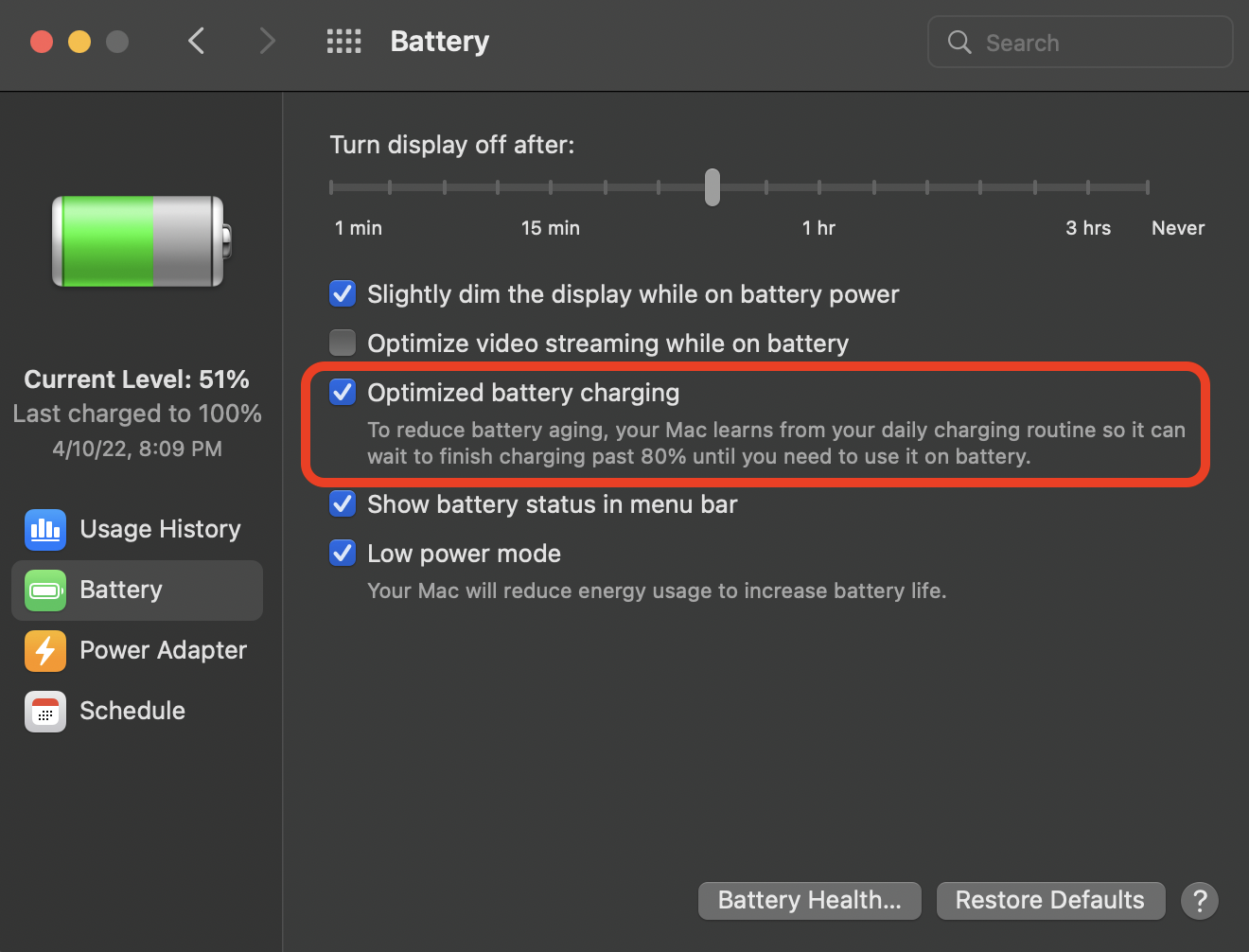
> "Yet they are not in widespread use; most devices have prioritized capacity/weight/size over longevity, Apple included. My current M1 has lost 10% of its capacity after just 120 cycles" A simple way to significantly extend battery longevity is to limit charge to 80% (only charging to 100% occasionally when you know you might need it, like a long day travelling). Unfortunately Apple doesn't yet provide this option o…
it has this though: https://www.macinstruct.com/images/2022/optimized-charging.p...
Re: Apple's Blue Ocean
#147Earlier quoted context omitted.
What about a fusion reactor, generating its own hydrogen molecules to power nuclear fusion through electrolysis from the water vapor in the air. There isn't really a theoretical limit to how small a fusion reactor can be, although clearly this would not achievable for a long time.
If you want to go totally crazy, you can use a black hole as a power source. The laws of physics don't give you a minimum size for them either. However for black holes the smaller they are, the more power they emit in terms of hawking radiation.
Re: Apple's Blue Ocean
#148Earlier quoted context omitted.
> "Why not no battery in the device?" How about a nuclear battery, aka radioisotope thermoelectric generator (RTG)? This would be sealed in (carefully!) and would last the lifetime of the device, with no need for charging, ever. Would need special steps/handling to ensure safe disposal at end of product life, however.
This is challenging because you probably don't want a phone that is hot all the time. There is however a very interesting technology which uses beta radiation and what are essentially "solar cells" to generate electricity directly[1]. Basically you could paint some Cesium 137 on to a solar cell and it would generate power 24x7! [1] Beta Voltaics a new kind of nuclear battery -- https://en.wikipedia.org/wiki/Betavolta…
Re: Apple's Blue Ocean
#149Earlier quoted context omitted.
But they do, specially in low RAM systems, as the SSD becomes like a backup ram to juggle extra information.
More so when the RAM remains limited on Macs as it too is integrated with the CPU and hence is non-upgradable. This is even worse than soldered SSD, as we can still make an attempt to replace the SSD chips with new ones with careful soldering, but nothing can be done about the RAM. These deliberately irreparable new Macs are just shitty products.
Re: Apple's Blue Ocean
#150Earlier quoted context omitted.
With a large 4K screen, I'm not seeing any benefit for MST, and studies have shown it decreases productivity after 2 screens. The other problems are simply fixed with using iCloud and treating your laptop as a disposable, which many laptops have been designed as. If you use the MacBook add intended and invest in apple care it's unbeatable.
The productivity after the second screen decrease because the software sucks at support those configurations. With specialized software ( multi track AV) and/or ad hoc setup ( e.g. deeply tuned Linux) the more the screens you throw at it, the better.