Live data from Hacker News

Safety benefits of roundabouts

theconversation.com

241–250 of 409 posts

Re: Safety benefits of roundabouts

#241
post #140

Earlier quoted context omitted.

> people will NOT understand a roundabout with more than one lane We have tons of 2-lane ones and everyone understands them…

Honestly, even looking at a picture showing how a 2-lane roundabout works ( https://www.epermittest.com/drivers-education/roundabouts ), I still can't understand how it works. Assuming 0 is the bottom and 90 is the right, how is it that a person following the inside route from 0 (exiting the left lane at 180) isn't going to get hit by someone following the outside route from 90 (exiting the right lane at 270)? I woul…

The "correct" answer is the 0->180 car has no indicator on as it enters the roundabout, and has its right indicator on as it exits the roundabout.

The 90->270 car sees the right indicator and lets the other car passed.

The real answer is somewhere between the above and the 90->270 car waiting to enter the roundabout because it is not sure if the other car is actually going 0->180 or 0->270 because they are a shit diver that doesn't indicate on roundabouts.

Re: Safety benefits of roundabouts

#242
In the Netherlands we had a huge phase of replacing regular crossings with roundabouts, which I consider to be an improvement. Now, however this is followed by a re-engineering phase of many of these roundabouts. The 2-lane ones, where a driver needs to pre-select whether they want to go a quarter round (turn right in Netherlands) or select for straight-ahead and 3 quarters round. The lanes on these roundabouts are separated by a rather high ridge to avoid drivers changing their mind and change lanes. This probably done for safety, except that they feel more unsafe now, by introducing "choice stress" upon entry of the roundabout, especially if the road directions aren't very clear. To me it feels like over-engineering.

Re: Safety benefits of roundabouts

#243
post #213

Earlier quoted context omitted.

It’s not the same though. Red means stop. It is ambiguous as to who must yield precisely because there is no red light to indicate it. What would the rule be? Your best guess as to the speed and distance of the other driver?

There is no ambiguity in practice because these only happen on T intersections. These rules also apply on low / moderate traffic + intersections with no issues mainly because you are expected to pay attention to the road and not just breeze through every intersection like a maniac.

There is ambiguity in practice. Accidents do happen in roundabouts and t intersections without anyone driving like “a maniac”. The point is that the article doesn’t really discuss the drawbacks of roundabouts of which there are many.

Re: Safety benefits of roundabouts

#244

Earlier quoted context omitted.

I would argue that the safety stats for them are still excessively car-centric. That is to say, roundabout collisions have better outcomes for car occupants specifically because they turn crashes into the kinds of crashes that cars handle best , which is low speed rear-endings, with the crumple zones doing all the heavy lifting to protect occupants. I’m much more skeptical about how roundabout users fare when they ar…

I'm both a car driver and a cyclist. There are a zillion roundabouts in the country I'm living in. This is my experience and I'd like to hear a traffic designer about it. Roundabouts feel safer than a 4 way intersecting when I'm in a car even if it's annoying to have to slow down and accelerate again when there is very little or no traffic, which is normal in the countryside. It also consumes more fuel, wears the car…

Your observations are quite apt.

"Researchers in Belgium found that single lane roundabouts without a protected bike lane increased crashes by 93%, while Danish researchers said roundabouts that did have separated lanes saw an 84% reduction in crashes."

CNBC: Roundabouts Are Safer. So Why Does The U.S. Have So Few Of Them? https://www.youtube.com/watch?v=atORPw-w83I

Re: Safety benefits of roundabouts

#245

Earlier quoted context omitted.

Not sure exactly what you mean by freely, but in most popular roundabout designs you can exit from the inner lane. A "standard" two lane roundabout will have two lanes entering AND exiting. You never change lanes in roundabouts, at least where I'm from. Only in a massive multi-lane roundabout (that's at that point more like a ring road) would you ever change lanes to exit. e.g. for a standard two lane roundabout with…

The car from the inner lane swiping into the car in the outer lane is the exact issue I'm talking about. The problem is when drivers enter in the left/inner lane, fully intending to take the first exit. If they proceed to exit directly from the inner lane, without first changing lanes, signalling, or yielding to outer traffic, they would intersect with a car in the outer lane innocently heading to the second exit. In…

The experience of most NZ cities and towns on a daily basis says otherwise.

Re: Safety benefits of roundabouts

#246
post #180

Ctrl+f "pedestrian" Only one result and it's not even about roundabouts. This is how American traffic engineering is done.

Is your argument that roundabouts are bad for pedestrians? If so why?

Have you ever tried to cross one? In the UK pedestrians technically have priority at roundabouts now but this doesn't change anything with basically no drivers giving way (and no enforcement). The best compromise is an underpass for pedestrians but this creates a really confusing layout (you always go the wrong way the first time) and the usual dark/dingy/scary problems with underpasses.

Re: Safety benefits of roundabouts

#247
Amazing to see a "What is a roundabout?" article living in UK. The way they are put in over here you get the idea traffic engineers not only love them, they are in love with them. I largely detest them, if I'm very honest. They can be done really well, but most aren't.

Re: Safety benefits of roundabouts

#249
post #20

The greatest thing about roundabouts is that they protect against the idiot that goes through an intersection at full speed. He does that either because he is passed out behind the wheel or because he did not notice a stop sign and thought he had the right of way, or maybe because he just does not care. Well with a roundabout if you just go straight ahead you hit the center circle. Good roundabouts always have a slig…

> The greatest thing about roundabouts is that they protect against the idiot that goes through an intersection at full speed.

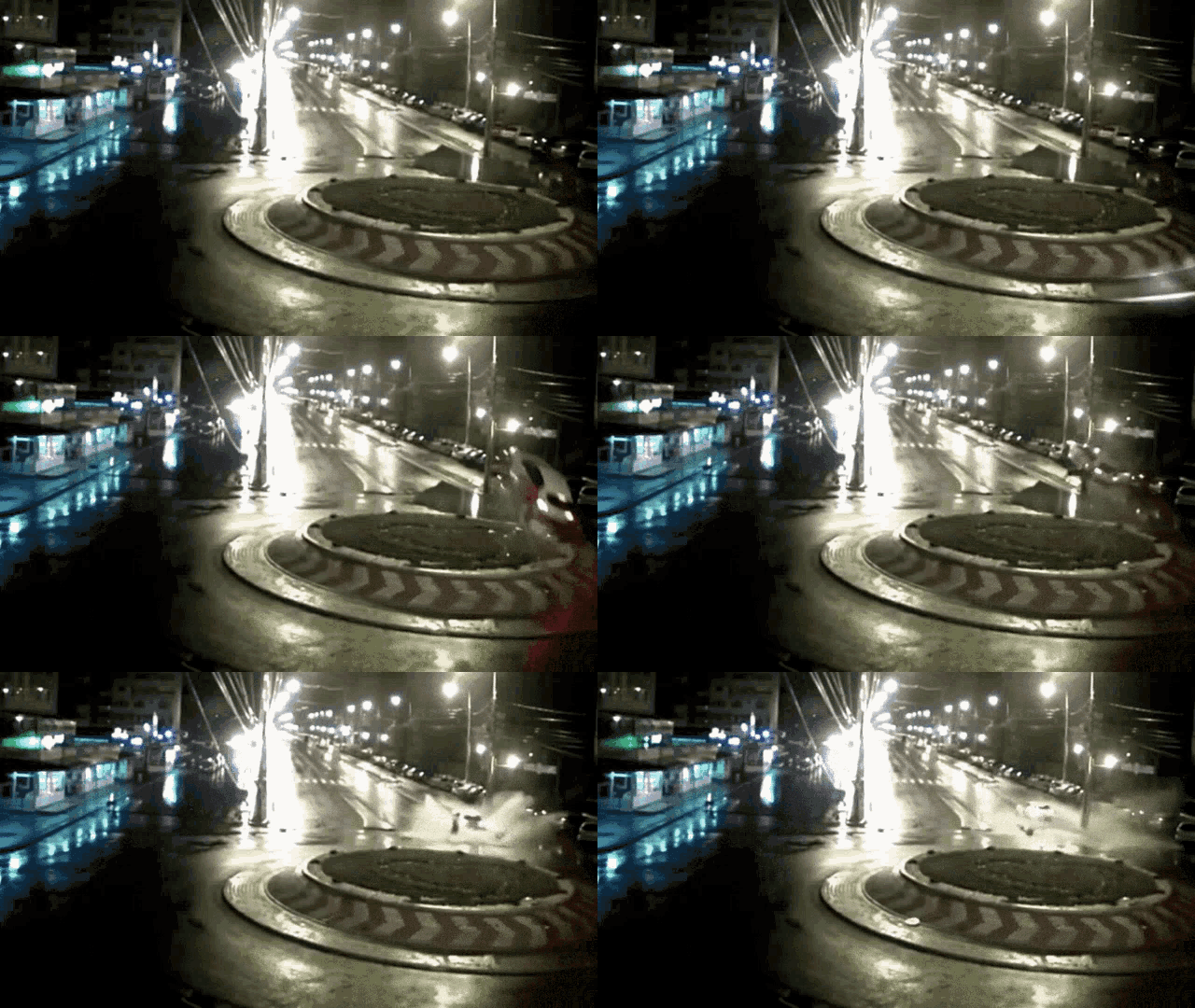
Who is protected exactly?

https://c.tenor.com/GLRaFTDEqngAAAAd/roundabout-poland.gif

https://c.tenor.com/0YMymTe85q8AAAAd/roundabout-car.gif

Re: Safety benefits of roundabouts

#250

Earlier quoted context omitted.

I would argue that the safety stats for them are still excessively car-centric. That is to say, roundabout collisions have better outcomes for car occupants specifically because they turn crashes into the kinds of crashes that cars handle best , which is low speed rear-endings, with the crumple zones doing all the heavy lifting to protect occupants. I’m much more skeptical about how roundabout users fare when they ar…

I'm both a car driver and a cyclist. There are a zillion roundabouts in the country I'm living in. This is my experience and I'd like to hear a traffic designer about it. Roundabouts feel safer than a 4 way intersecting when I'm in a car even if it's annoying to have to slow down and accelerate again when there is very little or no traffic, which is normal in the countryside. It also consumes more fuel, wears the car…

Ah, those traffic dividers, clearly designed by people assuming that all roads should be limited access...

"All those safety devices, including roundabouts, increase fatigue and danger."

They literally distract from the traffic when you aren't in a little isolated house on wheels where people are prone to forget that traffic even exists. All those things designed to help getting a driver's eyes off WhatsApp require cyclists to get their eyes away from traffic.

On the topic of roundabouts, one thing I rarely see discussed (never?) is that traffic lights conveniently compress the vehicle stream into packets of high and low intensity, greatly helping smaller intersections downstream. Roundabouts on the other hand flatten the vehicle frequency and of there's a difficult place to enter or cross the stream, even a modest amount of traffic can be too much. In the end everything that isn't a roundabout can only be navigated by relying on someone in the dominant stream showing off compassion with those waiting. This makes everything go even slower and you quickly end up with even dominant streams going less than walking speeds.

I have a hypothesis that roundabout-dominated road graphs are particularly prone to effective throughput dropping once a certain threshold of throughput demand is reached. Traffic light dominated graphs are immune to this if drivers are just a little careful to not enter an intersection before they can assume that they will be able to leave before the lights change.

Post reply on HN