Live data from Hacker News

Moog sells its business to InMusic

ra.co

181–190 of 206 posts

Re: Moog sells its business to InMusic

#181

Earlier quoted context omitted.

You are almost certainly referring to this: https://www.paulgraham.com/hijack.html Paul Graham compares the hijacking of an airplane to a buffer overflow attack. He doesn't claim that tools for writing more secure computer programs could prevent terrorists from hijacking a plane. He proposes the idea that some similar reasoning can be applied to preventing hijackings. It's not enough to monitor who gets on the airpla…

I know, that’s what I said his essay was about: Lisp knowledge would have prevented 9/11 and can prevent future hijacking attacks. Thanks for providing additional details - it's a treat to re-read his thoughts on 9/11

Likewise, knowledge of effective hijacking prevention techniques could be relevant in defensive program and system organization.

I don't think his point is very good because array overruns in a heap can be exploitable. Lisps (and other kinds of run-times) don't necessarily separate code from data in their heaps.

Re: Moog sells its business to InMusic

#182

Earlier quoted context omitted.

Soundwise those are quite poor copies. Behringer are hit and miss on this. They killed it with their Minimoog clones - very, very close to the real hardware - but not so much with some of their later efforts. I have their Pro-One and their K2 and both lack the character and warmth of the originals. They sound like clones. The P800, Solina and Kat all seem very good though. People who accuse Behringer of cloning are m…

> Soundwise those are quite poor copies. No they're not... at least on the clones I have, they nailed it. And yes I have the originals.

Classic analog synths rarely sounded exactly like other copies of themselves. There was quite a large variation from device to device. I anticipate the Behringer stuff to be more consistent. As far as how close they sound it will depend on the particular example of classic synth you compare it to.

Re: Moog sells its business to InMusic

#184
post #2

> inMusic isn't free from controversy. Formed in 2012 by Jack O'Donnell, a former vice-president at DJ equipment brand Stanton > Roger Linn, who made many ground-breaking drum machines in the '80s before creating the MPC 60 for Akai, has accused O'Donnell of failing to pay him royalties after acquiring Akai, repeatedly calling him unscrupulous and a "bastard" in interviews. Is it absolutely necessary to fuck people o…

[deleted]

Re: Moog sells its business to InMusic

#185
post #123
post #91

Earlier quoted context omitted.

Moog was actually employee-owned.

Not really. It's an interesting sidebar how companies use the phrase "employee-owned" to confuse people about who is in charge. Moog had an ESOP which just means the employees held 49% of the shares of stock in the company, as far as I understand without any right to influence operations, which remained fully with the CEO. That's "employee-owned" in the same sense that you "own" my house if you hold securities that a…

Huh, TIL. Thanks for clarifying!

Re: Moog sells its business to InMusic

#186
post #21

It’s sad how the entire music industry of actual innovators gets scooped up by conglomerates like InMusic. What is worse, however, is the blatant rip-off business plan of Behringer. They went so far as to buy the chip company CoolAudio to build clones of the Curtis CEM3340 oscillator chip featured in all these 80’s polysynths. Wanna know why Behringers product line exclusively features other peoples designs that have…

While I'm no fan of Uli's business practises, he does expose the fact that the uniqueness of a lot of gear is way overstated. And we havent seen actual innovation from the likes of Moog, Roland, Korg since the 90:ies maybe. So if they insist on repackeging the same ROMpler and Curtis chips at ever higher prices... Clone away.

unfortunately he also clones things that aren't Rompler and curtis chips.

I have a behringer model d and a pro one. They're fine machines.

But when they Behringer Swing seems to me to be a 1:1 clone of the Arturia Keystep which is not an old device, I kind of understand why everyone hates Behringer.

Re: Moog sells its business to InMusic

#187

Hardware synths, in particular the varieties that Moog makes, are at peak relevance again and who knows if that will remain the case. The brand was certainly sucking wind for a good 30 years of its history previously. Cashing out that equity now is a shrewd move...especially as consumer spending has gone to who knows where.

I think the answer is no. They may be more prevalent and widely adopted, but there's essentially no point in owning a hardware synth. It's been heading this way for a while, but the 5 years or so has really seen software modelling synths become almost free from drawbacks compared to soft synths.

I say this as someone that loathes soft synths, and loves playing with the hard synths. I absolutely despise the mouse interface outside of certain specific contexts, even outside of music.

There are a couple reasons. First, the fact is that you can create any sound from a hard synth on a soft synth given enough time. The sound quality will be better, or at least the same as a hard synth. Software can expand up until you run out of resources, so there's no limit on ENV, LFO... entire instances of the synth. There's probably use cases for getting two identical synths with different settings. Of course you can sample and layer, but even that is easier in DAW, either way.

So why even bother with the hardware synths in 2023? If you have a large amount of money, for a hobbyist, go ahead and get in the game. Be prepared to pay $1,000-20,000 or more, vs. $300-2000 for a good software setup.

It does feels more natural and like playing an instrument, and more fun to explore than a GUI. I can also move two knobs at once among a number of tricks in hard synths. This is a pain with software, even if you create macros, because you might not always want the same proportional adjustment in settings... ie. you can simultaneously turn on knob up and down (I imagine this is "possible" with DAW, but not natural and seamless).

There's another reason to use hardware. When you want a very specific sound, that you just know you can get easily from a specific synth. You could probably make a similar one with a generic synth, but don't want to. On the other hand, this is only necessary if a high quality plugin doesn't exist for your synth, which is unlikely unless it's an obscure one.

So, yes we're seeing a really interesting renaissance of hardware synths. This will continue for some time, and may not truly "end". However, right now they can't compete with hardware for easy control.

I can't help but think the control issue can be figured out, although it requires cooperation of a ton of different businesses, to support some number of controllers. Maybe this is truly impossible, but it seems do-able to have an array of knobs, and sliders... it's just that all the plugin companies would have to play around. I think NI has been doing this.

I think it's possible that we see more merging of DAW, controller, and plug-in. This is already occurring to a limited extent. DAWless machines are being loaded with single board computers that can run plug-ins. Your synth will also be a PC.

Anyway, what a rant, I'm sure no one will ever see this. Perhaps you can get by with just the learn button, but this has been a nightmare to me.
Re: Moog sells its business to InMusic

#188
post #35
post #31

Earlier quoted context omitted.

I like their expression pedals. Simple and functional. No power cord. Not unreasonably expensive.

I’ve never seen an expression pedal or any other keyboard pedal with a power cord.

They would if they had control voltage out.

Electro-Harmonix ships an expression pedal with the HOG2 that uses an accelerometer rather than a pot, and that also takes a power cord or batteries.

Re: Moog sells its business to InMusic

#189
post #136

Earlier quoted context omitted.

Isn't the DFAM eurorack compatable? I seem to recall being able to take it out of its case and plug a 12pin into it and it just works.

Yeah, but compared to their modules, it’s enormous. It would be a huge part of my case. And for the functionality it provides, it doesn’t really need to be that big. It has a great interface and it’s beautiful, but eurorack modules tend to pack their functionality into a tighter package. And I could imagine that if they put their minds to it, they could create smaller, more tightly focused modules than the semi-modul…

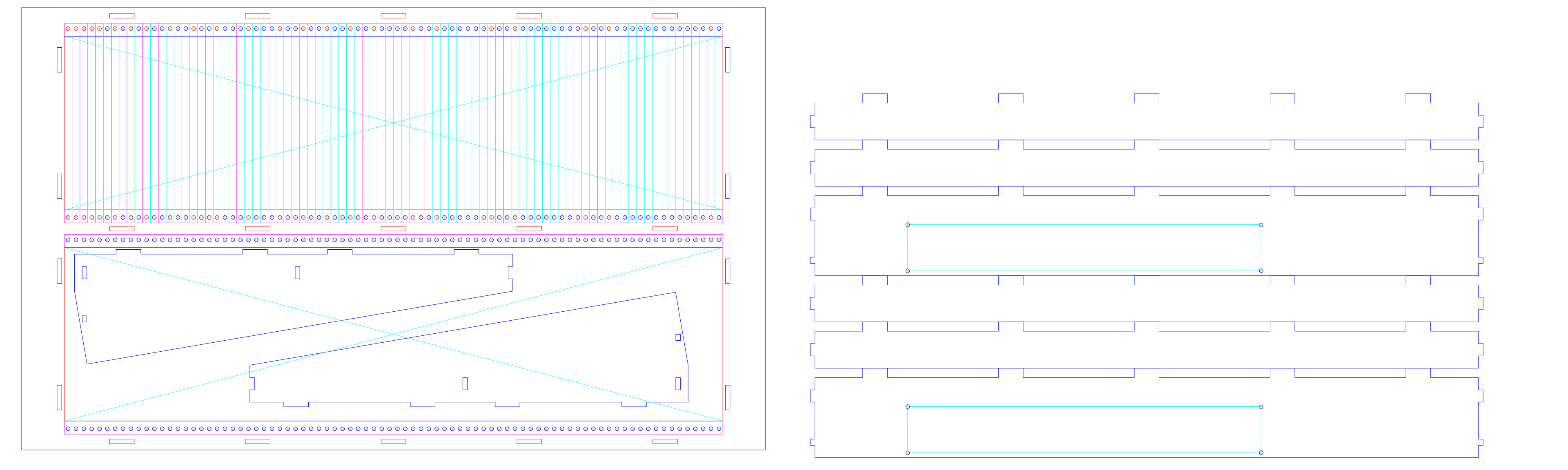
It's kind of unfortunate that eurorack cases and power supplies tend to be so expensive. My approach is to use cheap Meanwell supplies (a pair of RS-35-12s wired in bipolar configuration rather than the more common RT-65b) and laser cut more racks out of birch ply when I need more space, but if I was paying full retail price for rack space I would probably be using much smaller modules, and fewer of them.

(This is my most recent design: http://jsnow.bootlegether.net/84hp-rack-2row-slantback.svg -- the parts are made by running two jobs on the same file, always cutting red and alternating between cutting purple and blue. Turns out 3mm screws work fine in plywood if you can get the hole size just right.)

Re: Moog sells its business to InMusic

#190
post #175

Earlier quoted context omitted.

It's sad how some people think companies should have perpetual monopolies on things that were patented 50+ years ago.

What about stuff from two years ago?

Well patented stuff from 2 years ago is still covered by patent, so you can't copy it without getting sued usually. That's why the patent system exists.
Post reply on HN