Live data from Hacker News

The Last Egg

brr.fyi

161–170 of 204 posts

Re: The Last Egg

#161
post #20

Earlier quoted context omitted.

The south pole IS colonized. There is literally a colony there since 1956

A colony implies sustained long-term habitation by the same people; that's not true for the South Pole station, which is a research facility where people rotate out. As far as I know, the only country to try colonizing Antarctica proper has been Argentina, with a small number of families settling at Esperanza Base (at the north end of the Antarctic Penninsula) and a big fuss made about the first kids born on the Anta…

Checking via Wikipedia, the entire population of the continent (not just ASSPS) is 4,000, in the summer. It drops to about 1,000 in winter.

As you note, there've been several births (Wikipedia states 11), with those listed being Argentine.

https://en.wikipedia.org/wiki/Demographics_of_Antarctica>
Re: The Last Egg

#162

Earlier quoted context omitted.

From the article: "The greenhouse is a volunteer affair, and it yields enough for herbs and the occasional salad! It’s also the only place on station with humidity! Since the rest of the station has near-zero humidity, it’s a treat to spend time in here."

I'd have to question what "near-zero" actually means. I don't doubt that outside the humidity is super low, but inside I have my doubts. Super low humidity increases the risk of ESD which wouldn't be fantastic for any electronics. You'd need to walk around with a grounding strap all day otherwise you'll be zapping every bit of metal you encounter. I worked in a newly built data centre where the air conditioning (not…

Among other factors: humidity, even at modest levels, means frost and ice accumulation in any spaces with a thermal gradient.

Given that there's a roughly 150F / 85C temperature differential from the inside (assuming ~70F / 20C interior temperature, and -70F / -55C exterior), and that it never thaws, this means frost/ice accumulation is probably a major structural hazard. Even if it was possible to humidify interior spaces, it might be avoided for that reason.

(I'm of course speculating, though based on discussion of PassivHaus designs in Fairbanks Alaska and the attention paid to moisture, vapour barriers, and frost accumulation, as well as an earlier article I believe linked to HN showing the cold food storage at ASSPS which included massive amounts of accumulated frost, and that I suspect just from moisture contributed by the breathing of occupants / workers within the cold (ambient) storage structure.)

Re: The Last Egg

#163

Earlier quoted context omitted.

Well, I personally would be interested to see the talk/learn more about those in tech who have gone to the pole.

There are several Polies here (and folks who've spent time in other cool places - Ross Island, Greenland, Atacama Desert come to mind) and at least some are in tech. My Pole experience is a bit dated, but happy to chat about it. Blog from that is https://weaknuclearforce.wordpress.com/ (also, I dig the single-page latex resume format!)

I've been at these two places: https://en.wikipedia.org/wiki/Pituffik_Space_Base and https://en.wikipedia.org/wiki/Alert%2C_Nunavut

And yes: It was cold.

About food there were supplies almost every week as far as I remember, but I believe we got UHT milk.

Re: The Last Egg

#164

Earlier quoted context omitted.

> Eating by the seasons is also pretty interesting Eating by the seasons is mundane and normal almost everywhere in the world.

Are you sure? Obesity, caused by eating processed food, is normal almost everywhere.

I doubt this. Obesity, caused by eating processed food is certainly happening in many places, but outside the USA I don't think it's normal

Re: The Last Egg

#165
Why can't they keep chicken??? Chicken need water and layers pellets (which store fine). You get fresh eggs every day and free manure to use in your greenhouse! I really don't understand why they don't do it.

Re: The Last Egg

#166

Earlier quoted context omitted.

Reading this I am picturing a blowing blizzard and massive tractors crawling over the barren landscape. INTENSE!

It's both intense and the most boring thing you could imagine. Picture day after day in a tractor traveling across a white landscape with another tractor in front and another tractor behind. I have only traveled such things by snowmobile, but I've befriended a few of the traverse folks in Greenland and Antarctica and they described it as "intensely exhilarating and extremely boring".

[flagged]

Re: The Last Egg

#167

How do people deal with zero humidity? Does everyone use a CPAP to sleep?

I'm fairly certain the air will be conditioned and inside humidity kept to an acceptable standard.

Indoor air is heated but not humidified. Relative humidity outside is high, but the temperature is very cold, so the absolute amount of water in the air is very low. Bring that same air indoors, heat it up by ~150 degrees Fahrenheit, and the resulting relative humidity is very low.

Hard to measure at such low numbers. I have a handful of cheap consumer-grade sensors with me, and they all report "0%" or "lower limit" or equivalent. I can't share readings from official NSF-owned equipment.

Static buildup is a real issue. It's muscle memory now for me to ground myself before touching any electronics. There's makeshift grounding points (metal tape, metal frames, etc) everywhere. I'm still not used to the little shocks every time.

I humidify my bedroom at night using portable humidifiers. This takes ~1.5 gallons of water per night, which is deemed an acceptable use of water. Most people do this. I can get my room up to ~15% humidity with a reasonable amount of effort. The difference in sleep quality is noticeable.

Frost buildup is a real issue in humidified spaces, given the temperature gradient to the outside, even with triple-pane windows. The greenhouse has no exterior windows, so this isn't a problem.

The greenhouse is kept at ~25% relative humidity. It's the only place on station with infrastructure in place to provide humidity directly through the HVAC system.

Re: The Last Egg

#168

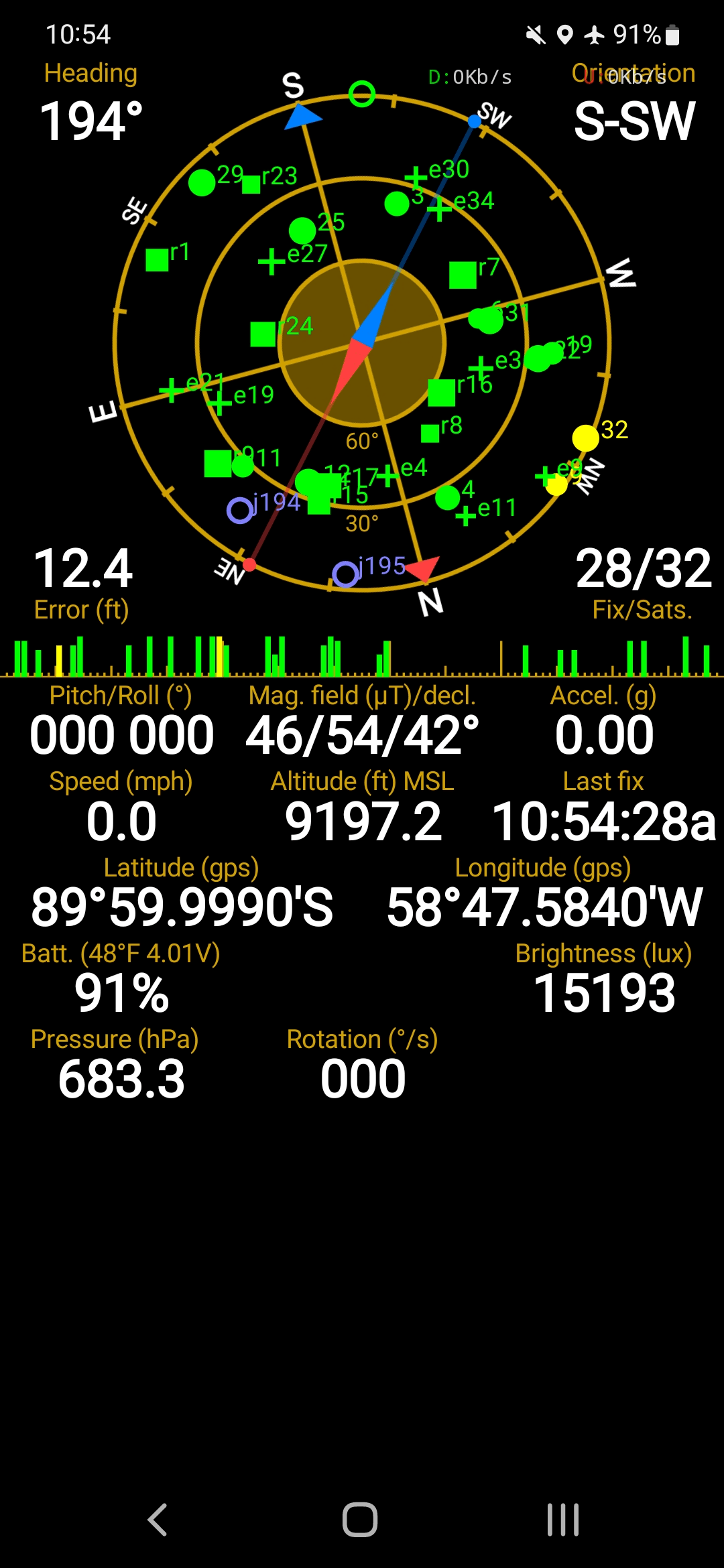
There was a Googler who spent some time at the South Pole station and gave a talk about it. I won't name him here, but maybe he's reading this? What I recall was him walking around and over the actual Pole and trying to get his GPS to register 90.0 degrees. It wouldn't go beyond 89.999.

Hah, I also tried this over the summer. Closest I could get was 89°59.9990'S:

https://brr.fyi/assets/misc/gps-01.png

Very amusing to do a few "laps around the world" and watch the longitude go haywire.

Re: The Last Egg

#169
post #101

Earlier quoted context omitted.

Yeah, I’d say that the default in the US is generally cheaper and lower quality than the default in France, at least (no experience with Ireland).

If you spend the same amount in US as France (milk _is_ more expensive in France), is the quality the same? This comment only seems to confirm that cheaper milk will be worse.

Just with https://www.numbeo.com/cost-of-living/country_price_rankings... the price is within 10%.

Re: The Last Egg

#170

Earlier quoted context omitted.

Hackers would probably also love to consider that a lot of hardware that has code that depends on lat/lon for internal calculations can have all sorts of weird problems. When you are exactly at the pole longitude can switch from +180 to -180 rapidly and that can be a catastrophic edge case for anything that needs to do positioning. I had the pleasure of watching an expensive drone crash into hull of a ship and sink i…

How come you were at the North Pole?

There are scientific, mining, and pleasure trips
Post reply on HN