Live data from Hacker News

Could seaweed be the 'fastest and least expensive' tool to fight climate change?

nationalgeographic.com

81–90 of 199 posts

Re: Could seaweed be the 'fastest and least expensive' tool to fight climate change?

#81
post #65

What does success look like in the climate change fight? Is there a point where victory can ever be declared? Is that a "correct" temperature (what is it) or a CO2 PPM number (what's ideal)? When industry and scientists stop lobbying for money to fight it?

278 ppm is known to be ecologically sustainable.

We can probably do higher; we probably don't want much lower.

Net zero emissions means a much higher level, just one which isn't constantly still going up.

Re: Could seaweed be the 'fastest and least expensive' tool to fight climate change?

#82
There won't be any ingenious, miracle carbon removal solution and various proposals may even be flirting with ecological disasters of planetary proportions. Anything that expands our footprint in order to mitigate our footprint is a dubious direction. Reminds of an apprentice wizard that panics and invokes a sequence of spells, each one worse than the other.

Discussions and thinking around sustainability underestimate the complexity of the problem we are facing. Climate change is but one symptom of the anthropocene (defined as the extremely intensive utilization of planetary resources).

In the fullness of time it might prove that climate change isn't even the most dangerous of the anthropocene side-effects. We already have several other channels and signals besides GHG emissions and induced climate change: ozone layer depletion, microplastics, invasive species, biodiversity loss etc. and there is a "smell" about them that's worse than rotting seaweed on a beach.

Don't get me wrong, various (bio)technological adaptations may play a role to expand our options, but fundamentally they need to fit together in a package that is conservative and will not lead to more harm and further degradation.

The principal component of our collective survival strategy is hard to substitute: Where possible, we need to do more with less. Where that is not possible, we simply need to do less.
Re: Could seaweed be the 'fastest and least expensive' tool to fight climate change?

#83
post #65

What does success look like in the climate change fight? Is there a point where victory can ever be declared? Is that a "correct" temperature (what is it) or a CO2 PPM number (what's ideal)? When industry and scientists stop lobbying for money to fight it?

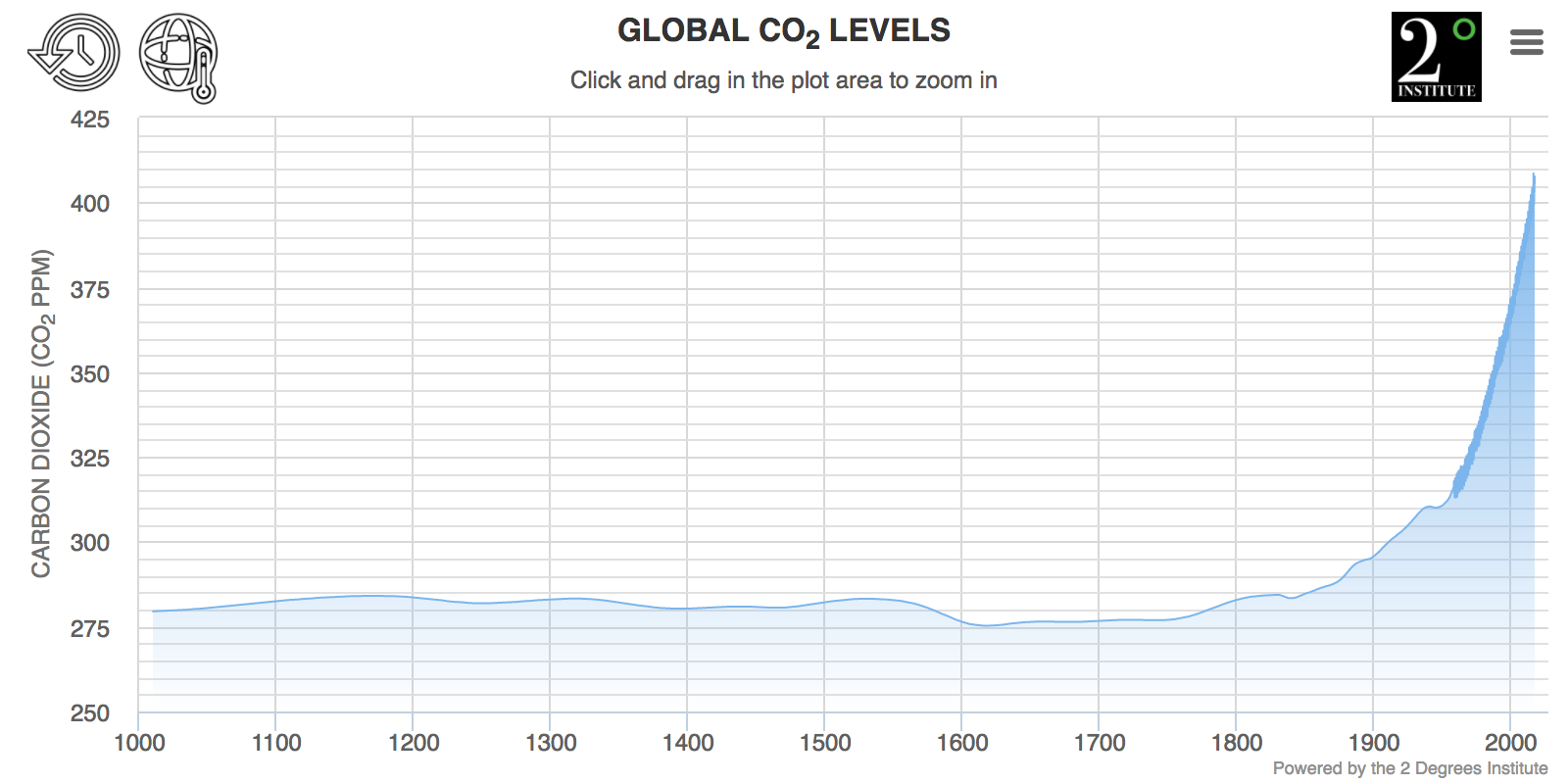
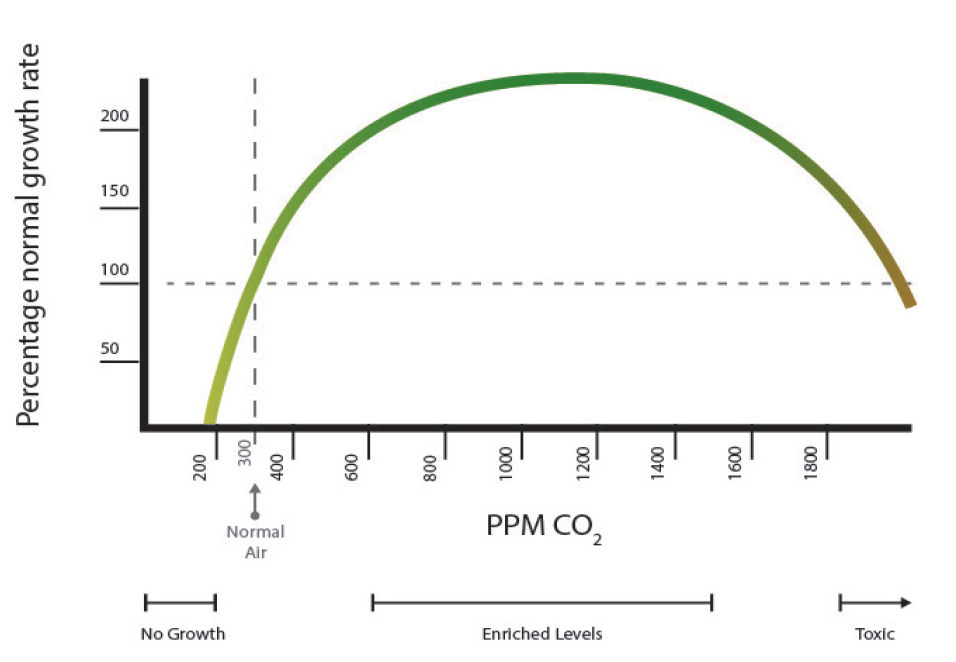
If we bring global CO2 back down to 280 ppm (like it was in the year 1700[1]), then a lot of today's farming methods will have substantially lower yields. Our modern crops need those higher CO2 levels to grow fast[2]. Without other ways to grow more food, people will starve.

[1]: https://www.co2levels.org/img/graph_grid.png

[2]: https://extension.okstate.edu/fact-sheets/images/greenhouse-...

Re: Could seaweed be the 'fastest and least expensive' tool to fight climate change?

#84
post #37

No The cow burp effect is a myth. With five minutes thinking about it, is easy to see why is a no solution. I have explained here before why will not work. Most of the seaweeds are water. And the dry matter is salty. Coastal areas are extremely busy. You can't remove Honk Kong city to culture seaweeds. You can't block maritime traffic routes to culture seaweeds, or stop all commercial fishing near the shore, or ban t…

Stop CAFO. Grassfed, grass finished cows only. The US once had millions of free roaming bison. The landscape was never more fertile.

>We model a nationwide transition [in the US] from grain- to grass-finishing systems using demographics of present-day beef cattle. In order to produce the same quantity of beef as the present-day system, we find that a nationwide shift to exclusively grass-fed beef would require increasing the national cattle herd from 77 to 100 million cattle, an increase of 30%. We also find that the current pastureland grass resource can support only 27% of the current beef supply (27 million cattle), an amount 30% smaller than prior estimates

[…]

>If beef consumption is not reduced and is instead satisfied by greater imports of grass-fed beef, a switch to purely grass-fed systems would likely result in higher environmental costs, including higher overall methane emissions. Thus, only reductions in beef consumption can guarantee reductions in the environmental impact of US food systems.

https://iopscience.iop.org/article/10.1088/1748-9326/aad401

Re: Could seaweed be the 'fastest and least expensive' tool to fight climate change?

#85

It's a cool idea but I don't see how this is a viable long term solution, even if done at a large scale. Global oil production is on the order of 90M barrels/year, each barrel contains about 300 lbs of oil, so we're currently producing something like 27B lbs (~12B kg) of oil per year. I'm not sure how much of this ends up as CO2 in the atmosphere versus e.g. plastics, but I think it's safe to say we're probably emitt…

Here is a calculation done by project Drawdown. Potentially 2.5 to 4.72 gigatons CO2e reduced/sequestered over a 30 year period: https://drawdown.org/solutions/seaweed-farming It is one of many viable solutions and humanity is working on many or most of them. We need them all. Seaweed would be great as cattle feed is one of the pathways this highlights.

Yeah that brings me to another problem. We have too much cattle already. Also, they emit methane.

Re: Could seaweed be the 'fastest and least expensive' tool to fight climate change?

#86
post #57

Most of the ocean is desert lacking the limiting nutrients of nitrogen, phosphorous and iron. If we can cheaply fertilize large swathes of the ocean with these limiting nutrients in a controlled manner, then this could trigger massive algae blooms that on sinking sequester massive amounts of carbon.

Unfortunately, fertilizer presently has a large carbon footprint

Many crop fertilisers have that issue, but fertiliser is not only one thing.

One hypothesis is that algae are limited by some single resource which could be gradually dropped out the back of cargo ships as they cross oceans, seeding carbon-absorbing algal blooms as they go.

(I heard about this nearly 20 years ago, so I assume that has either been tested or banned since then…)

Re: Could seaweed be the 'fastest and least expensive' tool to fight climate change?

#87

There won't be any ingenious, miracle carbon removal solution and various proposals may even be flirting with ecological disasters of planetary proportions. Anything that expands our footprint in order to mitigate our footprint is a dubious direction. Reminds of an apprentice wizard that panics and invokes a sequence of spells, each one worse than the other. Discussions and thinking around sustainability underestimat…

>There won't be any ingenious, miracle carbon removal solutions

OK but I think there will be.

Re: Could seaweed be the 'fastest and least expensive' tool to fight climate change?

#88
post #56

Earlier quoted context omitted.

We also extincted broad swaths of our ecosystem while keeping the rich westerners well air-conditioned. So… you know. No free lunch. Hope we, as biological creatures borne of a billion-year old evolutionary process, don’t actually need the system that birthed us (for some reason).

My sincere hope is that the poor non-Westerners will also be well air-conditioned. And yes, you are quite right that there is no free lunch. In my analysis, the opportunity cost of going all-in on degrowth and solar/wind is precisely that the global poor will remain poor. I'm by no means advocating that we destroy nature for the fun of it! But if the alternative is between us destroying nature or nature destroying us…

Nature will win in both of these scenarios.

Re: Could seaweed be the 'fastest and least expensive' tool to fight climate change?

#89
post #65

What does success look like in the climate change fight? Is there a point where victory can ever be declared? Is that a "correct" temperature (what is it) or a CO2 PPM number (what's ideal)? When industry and scientists stop lobbying for money to fight it?

If we bring global CO2 back down to 280 ppm (like it was in the year 1700[1]), then a lot of today's farming methods will have substantially lower yields. Our modern crops need those higher CO2 levels to grow fast[2]. Without other ways to grow more food, people will starve. [1]: https://www.co2levels.org/img/graph_grid.png [2]: https://extension.okstate.edu/fact-sheets/images/greenhouse-...

source pls (edit: thanks!)

Re: Could seaweed be the 'fastest and least expensive' tool to fight climate change?

#90

It's a cool idea but I don't see how this is a viable long term solution, even if done at a large scale. Global oil production is on the order of 90M barrels/year, each barrel contains about 300 lbs of oil, so we're currently producing something like 27B lbs (~12B kg) of oil per year. I'm not sure how much of this ends up as CO2 in the atmosphere versus e.g. plastics, but I think it's safe to say we're probably emitt…

Here is a calculation done by project Drawdown. Potentially 2.5 to 4.72 gigatons CO2e reduced/sequestered over a 30 year period: https://drawdown.org/solutions/seaweed-farming It is one of many viable solutions and humanity is working on many or most of them. We need them all. Seaweed would be great as cattle feed is one of the pathways this highlights.

It doesn't do as much as you think for cattle feed as most the high % numbers you see touted are only looking at feedlot emissions - which are only 11% of overall cattle emissions. Actual reductions are pretty small

>What’s more, feeding cattle algae is really only practical where it’s least needed: on feedlots. This is where most cattle are crowded in the final months of their 1.5- to 2-year lives to rapidly put on weight before slaughter. There, algae feed additives can be churned into the cows’ grain and soy feed. But on feedlots, cattle already belch less methane—only 11 percent of their lifetime output

[...]

>Unfortunately, adding the algae to diets on the pasture, where it’s most needed, isn’t a feasible option either. Out on grazing lands, it’s difficult to get cows to eat additives because they don’t like the taste of red algae unless it’s diluted into feed. And even if we did find ways to sneak algae in somehow, there’s a good chance their gut microbes would adapt and adjust, bringing their belches’ methane right back to high levels.

[...]

> All told, if we accept the most promising claims of the algae boosters, we’re talking about an 80 percent reduction of methane among only 11 percent of all burps—roughly an 8.8 percent reduction total

https://www.wired.com/story/carbon-neutral-cows-algae/

Post reply on HN