Live data from Hacker News

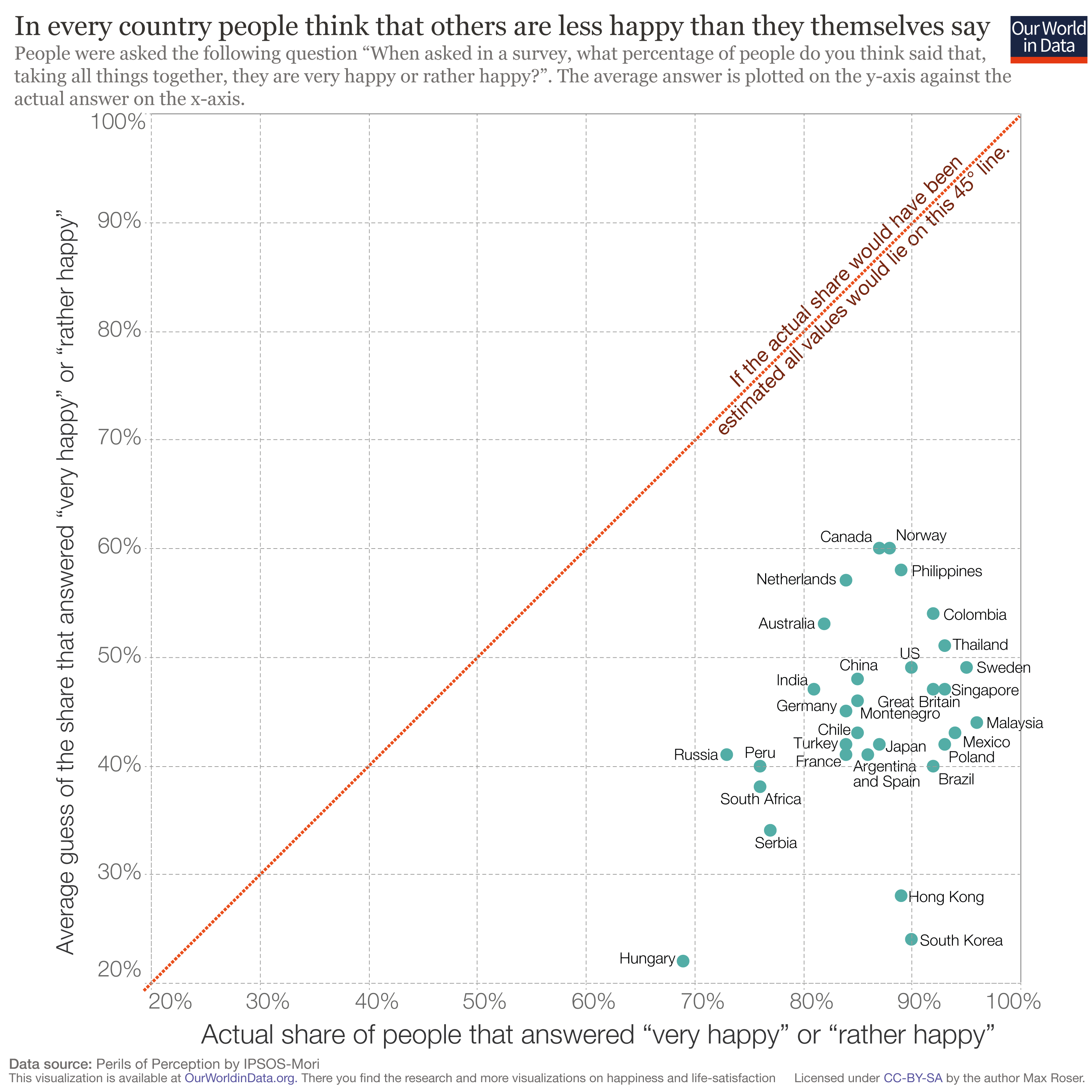
In every country people think others are less happy than they themselves say (2017)

ourworldindata.org

91–100 of 103 posts

Re: In every country people think others are less happy than they themselves say (2017)

#91
post #46

Earlier quoted context omitted.

I found a book a while ago, that made me change my perspective about how I see the world as a whole. This is the book, it's called Factfulness: https://www.goodreads.com/book/show/37850908-factfulness There are a lot of bad things that happen around us (war, hunger, discrimination, etc), but we are at the best time in the entire human history, even with that. Compared with every metric in history, we are better. Even…

> we are at the best time in the entire human history, even with that. I've heard this ad naseum during my whole life. The word they always forget is "materially". People are on average better off materially than ever before (maybe), but that is far from taking into account what it means to be human and what life is. One example is that we have better quality beds than ever before in history, but maybe that doesn't m…

Indeed. This is actually the cardinal error of all social sciences. "We can't measure the stuff that matters, so we measure what we can measure instead, and then use those measurements to draw conclusions about the stuff that matters." Economics, sociology, and psychology fall into this trap all the time, with disastrous consequences for policy.

Re: In every country people think others are less happy than they themselves say (2017)

#92
post #64

Earlier quoted context omitted.

Propaganda is about showing just the right data in the right way to make an argument. As such his backstory is perfect for a propaganda piece. > almost every metric That’s exactly the kind of thing that’s both misleading and false. Take global divorce rate, it’s one metric but you can easily turn it into several others if you’re trying to support a given narrative. Average length of marriage, percentage of the global…

Don't get uppity about "almost every metric". It's quite possibly true, after all. But then again we're defining the metrics aren't we, with all our recency bias and modern philosophy on life. A high divorce rate is a positive thing if it means people are getting out of bad marriages and living poverty free independent lives. We have a lot of civil law around divorce that makes it expensive and painful, but not Henry…

The book includes metrics that are really important , like rate of child mortality, people below the poverty line... stuff that really, really impacts the world population.

It's honestly bizarre to see people in this thread coming up with the most ridiculous metrics, like divorce rate, to "contradict" the general trend that the world is improving... it's seriously messed up to think those metrics are in some way similar.

Re: In every country people think others are less happy than they themselves say (2017)

#93
post #47
post #46

Earlier quoted context omitted.

I found a book a while ago, that made me change my perspective about how I see the world as a whole. This is the book, it's called Factfulness: https://www.goodreads.com/book/show/37850908-factfulness There are a lot of bad things that happen around us (war, hunger, discrimination, etc), but we are at the best time in the entire human history, even with that. Compared with every metric in history, we are better. Even…

> Compared with every metric in history, we are better. That claim alone should immediately make you doubt the metrics being used. In fact, it's easy to find dozens of metrics for which this isn't true. Housing affordability being a very obvious example. And the average democracy index has been going downwards for 15 consecutive years IIRC. Environmental pollution also most certainly isn't "at the best time in the en…

Housing affordability hasn't gone worse. People are picking on particular markets, but overall, especially in developed countries, it isn't getting any worse: inflation-adjusted price per square foot doesn't change over time, and average house size grows together with inflation-adjusted income. There are a couple exceptions (UK, Australia, Canada) but there are also opposite exceptions (Italy).

Environmental pollution especially in developed countries is now way lower than in any point in the living memory, plus quite a bit more. In developing countries, it's hit and miss.

Democracy only went down recently because it was forced upon many countries simply due to their defeat in the Cold War, those countries never been democratic before, never had any internal impulse to become democratic, and their peoples despised democracy and wanted this chaos to end as soon as possible. Reversal from artificial, externally forced democracy made vast majority of them happier. In many cases, their entire culture, religion and language itself precludes sustainable democracy. "Freedom" is not the universal desire of all people, time to get over it.

Re: In every country people think others are less happy than they themselves say (2017)

#94
post #87

Earlier quoted context omitted.

> Average length of marriage, percentage of the global population married, etc. Getting/being married is not itself a measure of happiness. Just the ability to get divorced is a huge positive change from the past. It means people don't have to be stuck in bad relationships. > Average lifespan after cancer diagnosis increasing is good but more people with cancer sounds bad. More people with detected cancer is good. A…

Screening is a separate question, many drugs extend people’s lives pans with cancer but don’t actually cure it. I would call them a good thing, but they do directly mean a higher percentage of the population has cancer irrespective of detection. Which gets to my point, people with cancer isn’t a statistic that’s universally good or bad but a complex thing.

In addition to screening, chance of cancer increases with age. The effect of more cancer may just be people living longer. People are getting cancer at 80 instead of heart attack at 60 or shot at 20.

Re: In every country people think others are less happy than they themselves say (2017)

#95
post #46
post #43

Earlier quoted context omitted.

This explanation is so obvious that I consider any study or chart that doesn't scream this at the reader in big red letters to be nothing short of propaganda. The conclusion those "researchers" would like to draw is that the world is better than "the people" think, when the far more plausible interpretation is that the world is so horribly bad that people are scared to even talk about how they feel.

I found a book a while ago, that made me change my perspective about how I see the world as a whole. This is the book, it's called Factfulness: https://www.goodreads.com/book/show/37850908-factfulness There are a lot of bad things that happen around us (war, hunger, discrimination, etc), but we are at the best time in the entire human history, even with that. Compared with every metric in history, we are better. Even…

[flagged]

Re: In every country people think others are less happy than they themselves say (2017)

#96
post #61
post #47

Earlier quoted context omitted.

> Compared with every metric in history, we are better. That claim alone should immediately make you doubt the metrics being used. In fact, it's easy to find dozens of metrics for which this isn't true. Housing affordability being a very obvious example. And the average democracy index has been going downwards for 15 consecutive years IIRC. Environmental pollution also most certainly isn't "at the best time in the en…

Don't throw around accusations like that willy nilly. It causes "propaganda" to become a trivialized term that everyone can just throw at anyone making any statement they don't agree with after 1 minute of consideration. This book was written by Hans Rosling, a man who was an expert in data analysis and whose mission was to show actual world data to people in fantastic visualizations they could clearly understand. If…

> do you have statistics for that for every country in the world, or you only care about your neck of the woods (which is not what Rosling cared about at all)? But even if that's true, it doesn't contradict the fact that almost every metric, if not every single one, is better today, please don't succumb to the strawman fallacy.

The same could be said for Rosling. How much of his bias has crept into his analysis? Is he measuring the right things -- or simply what is en vogue (or worse, what is best for his interests).

I would trust a basement-dwelling amateur analyst to find the "truth," much sooner than I would a pseudo-celebrity/influencer, going around holding TED talks.

Re: In every country people think others are less happy than they themselves say (2017)

#97
post #46

Earlier quoted context omitted.

I found a book a while ago, that made me change my perspective about how I see the world as a whole. This is the book, it's called Factfulness: https://www.goodreads.com/book/show/37850908-factfulness There are a lot of bad things that happen around us (war, hunger, discrimination, etc), but we are at the best time in the entire human history, even with that. Compared with every metric in history, we are better. Even…

> we are at the best time in the entire human history I constantly see this claim and I have really grown to hate it. It is a simple lie, in three ways, and thirds one is the worst. Firstly, the statement is only true if you compare human history over hundreds of years. So you comparing modern society to people who haven't discovered soap and hygiene. If that is your benchmark, even USSR looks good if you compare it…

> American economy was made great decades ago, when corporate tax rates were like 3x higher, education was free, etc.

American economy was made great when America was practically the only developed country in the world that wasn't devastated (in the literal sense of the word) by the WWII. It was trivially easy to outcompete everyone else and flood the world with US exports, which triggered the US Golden Era, during which uneducated people working jobs that could be learned in half a day could afford to live in detached houses - something to this day completely unheard of in the rest of the world.

Re: In every country people think others are less happy than they themselves say (2017)

#98
post #17

is it definitional if you include in the definition of "happy" that you feel you are well off compared to others in your society? ie: if happiness is relative then you can't be happy unless you think others are less happy. Perhaps the trick of modern society is to convince most people, as individuals, that they are better off than average - even when logically that can't be true (putting aside differences b/w means a…

> ie: if happiness is relative then you can't be happy unless you think others are less happy I don't _think_ most people think along those lines. I'd certainly hope not.

I think if you ask people what happiness is I agree, they'll come up with a different set of things. But if ask them if they are happy, they will reflect on how much worse their life could be and they'll largely see that in terms of how they perceive the rest of society around them. They will feel very guilty saying they are unhappy if they think they are actually better off than most other people are. So I agree with you but still think this effect will have an impact.

Re: In every country people think others are less happy than they themselves say (2017)

#99
post #46

Earlier quoted context omitted.

I found a book a while ago, that made me change my perspective about how I see the world as a whole. This is the book, it's called Factfulness: https://www.goodreads.com/book/show/37850908-factfulness There are a lot of bad things that happen around us (war, hunger, discrimination, etc), but we are at the best time in the entire human history, even with that. Compared with every metric in history, we are better. Even…

> we are at the best time in the entire human history, even with that. I've heard this ad naseum during my whole life. The word they always forget is "materially". People are on average better off materially than ever before (maybe), but that is far from taking into account what it means to be human and what life is. One example is that we have better quality beds than ever before in history, but maybe that doesn't m…

I saw some comment above lauding the progress we've made because "we consume more goods and services"--which feels farcical to me. Like great, we consume more junk food than at any time in history AND more diabetes and heart medication--what a win. Both get added to GDP, though. Like tires spinning in the mud...

Re: In every country people think others are less happy than they themselves say (2017)

#100
post #46
post #43

Earlier quoted context omitted.

This explanation is so obvious that I consider any study or chart that doesn't scream this at the reader in big red letters to be nothing short of propaganda. The conclusion those "researchers" would like to draw is that the world is better than "the people" think, when the far more plausible interpretation is that the world is so horribly bad that people are scared to even talk about how they feel.

I found a book a while ago, that made me change my perspective about how I see the world as a whole. This is the book, it's called Factfulness: https://www.goodreads.com/book/show/37850908-factfulness There are a lot of bad things that happen around us (war, hunger, discrimination, etc), but we are at the best time in the entire human history, even with that. Compared with every metric in history, we are better. Even…

> Compared with every metric in history, we are better.

I call this the "Hobbes fallacy" and it seems to be in vogue among a certain literati a la Steven Pinker who have taken up the task of proving that lay people's pessimism and anxiety are unfounded.

I propose an alternative: that when we expand the timeline of humanity back far enough, many of the improvements in the modern era disappear and are seen to only be improvements from local minima occuring during the last several hundred or thousand years.

Go back further to pre-agricultural times when big game and forage were still abundant and hadn't been depleted from population growth. Humans had excellent health, a modal survival after childhood comparable with modern humans, easily obtainable food, few working hours, lots of social support, living with friends and family. Nowadays that type of lifestyle would be an idyllic luxury for many.

After the resource crunch and transition to sedentary agriculture you start seeing lifespan and health plummet, food insecurity, caste societies, endemic war, slavery. These things were not widespread for most of human history, just the agriculture era, which can be viewed as a time of unusual scarcity that created a high degree of competition and adaptation.

Technology has merely clawed back much of what used to be the common human condition.

Post reply on HN