Live data from Hacker News

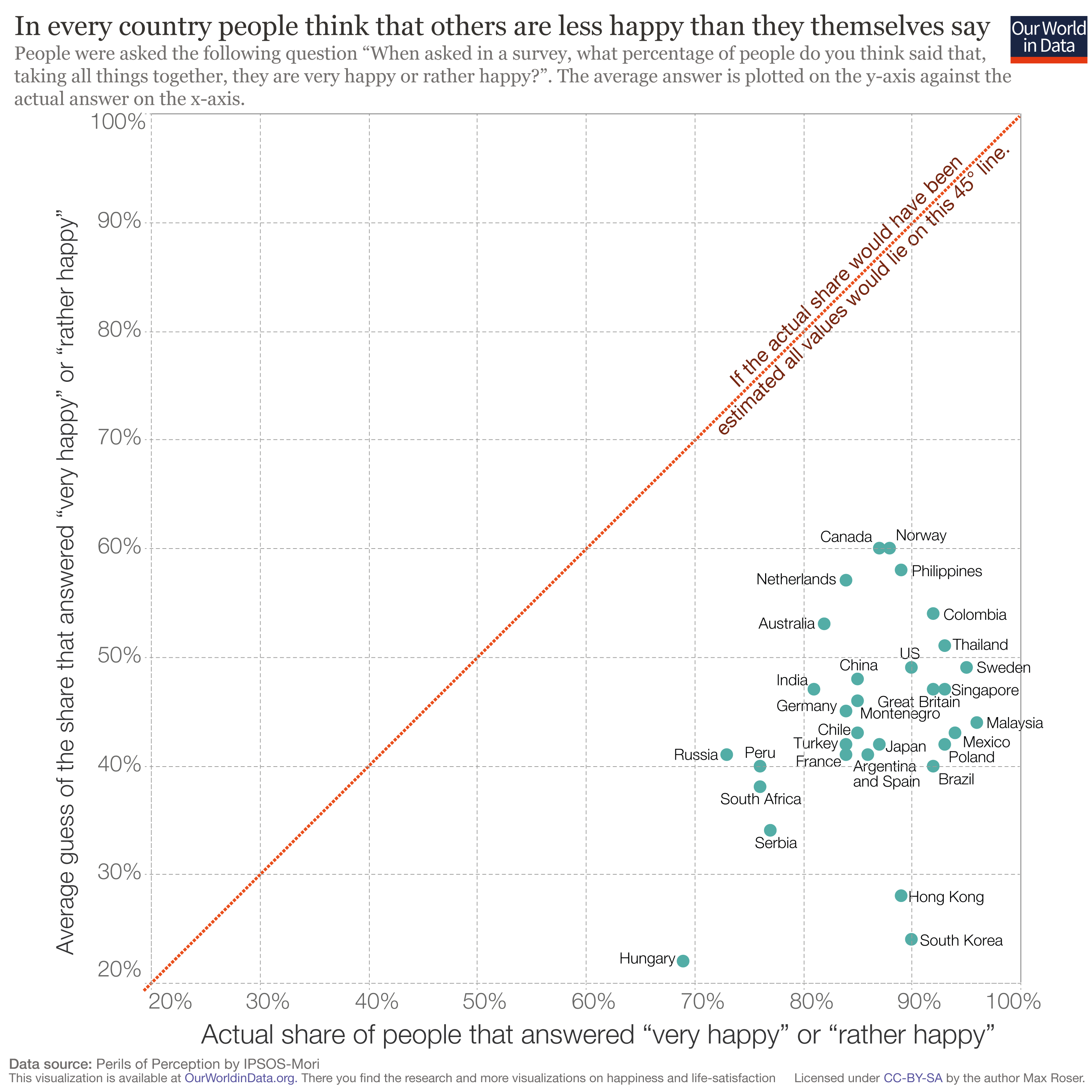
In every country people think others are less happy than they themselves say (2017)

ourworldindata.org

51–60 of 103 posts

Re: In every country people think others are less happy than they themselves say (2017)

#51
post #47

Earlier quoted context omitted.

> Compared with every metric in history, we are better. That claim alone should immediately make you doubt the metrics being used. In fact, it's easy to find dozens of metrics for which this isn't true. Housing affordability being a very obvious example. And the average democracy index has been going downwards for 15 consecutive years IIRC. Environmental pollution also most certainly isn't "at the best time in the en…

I haven't read the book but my assumption would be that they're thinking at larger sample sizes than you're currently thinking off. The last 50 decades have probably been the golden years of western civilization and democratic freedom, despite the evidence of decline within the last few years

If the claim is only true over spans of time on the order of lifetimes, then it’s not much comfort.

Re: In every country people think others are less happy than they themselves say (2017)

#52
post #47
post #46

Earlier quoted context omitted.

I found a book a while ago, that made me change my perspective about how I see the world as a whole. This is the book, it's called Factfulness: https://www.goodreads.com/book/show/37850908-factfulness There are a lot of bad things that happen around us (war, hunger, discrimination, etc), but we are at the best time in the entire human history, even with that. Compared with every metric in history, we are better. Even…

> Compared with every metric in history, we are better. That claim alone should immediately make you doubt the metrics being used. In fact, it's easy to find dozens of metrics for which this isn't true. Housing affordability being a very obvious example. And the average democracy index has been going downwards for 15 consecutive years IIRC. Environmental pollution also most certainly isn't "at the best time in the en…

https://en.wikipedia.org/wiki/The_Economist_Democracy_Index shows that average democracy index has not been going downwards for 15 consecutive years.

Re: In every country people think others are less happy than they themselves say (2017)

#53
post #47
post #46

Earlier quoted context omitted.

I found a book a while ago, that made me change my perspective about how I see the world as a whole. This is the book, it's called Factfulness: https://www.goodreads.com/book/show/37850908-factfulness There are a lot of bad things that happen around us (war, hunger, discrimination, etc), but we are at the best time in the entire human history, even with that. Compared with every metric in history, we are better. Even…

> Compared with every metric in history, we are better. That claim alone should immediately make you doubt the metrics being used. In fact, it's easy to find dozens of metrics for which this isn't true. Housing affordability being a very obvious example. And the average democracy index has been going downwards for 15 consecutive years IIRC. Environmental pollution also most certainly isn't "at the best time in the en…

Exactly this. Not only are objective metrics difficult - our interest in and capacity to measure social phenomena, especially self reported social phenomena varies over time, and is deeply amenable to accidental or deliberate manipulation (cognitive aspects of survey methodology is a whole field). Moreover, the subjective experience of a time is impossible to convey. Many of the deepest and most personally significant aspects of everyday interpersonal life - level of community integration, personal emotional investment in ones occupation, level of creative engagement etc - are hard or impossible to measure.

To take an arbitrary example from my own life, the last recession was an incredible time in Ireland. The housing crisis that has boiled for decades diminished, cheap and free property rentals in Dublin lead to an explosion in the creative arts - including dozens of 'open access' non profit creative spaces. Mass underemployment meant that social status briefly became much more about creative engagement and sociability that wealth display. Bars became less the focus of social life, which moved to house parties and non-profit social spaces. It was a creative and social renaissance. All of this disappeared so completely during the 'recovery' that it's difficult to convey what it was like to people who weren't around to experience it.

You can point to crisis of homelessness today, a generation forced to leave with their parents into their thirties, the worsening of the Irish health service, pressures on the cost of living. But you can't easily convey the comparative misery and defensive superficiality wrought by inequality in Dublin today. You can't capture on a chart the experience of living through a beautiful communal creative moment when an entire society caught a collective breath.
Re: In every country people think others are less happy than they themselves say (2017)

#54
post #42

Earlier quoted context omitted.

From Hong Kong and I’m curious when this survey is conducted. Seriously I can’t imagine people being happy over the trauma the last few years

No. This image was from 2017. Data maybe earlier.

Shouldn't this link get a [2017] in the title @dang ?

The date can be confirmed from the url itself.

Re: In every country people think others are less happy than they themselves say (2017)

#55

Such an arbitrary chart. On top of that, like other here said - can be easily skewed if the people surveyed are swayed by constant negative news in the media. They can say they're happy because they know it for sure but for others, they only see things in a twisted view.

Isn't that what the chart is trying to show? To confirm that yeah, the world is actually happier than we estimate. PS. "arbitrary", no idea if arbitrary, but the chart is difficult to read.

You can certainly view it from different perspectives, e.g. people are happier than estimated or people estimate lower than actual happiness. So your point is valid as well. As for readability - it took me a while to get it too so I agree.

Re: In every country people think others are less happy than they themselves say (2017)

#56
post #47

Earlier quoted context omitted.

> Compared with every metric in history, we are better. That claim alone should immediately make you doubt the metrics being used. In fact, it's easy to find dozens of metrics for which this isn't true. Housing affordability being a very obvious example. And the average democracy index has been going downwards for 15 consecutive years IIRC. Environmental pollution also most certainly isn't "at the best time in the en…

https://en.wikipedia.org/wiki/The_Economist_Democracy_Index shows that average democracy index has not been going downwards for 15 consecutive years.

Where? It says that world average in 2006 was 5.52 and in 2022 it was 5.29. That is clearly a downward movement.

Re: In every country people think others are less happy than they themselves say (2017)

#57
post #24

Not surprising when media hyperfocuses on doom, crime, death and conflict. Society clearly sounds like a terrible place when viewed through that extreme lens, so people’s everyday worries would be mild in comparison to what everybody else seems to be going through.

> Not surprising when media hyperfocuses on doom, crime, death and conflict.

I used to think the contrary but nowdays I think you're right.

A few years ago I unfollowed almost everybody on facebook and my usage time dropped significantly. That is until facebook started spamming me with doom news articles, on the same exact kind of topics that I'm drawn in.

The bottom line is click based "news" has to draw people in on very low quality content on the lines of the 7 cardinal sins + reality escapism.

Re: In every country people think others are less happy than they themselves say (2017)

#58
post #46
post #43

Earlier quoted context omitted.

This explanation is so obvious that I consider any study or chart that doesn't scream this at the reader in big red letters to be nothing short of propaganda. The conclusion those "researchers" would like to draw is that the world is better than "the people" think, when the far more plausible interpretation is that the world is so horribly bad that people are scared to even talk about how they feel.

I found a book a while ago, that made me change my perspective about how I see the world as a whole. This is the book, it's called Factfulness: https://www.goodreads.com/book/show/37850908-factfulness There are a lot of bad things that happen around us (war, hunger, discrimination, etc), but we are at the best time in the entire human history, even with that. Compared with every metric in history, we are better. Even…

I've heard this book cited many times, and people saying that the "bad" things we see are just the news cycles and very temporary, and in general we're better off (e.g. "The richest person has the same iPhone as you and uses the same kind of toilet").

Sure, some things are "objectively" better, like lower child mortality and so on. But happiness is so subjective. It's entirely possible that when we were hunter gatherers, the average person was happier, even though child mortality and life expectancy were considerably lower.

It's easy to think that access to high tech like iPhones and a toilet to shit in makes people happy, but I don't think this is the case.

Re: In every country people think others are less happy than they themselves say (2017)

#59

What’s wrong with Honk Hong and South Korea ? 90% says they’re very or rather happy and thinks only 20% of their peer does. I wonder if that’s linked to a cultural thing. Any Asian expert have an idea here ?

You don't have to be an Asian expert (wtf is that anyway?) to know that only people relatively well off participate in a survey. In countries with sufficient inequality those people know and see daily enough people in comparative misery around them.

If survey equally sampled people who eg. live in cage homes in “honk hong” or slave away for food at salt mines in SK who knows if results would differ

Post reply on HN