Live data from Hacker News

Digital Audio Workstation Front End Development Struggles

billydm.github.io

21–30 of 276 posts

Re: Digital Audio Workstation Front End Development Struggles

#21
post #2

Its weird to see the impressions of someone who has apparently never used the equipment used in music production trying to talk intelligently about said devices. So many incorrect assumptions its really painful to read as someone aquainted with audio engineering. Interesting window into how the devs see it nonetheless.

the comments about the layout of “mixing tracks” not following design guidelines or being a standard list/tree/etc struck me.

in traditional audio engineering we call them channel strips and their layout reflects the signal flow - eq knobs are typically at the top, followed by compression, fx, and so on.

Re: Digital Audio Workstation Front End Development Struggles

#22
post #7

I actually know this space fairly well, probably better than most, because being an implementor of a UI compositor raises some difficult technical challenges with respect to UI tree backing layers and draw invalidation. I'm still not actually sure what the state of the art on these matters is after having researched this for years, and I suspect even what we do today across software like web browsers, video game UI i…

From your description I think that .NET WPF[0] has the same architecture? [0]: https://learn.microsoft.com/en-us/dotnet/desktop/wpf/overvie...

I don't doubt they do something similar, or perhaps they inherent Win32 invalidation somehow, or build on top of it.

Re: Digital Audio Workstation Front End Development Struggles

#23

I actually know this space fairly well, probably better than most, because being an implementor of a UI compositor raises some difficult technical challenges with respect to UI tree backing layers and draw invalidation. I'm still not actually sure what the state of the art on these matters is after having researched this for years, and I suspect even what we do today across software like web browsers, video game UI i…

> I'm not sure even operating systems do Oddly enough Windows used to be a lot better at what you describe than it is (in practice) today. I've used old systems where it took 0.5sec to clear the screen, and you could see the color sweep down the monitor from top to bottom. Now THAT is slow. Because of that the OS used a lot of tricks to minimize drawing, such as xoring the caret, and precisely tracking dirty regions…

Which is why on modern Windows one would use the compositor APIs as well, however that implies some COM fun, which could be great if WinDev wasn't stuck in their ways on how to provide tooling for it.

Re: Digital Audio Workstation Front End Development Struggles

#25
post #2

Its weird to see the impressions of someone who has apparently never used the equipment used in music production trying to talk intelligently about said devices. So many incorrect assumptions its really painful to read as someone aquainted with audio engineering. Interesting window into how the devs see it nonetheless.

the comments about the layout of “mixing tracks” not following design guidelines or being a standard list/tree/etc struck me. in traditional audio engineering we call them channel strips and their layout reflects the signal flow - eq knobs are typically at the top, followed by compression, fx, and so on.

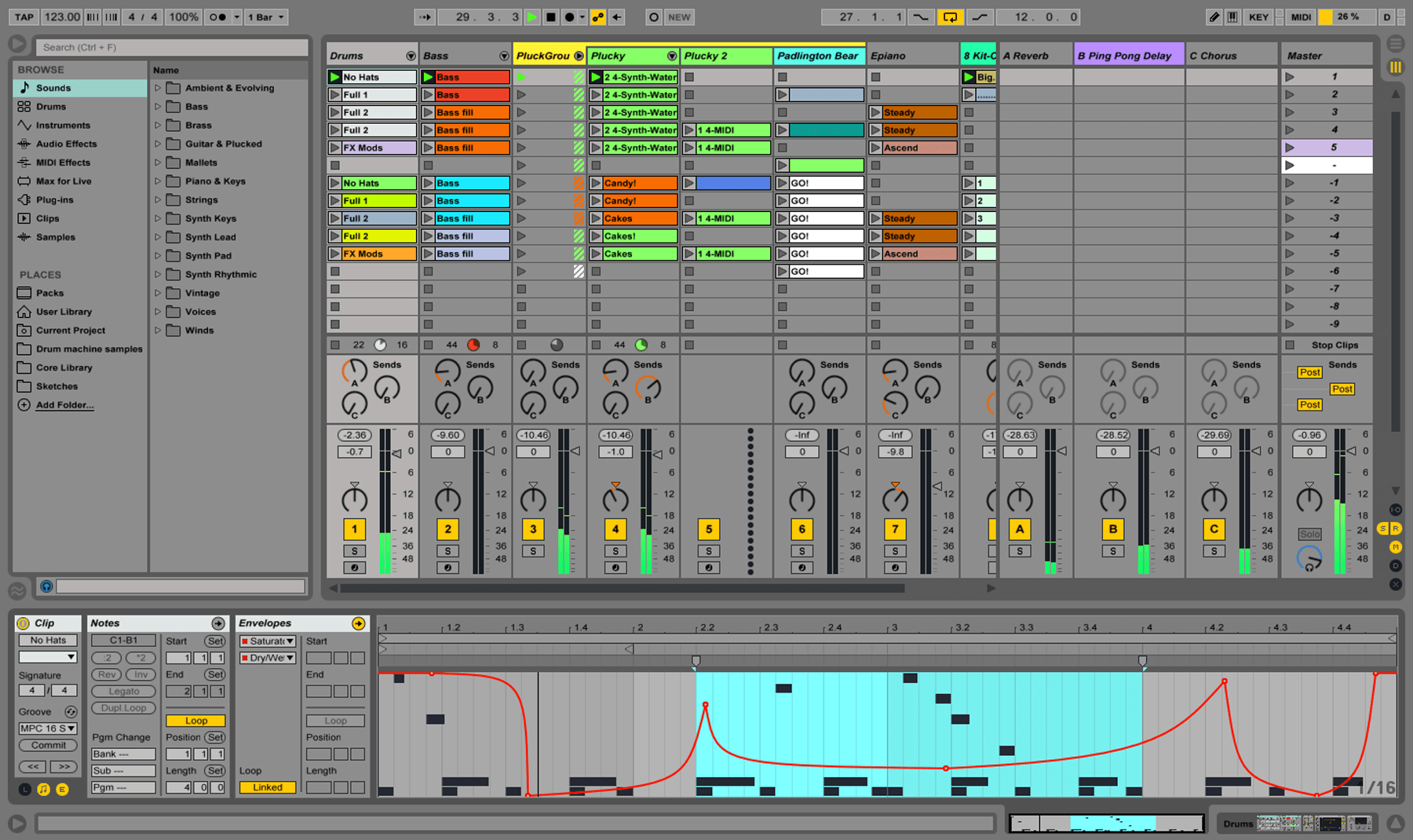
I think he meant that they don’t follow typical design guidelines for graphical user interfaces on a computer. Which they don’t — outside DAWs (and maybe some image editors?), I’ve never seen a GUI arranged like a channel strip, where controls are stacked on top of each other but not necessarily arranged in a perfect grid. A set of controls like e.g. [0] in Ableton is highly non-standard, compared to the kinds of layouts most GUI toolkits provide.

[0] https://rekkerd.org/img/201210/ableton_live9.png

Re: Digital Audio Workstation Front End Development Struggles

#26
post #15

I actually know this space fairly well, probably better than most, because being an implementor of a UI compositor raises some difficult technical challenges with respect to UI tree backing layers and draw invalidation. I'm still not actually sure what the state of the art on these matters is after having researched this for years, and I suspect even what we do today across software like web browsers, video game UI i…

> Pixel fill is expensive. And how. People don't realize that even with modern graphics card bandwidths, windows that are a good fraction of a 4K monitor take a remarkable amount of bandwidth to clear and fill.

Is there somewhere that has a good guide to understanding why this is the case? I'd love to learn more about it. I imagine there's a lot more to it than a gpu's pixel fill rate, which from the marketing should be sufficient but obviously from this discussion is not.

Re: Digital Audio Workstation Front End Development Struggles

#27
It's kind of funny how the author dismisses web technologies while complaining about redundant rerenders in Rust GUI libraries. This is all solved in browsers, both on the rendering engine and on the web framework library levels.

Yes you need to pay attention to performance, but the premise that "web is slow" has been disproven so many times already. Just because it's really easy to write apps that are slow (and thus these apps being ubiquitous) doesn't mean that you can't write performant apps if you are so motivated.

Re: Digital Audio Workstation Front End Development Struggles

#28
post #27

It's kind of funny how the author dismisses web technologies while complaining about redundant rerenders in Rust GUI libraries. This is all solved in browsers, both on the rendering engine and on the web framework library levels. Yes you need to pay attention to performance, but the premise that "web is slow" has been disproven so many times already. Just because it's really easy to write apps that are slow (and thus…

The amount of effort it takes to create high-performance applications in a web environment is significant, though, and the benefits you get simply working in a faster language in a desktop environment are lost on most web developers, I think, simply because most of them don't actually do any desktop or graphics API work.

They simply wouldn't know.

Also UI compositors are not a solved space. If they were, people would absolutely not being using Electron. But no one is saying, "Hey I have a CSS 2.1 compliant rasterizer and compositor that you can use in your C++ or Rust environment!" are they?

Re: Digital Audio Workstation Front End Development Struggles

#29
> This performance is not a problem if the app is small or the app already redraws every frame like a video game.

Seems to me like immediate mode UIs were dismissed rather too quickly. Why not update a DAW UI like a video game? It has similar realtime requirements.

Re: Digital Audio Workstation Front End Development Struggles

#30
> Both Javascript and the DOM are slow, there's no changing that.

The DOM isn't slow. Adding or removing a DOM node is literally a few point swaps, which isn't much more than setting a property on an OOP language object. What is slow is "layout". When Javascript changes something and hands control back to the browser it invokes its CSS recalc, layout, repaint and finally recomposition algorithms to redraw the screen. The layout algorithm is quite complex and it's synchronous, which makes it stupidly easy to make thing slow. Frameworks like React with virtual DOMs help you by redrawing on every state change, which will typically both speed things up significantly and also carry you through a lot of things that would break if you were using non virtual DOM frameworks like JQuery. You can get smooth and quick animations with JavaScript and the DOM, however, but only if you build things to limit what your application can do in a frame to operations which can be performed on the GPU.

I can understand if that's not exactly an option for the author of this article, but I'm not convinced you couldn't get Electron (or similar) to work as a GUI framework for a DAW. I suspect Electron specifically might actually be a pretty good framework for DAW's, considering what Microsoft is doing with VSC. I also think that the downside of frameworks like Electron is that you need to be, not only Microsoft, but the Microsoft VSC team (and not the Microsoft Teams team) specifically, to bend them to your way.

That being said, I think this will likely be one of those things where you'd need to create a GUI framework (or bend one to your will) to really get DAWs to work for you. Because I think the author is spot on about the "state" of GUI frameworks in general.
Post reply on HN