Live data from Hacker News

Levels of banned CFCs rising

nature.com

71–80 of 181 posts

Re: Levels of banned CFCs rising

#71

Earlier quoted context omitted.

I understand that pointing out problems in complex systems without proposing a solution is ultimately indifferent from eloquent bitching, which I can certainly be fairly accused of. That said, what the west is currently doing to address climate change - analogous to cheering for the people trying to push a derailed 130-ton freight car back onto the rail tracks with unassisted manpower alone - is not a solution either…

You are a very good writer and I’m intrigued by this thread. Can you elaborate on what you see as actual solutions and how they would look (no matter how far fetched)?

Thank you for the complement. I'm under no delusion that I have the solutions to the whole world's problems figured out. These ideas are like unrefined chunks of coal, rife with imperfections and riddled with flaws and only under the great pressure and heat of vigorous, critical debate may they ever hope to become diamonds.

I think R&D on the scale of what the US spent relative to GDP during WW2 might be a place to start. That's economically likely to require severe and heavy cuts across the board and may require a transformation of what are seen as the traditional roles of government. Half of all spending in the US goes to social security, medicare, and medicaid. These three programs combined take up almost triple US military spending. What's worse, they're mathematically unsustainable. Social security and medicare are effectively pyramid schemes that are running out of new people to recruit (result of low birthrates, dramatic improvements in life expectancy, and the lowest rates of net immigration into the country, as a % of existing population, in this country's history). These programs are going to die sooner or later anyway, why not rip off the band-aid now and start putting that enormous spending towards solutions for problems that can save billions rather than millions?

At the same time, there probably needs to be major overhauls to the US tax system. Even when top marginal rates were close to 90% last century, large corporations effectively bought politicians to create enormous tax write offs for them. As a result, total federal government receipts as a percent of GDP have never left the range of 16%-26%. Let's consider a flat federal tax rate of 27% across the board, with only one category of write-offs: R&D for carbon-negative / climate-healing solutions (as opposed to carbon neutral / climate-unaffecting solutions). We're going to need to be capable of removing other countries' carbon emissions if we fail to get them on the same page diplomatically or militarily, and I will never support military intervention (read: mass murder of innocent civilians) as a solution.

Imagine the sheer power of the US government being deployed full-force, with such overwhelming financial backing that we strive to go so deeply carbon negative that it doesn't even matter whether India and China are on board or not.

Yes we would be giving up the fights on a lot of problems, but IMO, no problems other than climate change and nuclear conflict between superpowers threatens the whole of humanity. While not perfect, the nuclear superpower problem is not getting worse as quickly as climate change, so on some level it makes sense to go full-steam-ahead on resource allocation to the largest issue first, and then work our way down the chain to smaller ones, rather than overextending ourselves and failing to solve problem #1, like we're doing now.

These are obviously some pretty radical proposals and I don't think there is political will to even have anything remotely like this seriously considered, so our corrupt, money-influenced political system probably needs to be changed first.

Just like how FTP separates the data plane (political outcomes) from the control plane (political process), we too need to protect the control plane from adversarial influence (big corporation lobbyists, citizens united, etc) before we can ever hope to achieve meaningful political outcomes.

Accordingly, whatever solves the political corruption ("lobbying") problem first should probably be our first step.
Re: Levels of banned CFCs rising

#72
post #18

Earlier quoted context omitted.

China is mentioned as having been a likely culprit in the past. I don't understand why Westerners are so keen to make major sacrifices to quality of life in the name of fighting climate change when nothing we do will make a statistically significant impact in the long run with major population centers like China, India, and Nigeria continuing to grow more wealthy with rapidly increasing demand for reliable, 24/7 ener…

I mean what do you propose western nations do? Nothing? Yeah stupid measures like removing straws from restaurants make 0 difference, but pushing for more fuel efficient vehicles and cleaner sources of electricity seems like a worthwhile effort without much QoL sacrifice. Green infrastructure (i.e. reducing car dependence) also seems to improve quality of life in many places, so I would argue we should be trying to d…

Not every culture values virtue signaling as much as the current regime in the west; performative acts are not necessarily going to influence other cultures such as China, etc.

Re: Levels of banned CFCs rising

#74

Earlier quoted context omitted.

This sort of ignores the global nature of our supply chains though. Someone can be very green in life here in the EU because all the products they buy are manufactured in China and their environmental impact is externalised and put onto the stats of another country that's trying to meet our demands. By regulating what's available on markets here we can pressure maufacturers elsewhere. What is the alternative you woul…

Do the difficult thing. Stop buying from China. As consumers, buy things with a transparent supply chain. Look for ESG reports on the companies you buy from. The hard part of this is it requires consumers to be educated and act. This almost never happens unless the costs for not acting are built into the prices of goods. Doing that requires political will. It's going to make a lot of people very angry; and we're not…

So, don't buy anything containing electronics?

Re: Levels of banned CFCs rising

#75
post #48

Earlier quoted context omitted.

Do the difficult thing. Stop buying from China. As consumers, buy things with a transparent supply chain. Look for ESG reports on the companies you buy from. The hard part of this is it requires consumers to be educated and act. This almost never happens unless the costs for not acting are built into the prices of goods. Doing that requires political will. It's going to make a lot of people very angry; and we're not…

I might suggest the slightly less difficult thing that I think could be reasonably politically accomplished. Introduce carbon tariffs on goods imported from dirty countries to make their products less competitive and provide an incentive to clean up manufacturing.

Great baby step. I'm all for it. Let's just make sure nobody is under the impression that this is anything more than a baby step - far more will be needed, ultimately.

Re: Levels of banned CFCs rising

#76
post #50

Earlier quoted context omitted.

Because it's non-negligible source of warming greenhouse gases that is completely avoidable - we have plenty of substitutes available to us with lower global warming potential. Releasing 1 kg of CFC-13 will trap the same amount of heat as 14,000 kg of CO2. Project Drawdown lists managing refrigerants as one of the top 10 solutions to limit warming in both 1.5 and 2C scenarios. https://www.drawdown.org/solutions/table…

Yes, but the point is the danger from the warming contribution is less than the danger from an ozone hole, so why focus on the warming? Unless the ozone depletion is below the recovery rate.

The combined emissions of CFC-13, CFC-112a, CFC-113a, CFC-114a and CFC-115 increased from 1.6 ± 0.2 to 4.2 ± 0.4 ODP-Gg yr-1 (CFC-11-equivalent ozone-depleting potential) between 2010 and 2020. The anticipated impact of these emissions on stratospheric ozone recovery is small. However, ongoing emissions of the five CFCs of focus may negate some of the benefits gained under the Montreal Protocol if they continue to rise. In addition, the climate impact of the emissions of these CFCs needs to be considered, as their 2020 emissions are equivalent to 47 ± 5 TgCO2.

https://www.nature.com/articles/s41561-023-01147-w

Re: Levels of banned CFCs rising

#77

Earlier quoted context omitted.

The factories that make solar panels and wind turbines for us today will make solar panels and wind turbines for the rest of the world tomorrow, and also more factories in between now and then. > make even a proverbial "drop in the bucket" These drops in a bucket are exponential. What did your mother teach you about exponentials? > the way things are done in China not changing China is making solar panels and nuclear…

As far as the cult goes, I think they probably mean the “we have to tear down the economy and re build it to address climate Justice” and “any sacrifice is worth it in the name of climate change crowds”. Of which a large number just pay lip service, but there are still a lot of true believers.

I would be much more sympathetic to these concerns if I saw credible green extremist policy pushes of the kind you describe, but the extent of green policy so far seems to be... EV subsidies for Elon Musk.

No, right now green extremists are primarily just bogeymen invoked by the usual conservative causes. I just don't feel a pressing need to jump into this fight on the side of legacy energy. Not yet and probably not ever.

Re: Levels of banned CFCs rising

#78

Earlier quoted context omitted.

> I don't understand why Westerners are so keen to make major sacrifices to quality of life in the name of fighting climate change when nothing we do will make a statistically significant impact in the long run with major population centers like China, India, and Nigeria continuing to grow more wealthy with rapidly increasing demand for reliable, 24/7 energy production, cheap air conditioning, etc. Can't convince the…

Is the strategy of doing it ourselves and politely asking China and India to get on board this century working so far? I'm not saying we shouldn't be taking steps to reduce our carbon footprint in the west, I'm saying that doing that and hoping that other countries will voluntarily join us isn't working.

>Is the strategy of doing it ourselves and politely asking China and India to get on board this century working so far?

Yes.

Western shifts to less-harmful methods and materials increases the size of the market for those methods and materials and lowers their costs, spurring adoption in places not as rich as the West.

The early adoption of solar panels in the west drives production capacity in poorer nations that are more manufacturing-oriented. The increased production capacity increases supply, which lowers prices, which makes it more affordable for them to transition to solar (and other technologies).

International conventions, treaties, and agreements headed by richer nations bring along poorer nations.

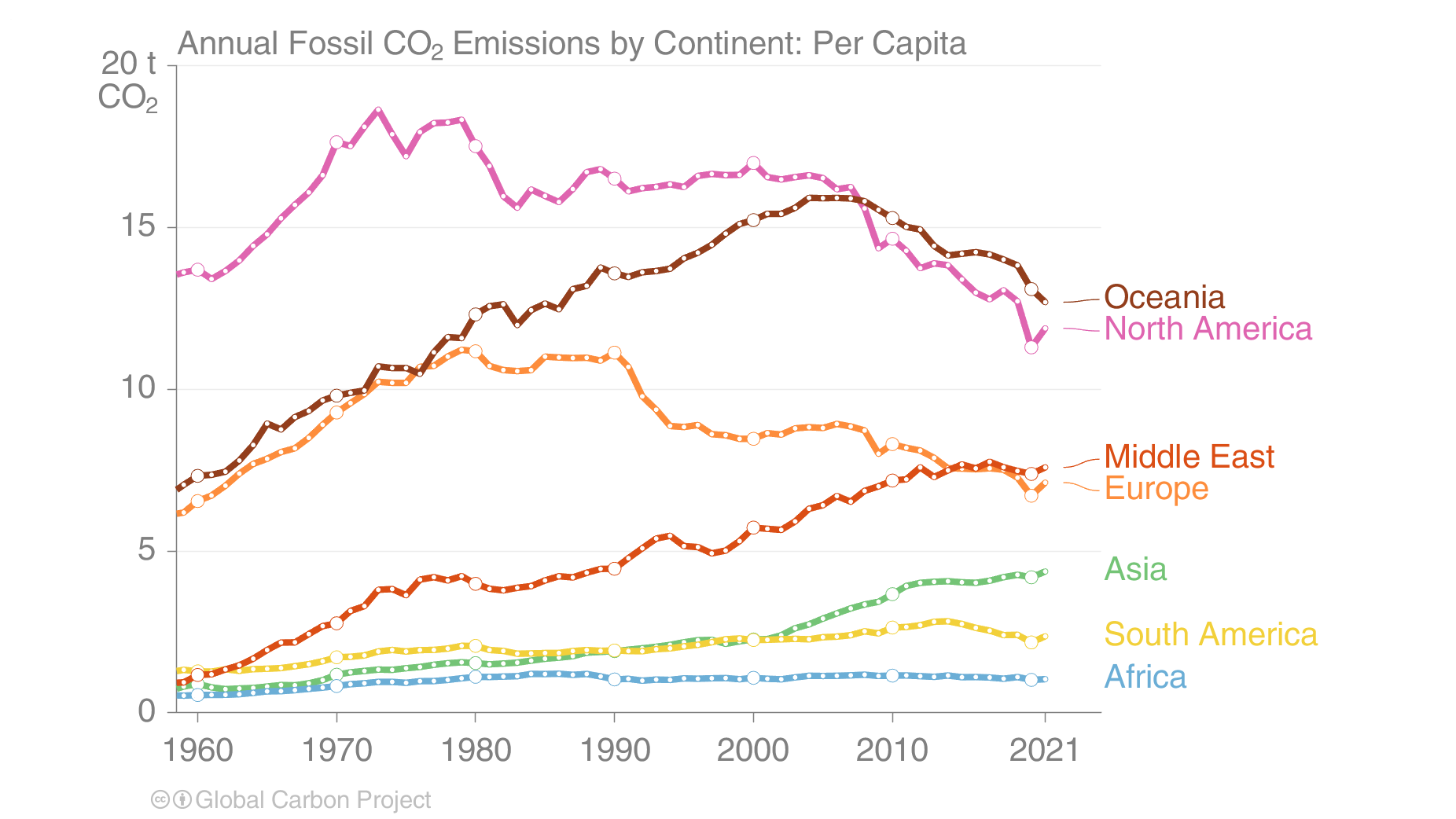
In the US, harmful emissions like CO2 and GHG plateaued in the 70s and 80s and started declining on both a total and per-capita basis in the 2000s. They are still much, MUCH, higher than the rest of the world but are declining. In China and India emissions have started to slow their rate of increase or have plateaued in the last 10 years.

China went from ~5% of their energy coming from renewables and nuclear in 2000 to 15% in 2019. The US was at approximately 40% in 2020. Given the rates of change China will probably surpass the United States in renewable/nuclear generation as a percentage of their electricity generation in 10-20 years.

I would expect the emissions curves to mimic those of Europe and the United States, lagging by 30-40 years.

This is a decades-long effort, not something that can be realized in years. The infrastructure built 20 years ago still has 30 years left in it, so the targets we want to hit in 50 years need to be planned for and built today.

But as for your question "the strategy of doing it ourselves" isn't really valid.

Each individual American emits roughly 3x the amount of CO2 that a Chinese person does. We're not "doing it ourselves" we are barely sacrificing anything while expecting people poorer than us to do what we don't want to do.

https://robbieandrew.github.io/GCB2022/PNG/s76_2022_Continen...

Re: Levels of banned CFCs rising

#79

Earlier quoted context omitted.

China is mentioned as having been a likely culprit in the past. I don't understand why Westerners are so keen to make major sacrifices to quality of life in the name of fighting climate change when nothing we do will make a statistically significant impact in the long run with major population centers like China, India, and Nigeria continuing to grow more wealthy with rapidly increasing demand for reliable, 24/7 ener…

We don't have to trust their numbers, we have satellites that can monitor the emission levels. The US pollutes at roughly twice the amount on a per person basis as China. In addition we "outsource" some of our pollution to them by them doing our manufacturing. It's tough to both raise the standard of living (reduce poverty) while also reducing pollution but China has a lot of initiatives to be more green; for example…

We do have a worse starting point, but as another commenter has pointed out, we're trending in the right direction and China is trending in the wrong direction.

Part of the solution is necessarily going to be temporary reductions in American energy consumption, writ large, until we can produce technology to sustainably remove carbon emissions from the environment at scale. I'm all-in, for instance, on banning SUVs and "light" trucks for personal ownership, which categorically require more energy input (regardless of whether gasoline, hydrogen, electric, etc) than sedans and compact cars - to say nothing of the pedestrian safety risks, no less.

Hell, I'm open to considering energy quotas for residential homes, to be reduced to a level sufficient only for the sustainment of life past a certain threshold, to disincentive wasteful use of electricity.

These are all tiny steps in the right direction, and all insufficient alone, but our progress in saving the climate is a vector value, not a boolean value. A bunch of little improvements in the right direction do help, but we cannot accept them as a "complete" solution on their own.

Re: Levels of banned CFCs rising

#80

Earlier quoted context omitted.

This sort of ignores the global nature of our supply chains though. Someone can be very green in life here in the EU because all the products they buy are manufactured in China and their environmental impact is externalised and put onto the stats of another country that's trying to meet our demands. By regulating what's available on markets here we can pressure maufacturers elsewhere. What is the alternative you woul…

I understand that pointing out problems in complex systems without proposing a solution is ultimately indifferent from eloquent bitching, which I can certainly be fairly accused of. That said, what the west is currently doing to address climate change - analogous to cheering for the people trying to push a derailed 130-ton freight car back onto the rail tracks with unassisted manpower alone - is not a solution either…

I don't think you're giving the west a fair shake here.

The work the west(and China) is doing to develop non-fossil fuel based tech cheap is directly applicable to those growing economies, and not a pointless waste of time.

Post reply on HN