Earlier quoted context omitted.
I suspect lines of code and number of developers are strongly enough correlated that it's hard to get any additional predictive power from the latter!
I think that's true when the source is first written. But # of devs only ever goes up during maintenance lifecycle, while loc may not change much.
Gordon Moore has died
231–240 of 250 posts
Re: Gordon Moore has died
#232Re: Gordon Moore has died
#233I really hope his casket has an Intel Inside sticker on it. RIP
Re: Gordon Moore has died
#234Wow, we have lost a true legend. As I get older, I marvel a bit at the giants I once shared time on the earth with. Sometimes it feels like we don't have giants in the 21st century in the same way.
I sometimes make myself a mental list of famous people who are expected to die soon. The following people will all die in the next few years: Jimmy Carter (98), Henry Kissinger (99), Dick Cheney (82), Pope Francis (86), Paul McCartney (80), John Williams (91), William Shatner (92), and Ali Khamenei (83).
Re: Gordon Moore has died
#235I have never had any brush with the giant. But I have my own little story to share. Way back in 1998, I was a newly minted engineer in India and was visiting Bangalore. While roaming around on MG Road, I picked up a book named “Inside Intel”. It is through that book that I learned about Gordon Moore. On the 48 hour train journey back to Delhi, I devoured the book. It left an impression and I was in awe. It also ignit…
Blossom book house <3
Late 90s and early 2000s, I recall that Intel Inside, Lee Iacocca’s book, Who Moved my Cheese, Seven Habits of Highly Successful People, Jack Welch’s book, etc were commonly sold, in addition to the latest novels. I even remember buying Sylvia Nasar’s A Beautiful Mind (was popular because of the movie then) from a roadside vendor.
Re: Gordon Moore has died
#236Earlier quoted context omitted.
I just watched Some Like It Hot (1959) a few weeks ago. Great comedy, looks phenomenal in 4K
I watch old ones, too, but always by myself. Nobody else wants to. It's always "eww, black and white!" Often they're right. They'd be much more watchable with an AI that could sharpen the picture and colorize it.
Re: Gordon Moore has died
#237Unmentioned so far- I was watching the University of Utah's 50th Anniversary of CS sessions[1], and- apologies I forget who- someone mentioned that it was Carver Mead who largely promoted "Moore's Law" as an idea. Just some random trivia, to highlight how such a strong piece of identity around such a more dynamic & wide-ranging man came about.
Hopefully not the "Douglas Engelbart: creator of the mouse" identity.
Re: Gordon Moore has died
#238Earlier quoted context omitted.
I just watched Some Like It Hot (1959) a few weeks ago. Great comedy, looks phenomenal in 4K
I watch old ones, too, but always by myself. Nobody else wants to. It's always "eww, black and white!" Often they're right. They'd be much more watchable with an AI that could sharpen the picture and colorize it.
Re: Gordon Moore has died
#239Earlier quoted context omitted.
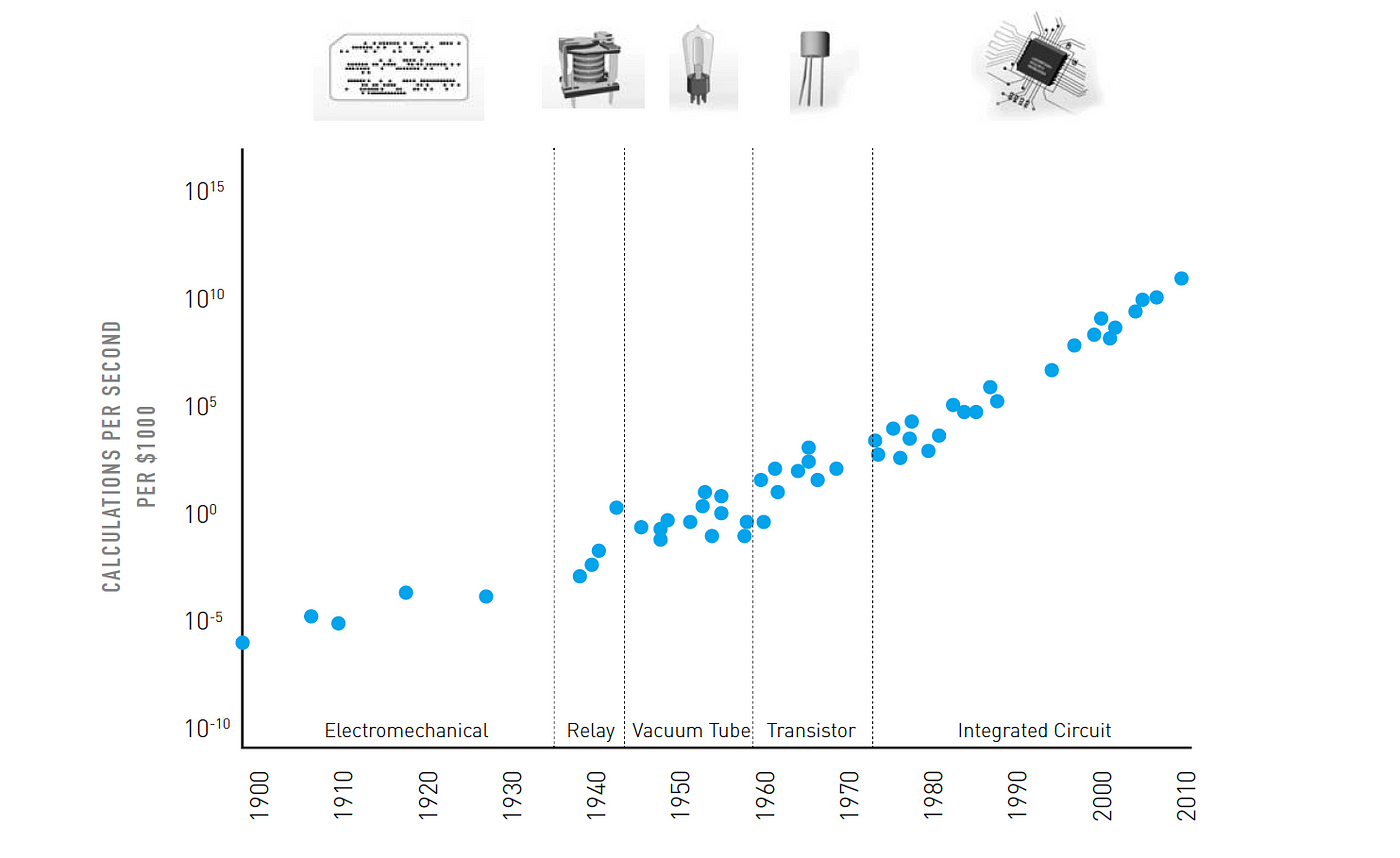
I think the spirit of Moore's Law (the context in which it is most often used) is better referred to as the Law of Accelerating Returns [1] [2] (e.g. by Ray Kurzweil). Moore's Law is a sub-section (in time and technology) of the Law of Accelerating Returns. [1] https://www.kurzweilai.net/the-law-of-accelerating-returns [2] https://link.springer.com/chapter/10.1007/978-3-662-05642-4_...
Naw, this is from a quarter century after Moore’s predictions, and Moore’s law had already started slowing down by then. Kurzweil was also selling snake oil (immortality) here, and the proof is in the final figure in the article, it’s 100% misleading and has left me with mistrust for all the rest of what Kurzweil said. Why did he leave out all the population data between 1920 and 2000, data which we have available at…
[1] https://miro.medium.com/v2/resize:fit:1400/1*vlmZ_Y3a-PGsK0S...
Re: Gordon Moore has died
#240Earlier quoted context omitted.
Naw, this is from a quarter century after Moore’s predictions, and Moore’s law had already started slowing down by then. Kurzweil was also selling snake oil (immortality) here, and the proof is in the final figure in the article, it’s 100% misleading and has left me with mistrust for all the rest of what Kurzweil said. Why did he leave out all the population data between 1920 and 2000, data which we have available at…
Really? I thought the exponential growth of calculations per second per dollar was rather well-established at least from 1900 through 2010 [1], a period of time that is much broader than Moore's Law? [1] https://miro.medium.com/v2/resize:fit:1400/1*vlmZ_Y3a-PGsK0S...
In case you missed it, my point is not that flops didn’t increased exponentially for most of the last century, it’s that Kurzweil wasn’t the first to observe it, and didn’t add anything rigorous to what Moore & others had already done. Kurzweil only made a mockery of it by fabricating some of the data and using the larger argument to claim we’re headed toward immortality, joining an illustrious list of people who get attention by hawking the fountain of youth.
BTW feel free to re-read Kurzweil’s predictions about computation growth in the article and ask yourself whether they’re true. One of his scheduled predictions is up this year. He’s off by a few orders of magnitude according to his own definitions, and furthermore his definitions are off by a few more orders of magnitude according to other researchers, and on top of that his claim that enough flops equal human brain capability are, to date, false. These things put the remainder of his predictions really far behind schedule, and possibly slipping at an exponential rate, which kinda undermines the whole point, right?