Live data from Hacker News

Hyundai promises to keep buttons in cars

thedrive.com

11–20 of 491 posts

Re: Hyundai promises to keep buttons in cars

#11
That's wonderful, I hope other car makers realize how distracting and dangerous touch controls are for a driver's ability to focus on driving.

My car has physical controls for most things, and I use CarPlay for music/podcasts and navigation, and even for that purpose it's extremely distracting to use it while driving when compared to the physical interfaces for A/C, seat heaters, mirror adjustment etc. I generally avoid as much of the CarPlay interface as possible while driving.

Voice commands are not the silver bullet solution here, they have a lot of problems such as requiring all passengers to stop talking, and it interrupts the radio, podcast, or music, and generally it's awkward to use voice commands during a phone call. Voice commands are probably fine for some low stakes input like asking to call someone, changing music tracks etc.

Re: Hyundai promises to keep buttons in cars

#12
post #7

Earlier quoted context omitted.

I personally don't enjoy voice commands, they require all passengers to stop talking, and it interrupts the radio, podcast, or music, and generally it's awkward to use voice commands during a phone call. Well placed physical interfaces are unbeatable for their input reliability, which translates to less time spent distracted from the road.

They don't have multiple mics to triangulate on the driver's voice? What you describe does sound annoying!

I don't have a high-end luxury car, I've only used Android Auto / Apple CarPlay through the car's microphone system.

Even if we assume a sophisticated system that can triangulate your voice, trying to talk to the car while driving, and having other passengers talking seems like a recipe for distraction.

Re: Hyundai promises to keep buttons in cars

#13
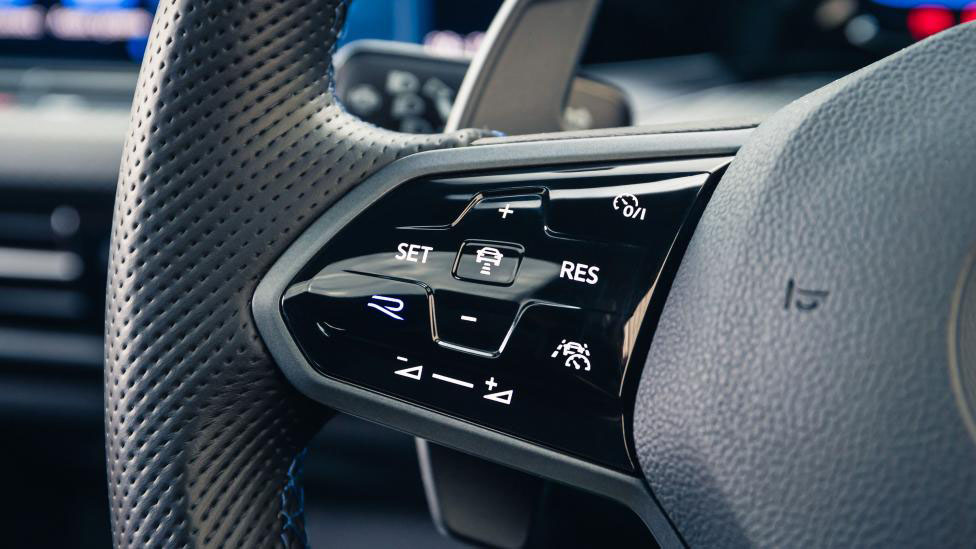
I have a 2022 VW Golf GTI. It has no buttons for the climate control and haptic buttons for the steering wheel controls. I think there's some assumptions the designers might have made about how people would use the system:

The first is how HVAC systems work in a house, old cars, and new cars.

- Home window and central ACs (at least all the ones I've seen) can't adjust the temperate of the air that comes out, it's tied to external values like whether the air recirculation is on, the temperature of the outside air, wind, etc. For example if it's 90f out and you turn on the AC and the desired temp is below that it will output 70f. There's many variables, size of the system whatever, point is YOU CAN'T CONTROL THE TEMPERATURE OF THE AIR COMING OUT OF THE SYSTEM

: You set a desired temperature

: If that temperature is above (AC) or below (heat) the compressor and fan turn on

: The system outputs a fixed air temperature, as cold as possible for all the variables BUT NOT your desired temperature

: When the desired temperature is reached (or a few degrees in either direction to prevent rapid cycling) the compressor turns off. The fan may also turn off or continue to run depending on the settings.

Cars:

In older cars and newer cars when automatic climate control is off or unavailable the system outputs the TEMPERATURE YOU CONTROL. You aren't setting a desired temperature but an output temperature. One exception to this is cars that turn off the compressor when your interior air is below the desired.

Many newer cars have automatic climate control. You set the desired temperature and it adjusts both the air temperature, fan speed, and position until you reach the desired temperature.

That means if it's 90F in the car and you want 69F the initial output air temperature will as cold as possible, possibly lower than your desired to assist in getting to your desired. This is accomplished via air mixing with the heater core. *It's more complex than this but for the sake of simplicity

I believe the goal was that you would set a fixed temperature, turn on auto, and rarely touch the system. This is even more possible in my car because there's dedicated defrost buttons that override the system when on and return it to the previous setting when you turn it off.

This means there's less interaction with the system and therefore less need for dedicated buttons and less distraction, assuming that's how it's used.

Steering wheel:

The steering wheel has a volume control:

https://www.topgear.com/sites/default/files/2022/02/TopGear%...

Both + and - are on one long strip with no gap between other buttons. When you press it there's a small amount of movement and haptic feedback. It does not respond to touch unless you slide.

The operation is as follows: Press + and the volume increases by 1 Press - and the volume decreases by 1 Slide your finger from left to right the volume increases multiple values depending on the amount of contact and speed of the swipe Slide your finger from right to left ....

Again, the sliding action mimics the operation of a phone. I don't think it's unreasonable for the designers to assume the operation would be natural for people.

Overall there's a greater learning curve however a learning curve for a car isn't important in most situations since you usually keep a car for a few years. I've gotten used to it and I would have liked real buttons I don't see a problem. Taking my eyes off the road can happen for many things, like GPS, text messages, etc. That's something I need to known not to do because simply reduces the reasons doesn't seem like the ideal solution.
Re: Hyundai promises to keep buttons in cars

#15
I've never owned a Hyundai, but stuff like this makes me want to look at them.

I recently bought what I thought was a car, only to find it is a tech-ridden abomination.

I want a vehicle that is reliable. I want a vehicle that is simple. I do not want a rolling AI/touchscreen.

Even just from a security standpoint I want minimal software in my car.

Re: Hyundai promises to keep buttons in cars

#17
post #10

Wow, talk about missing the point. Four grids of uniform buttons, they think that's an improvement over a touchscreen? There is zero practical distinction between taking your eyes off the road to see which button you're pushing vs taking your eyes of the road to see which part of the screen you're touching. GOOD HVAC/radio design means you can perform ALL essential functions WITHOUT taking your eyes off the road AT A…

It could certainly be improved, but it still looks much more usable than a touchscreen to me.

Re: Hyundai promises to keep buttons in cars

#18
post #10

Wow, talk about missing the point. Four grids of uniform buttons, they think that's an improvement over a touchscreen? There is zero practical distinction between taking your eyes off the road to see which button you're pushing vs taking your eyes of the road to see which part of the screen you're touching. GOOD HVAC/radio design means you can perform ALL essential functions WITHOUT taking your eyes off the road AT A…

[flagged]

Re: Hyundai promises to keep buttons in cars

#19
post #10

Wow, talk about missing the point. Four grids of uniform buttons, they think that's an improvement over a touchscreen? There is zero practical distinction between taking your eyes off the road to see which button you're pushing vs taking your eyes of the road to see which part of the screen you're touching. GOOD HVAC/radio design means you can perform ALL essential functions WITHOUT taking your eyes off the road AT A…

I’m pretty sure you regularly use a piece of plastic with 104 near identical buttons without looking at any of them.
Post reply on HN