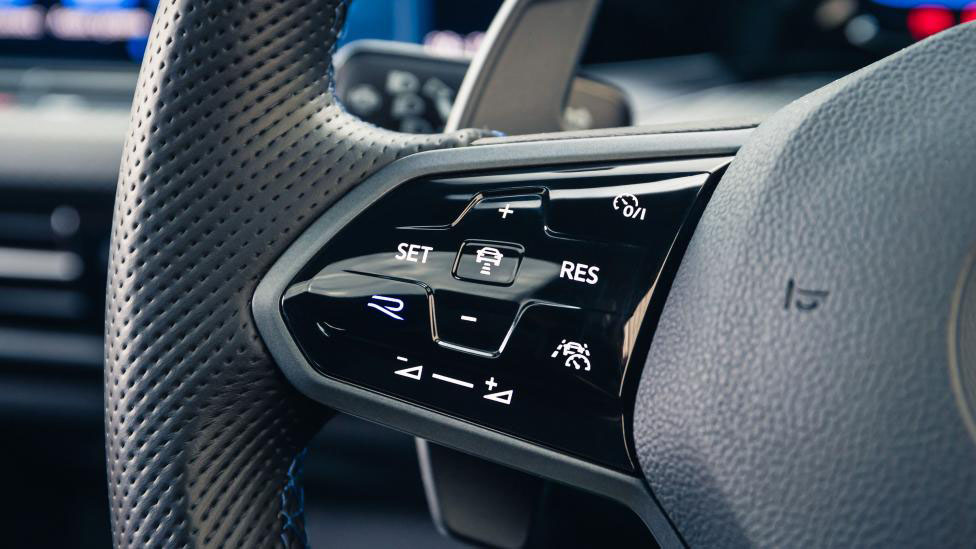
I have a 2022 VW Golf GTI. It has no buttons for the climate control and haptic buttons for the steering wheel controls. I think there's some assumptions the designers might have made about how people would use the system:
The first is how HVAC systems work in a house, old cars, and new cars.
- Home window and central ACs (at least all the ones I've seen) can't adjust the temperate of the air that comes out, it's tied to external values like whether the air recirculation is on, the temperature of the outside air, wind, etc. For example if it's 90f out and you turn on the AC and the desired temp is below that it will output 70f. There's many variables, size of the system whatever, point is YOU CAN'T CONTROL THE TEMPERATURE OF THE AIR COMING OUT OF THE SYSTEM
: You set a desired temperature
: If that temperature is above (AC) or below (heat) the compressor and fan turn on
: The system outputs a fixed air temperature, as cold as possible for all the variables BUT NOT your desired temperature
: When the desired temperature is reached (or a few degrees in either direction to prevent rapid cycling) the compressor turns off. The fan may also turn off or continue to run depending on the settings.
Cars:
In older cars and newer cars when automatic climate control is off or unavailable the system outputs the TEMPERATURE YOU CONTROL. You aren't setting a desired temperature but an output temperature. One exception to this is cars that turn off the compressor when your interior air is below the desired.
Many newer cars have automatic climate control. You set the desired temperature and it adjusts both the air temperature, fan speed, and position until you reach the desired temperature.
That means if it's 90F in the car and you want 69F the initial output air temperature will as cold as possible, possibly lower than your desired to assist in getting to your desired. This is accomplished via air mixing with the heater core.
*It's more complex than this but for the sake of simplicity
I believe the goal was that you would set a fixed temperature, turn on auto, and rarely touch the system. This is even more possible in my car because there's dedicated defrost buttons that override the system when on and return it to the previous setting when you turn it off.
This means there's less interaction with the system and therefore less need for dedicated buttons and less distraction, assuming that's how it's used.
Steering wheel:
The steering wheel has a volume control:
https://www.topgear.com/sites/default/files/2022/02/TopGear%...
Both + and - are on one long strip with no gap between other buttons. When you press it there's a small amount of movement and haptic feedback. It does not respond to touch unless you slide.
The operation is as follows:
Press + and the volume increases by 1
Press - and the volume decreases by 1
Slide your finger from left to right the volume increases multiple values depending on the amount of contact and speed of the swipe
Slide your finger from right to left ....
Again, the sliding action mimics the operation of a phone. I don't think it's unreasonable for the designers to assume the operation would be natural for people.
Overall there's a greater learning curve however a learning curve for a car isn't important in most situations since you usually keep a car for a few years. I've gotten used to it and I would have liked real buttons I don't see a problem. Taking my eyes off the road can happen for many things, like GPS, text messages, etc. That's something I need to known not to do because simply reduces the reasons doesn't seem like the ideal solution.