Earlier quoted context omitted.
> It's probably harder to tie devices in a single household together with IPv6 than with IPv4, or so they think. It's probably easier, in fact. A significant and growing number of households are behind CGNAT on IPv4 and not have a 1:1 household : ip address relationship. On the other hand, if they're on IPv6, they're most likely on the same /64. But, Roku's not doing IPv6 was handy for me when Netflix decided not to…
The big issue with v6 is you don't know what every ISP is doing with their IP space. The current RIPE recommendation is to delegate somewhere between a /48 to a /56 to every customer. Some ISPs might only delegate a 64, and perhaps typical home wifi setup may only use a single /64. For data aggregation maybe the error is ok, but I've wondered about what IP banning/filtering looks like for v6. Assume everyone gets a /…
Roku devices don't support IPv6 in 2023 and it's costing ISPs
201–210 of 233 posts
Re: Roku devices don't support IPv6 in 2023 and it's costing ISPs
#202Earlier quoted context omitted.
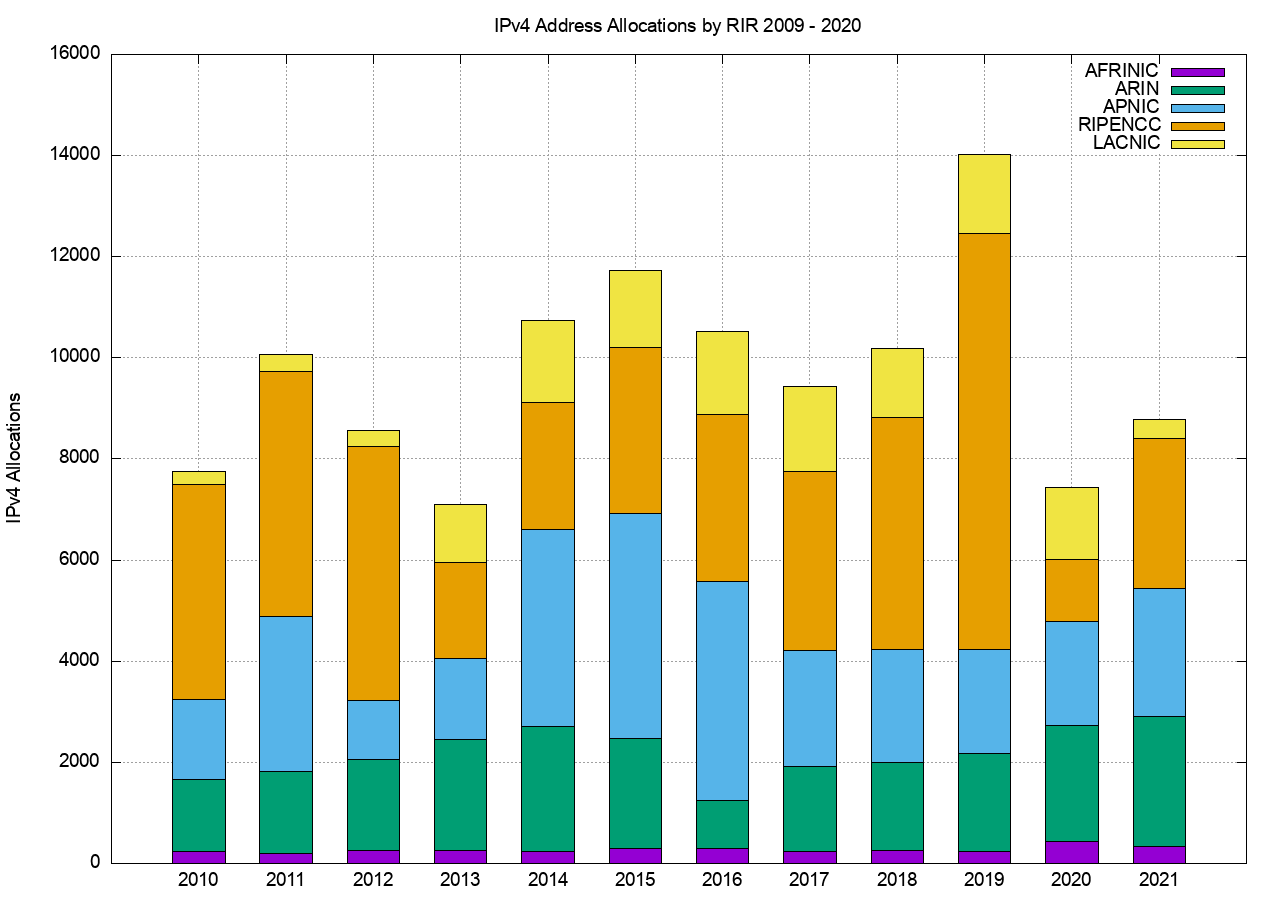
> Adoption has been declining for years. Source? > Many devices don't support it. Source? > Many services seemingly support it but break in strange ways. Got any examples? > And not to mention it's a subtle and yet powerful privacy attack vector. This is the only statement you've made that has any merit, and even then very little. Privacy Addresses have been a thing for a while, and most OS's support it. No longer ar…
Here you go: https://www.potaroo.net/ispcol/2022-02/ipv6-fig4.png also: https://www.potaroo.net/ispcol/2022-02/ipv6-fig5.png You can answer the rest of your own questions. I am not your personal Google.
Re: Roku devices don't support IPv6 in 2023 and it's costing ISPs
#203Earlier quoted context omitted.
Unless it's a server motherboard, it most likely supports DisplayPort or HDMI, possibly even over Thunderbolt/USB-C? Legacy compatibility is not an issue (unless it makes things complicated, unreliable or limited in the name of backward compatibility). Lack of modern functionality is. Similarly, presence IPv4 support in devices is not a problem - lack of IPv6 support is. The comparable issue would be if you have boug…
This reminded me of an e300-8D I recently parted ways with. Bought new in 2017 but only had VGA out from the BMC... I gave away the VGA monitor I was using with it. Looking back I'm surprised I didn't just buy an active converter, it was such a pain to pull that monitor out :p.
Fortunately, most of server boards have a built-in LOM solution with some sort of IP-KVM. So the actual video output is only ever needed for the very first time - and that's if LOM defaults are not known.
Or, well, if things break - e.g., I've had issues because management port sharing was enabled by default and I haven't realized I should turn it off until I've noticed that my server became unresponsive for IPMI-over-IP queries.
I'm a bit frustrated that I had to purchase an adapter, but at least that was an one-in-a-lifetime purchase.
Re: Roku devices don't support IPv6 in 2023 and it's costing ISPs
#204Earlier quoted context omitted.
It would be pretty cool to be able to program my Roku to do anything I want, rather than be limited to whatever they want. In theory I can connect another device to the TV and use it as a display, but even in that case the Roku software is active. A security researcher (amateur or professional) is going to want to get in there and see what's going on in addition to running through a proxy. There are also some scenari…
Right -- and I get that -- but I guess my point is, what can even really be done by rooting a Roku, since all the stuff in user space is close source/proprietary and the drivers are unlikely to be useful with an alternate distro. A RPi would be a much better choice for a poor kid in a neighborhood who wanted to have a way to program.
Re: Roku devices don't support IPv6 in 2023 and it's costing ISPs
#205Earlier quoted context omitted.
Finally some sense. There are so many senseless IPv4 shills here. IPv6 always works, never had a problem with it. Just switch to it alrready.
I'll switch when IPv4 stops working. Until then, I have no reason to switch. > It's costing ISPs I hate my ISP so this is actually a feature. If they add an IPv4 surcharge to my bill then I'll reconsider.
IPv4 has stopped working for a lot of people already, especially if they're not with a fancy-pants ISP with lots of legacy IPv4 addresses already 'in the bank'. From another discussion:
> I've actually run into this [CG NAT] helping a friend host a game server on their residential internet in a more rural part of Texas. They had to call their ISP and request a static IP address at an extra cost of something like $5/mo.
* https://news.ycombinator.com/item?id=35046929
IPv4 is also not working for the Indian reservation mentioned in the article: they had to spend >$200K to support these Roku devices.
Re: Roku devices don't support IPv6 in 2023 and it's costing ISPs
#206Earlier quoted context omitted.
> IPv6 for local networks, makes no sense is completely unnecessary, and is a hill I will die on. IPv4 is here to stay. Why would you make everything gratuitously complicated by having two separate forms of addressing? All that IPv4 gains you is new and exciting ways to mess up your networking. Just give every device a normal public address (of course you probably want to firewall off inbound traffic from the WAN to…
Why would I want any of my devices on my network to have a publicly route-able address? > Why would you make everything gratuitously complicated by having two separate forms of addressing? How is IPv6 itself not "gratuitously complicated". You think I am going to remember the IP of my firewall, my network switch, if it is that mess of characters that is an IPv6 address? I can easily recall 10.10.10.1 is my gateway, o…
So that your addressing works normally, and you don't have to deal with the same machine having two different addresses depending where you are (e.g. my photo server's address is the same whether I'm travelling or at home). Even if you only ever access your home network from outside via a VPN (which may well be a good idea), having globally unique addresses eliminates a whole bunch of possible issues - no more weirdness because the coffee shop you're in picked the same private subnet as you did.
> How is IPv6 itself not "gratuitously complicated".
IPv6 is needed for the public internet, there are just too many hosts for anything else. So you either learn IPv6 or IPv6 + another similar, but somewhat different thing.
Re: Roku devices don't support IPv6 in 2023 and it's costing ISPs
#207Earlier quoted context omitted.
This is one of the worst takes I've seen in this thread. NAT is only kind of a firewall and there have been plenty of terrible router firmwares out there that have lead people to subvert it (UPNP being one of the most problematic). If you in your other thread don't trust the ISP device, then don't trust NAT on your ISP device either. Quite often the ISP can have their modem route traffic from their internal 10 net to…
>If you in your other thread don't trust the ISP device, then don't trust NAT on your ISP device either There is no logic there. firewall configuration is much harder to secure than NAT configuration.
Disagree. Just the XML parsing logic required for uPnP alone is more complex than a basic firewall implementation.
Re: Roku devices don't support IPv6 in 2023 and it's costing ISPs
#208Earlier quoted context omitted.
If I’m following your logic, you’re saying you trust tplink etc to keep Grandma safe, but only for IPv4, and not IPv6? Why?
I am not trusting them, behind a ipv4 nat inbound connections are by default inaccessible ipv6 most configuration end up with all devices publically routable and must have a firewall deny policy inplace to block inbound connection Shodan is filled with people with misconfigured ipv4 routers that end up with all kinds of device that should not be on the public internet (webcams, printers etc) out there for anyone to c…
No they're not. They're by default obscured, but anyone can guess your internal IP and send a packet for it, and the router will happily forward it on unless its firewalling tells it not to. And that's without even even getting into all the extra attack surface opened up by legitimate and not-so-legitimate workarounds for the issues NAT causes.
Re: Roku devices don't support IPv6 in 2023 and it's costing ISPs
#209Earlier quoted context omitted.
Apple TV shows promotions for apps in the top row. These are ads. They are often shows the user isn't interested in, but the service is interested in pushing.
I'm pretty sure thats a feature for any app you put in the top row. If you have Netflix in that row it will show you recommended.
Re: Roku devices don't support IPv6 in 2023 and it's costing ISPs
#210Earlier quoted context omitted.
I raise you a B550M board! https://www.biostar.com.tw/app/en/mb/introduction.php?S_ID=9... Depending on the rules there's also the https://www.asus.com/motherboards-components/motherboards/pr... with ps/2 and while there is no physical VGA you can passive adapter one out of the DisplayPort connector.
Passive adapters from DisplayPort to VGA sounds unlikely? Port powered adapter, sure, but unless they're doing something really weird, you need at least some DACs and maybe something to translate sync? That's unlike single channel dvi-d hdmi conversion which is just a matter of connecting pins; IIUC, you can passively convert from display port to single channel dvi-d (and therefore hdmi), but dual-channel dvi-d needs…