Live data from Hacker News

AI teaches itself to use an API

twitter.com

71–80 of 162 posts

Re: AI teaches itself to use an API

#71
post #68
post #61

Earlier quoted context omitted.

Tony Stark is an exception, though. He was once a slave who escaped after he fooled his captor into letting him create a minature arc reactor that he embedded into his own chest in order to fly to freedom and safety - as well as to magnetically keep shrapnel from invading his heart and killing him. He isn't the normal billionaire owner of a software company (outside of comic books).

Didn't he have JARVIS before all that? I'd expect the missiles he was demoing earlier in the movie to have had AI help in design.

Nope. I'm talking about the very youthful Tony Stark, who was a defense contractor in 1963. [1] While he was demoing some new weapons in the jungles of Vietnam, he was captured by a Viet Cong warlord and forced to create weapons for the oppposing side. And, they didn't want to pay him defense contractor wages!

So Iron Man was born, and Stark flew away with his humming arc reactor in his chest. [2]

He looks incredibly youthful for being around 80. I guess that hum in his chest keeps him young.

[1] https://www.britannica.com/topic/Iron-Man-comic-book-charact...

[2] https://ironman.fandom.com/wiki/Tales_of_Suspense

Re: AI teaches itself to use an API

#72
post #48
post #27

Earlier quoted context omitted.

Can you think of any category of software that doesn't eventually have an open source alternative? There are many open source projects orders of magnitude more complicated than a LLM. The linux kernel, Blender, Firefox, etc. These LLMs aren't inherently complicated to implement, just expensive to train. And if the LLaMA release/leak is anything to go by we are extremely close to ChatGPT running on consumer hardware.

Straining this metaphor beyond all recognition, it seems like Tony Stark's AI allows him to be the entire military industrial complex with a tiny headcount, since it's hooked up to a highly automated factory. He is able to use the AI the way he uses it because he inherited an arms company. So maybe everyone can have their own Jarvis, but theirs won't be hooked up to a factory. I guess it can help them forage for food…

I don’t know about a factory, but 3D printers, lathes and Arduinos are pretty cheap. Even PCBs are manufacturable at home with a little creativity and patience.

If you’ve ever watched Stuff Made Here on youtube, imagine people inventing things like that on a mass scale. That’s a future I want to live in, the pace of technological progress would be staggering.

Re: AI teaches itself to use an API

#73
post #63
post #45

Earlier quoted context omitted.

>If you have a technology with practically zero marginal cost, pricing it very low and distributing it widely would maximize your profit. This is just fundamentally not true or else all software would be sold for next to nothing. If a company is choosing between selling a billion copies of its software for $1 each or two copies of its software for $1b dollars each, it will choose to set the price at $1b. The sky-high…

> This is just fundamentally not true or else all software would be sold for next to nothing. How much have you spent on purchasing software this year? For the past 15 years, pretty much 100% of the code running on my personal laptop and work desktop is opensource. The few remaining non-opensource programs, such as UEFI and wifi firmware, came free of charge with the hardware. The only software I directly purchased i…

> How much have you spent on purchasing software this year?

I work with tooling that costs on the order of $100k/seat. We don't get many add-ons, or it would be worse. You don't seem to understand how industrial software works. Negotiations involve the vendor figuring out how much your company is worth, and charging the largest fraction of that possible. The number of vendors in a niche is extremely small and they all work the same way.

Re: AI teaches itself to use an API

#74
post #72
post #48

Earlier quoted context omitted.

Straining this metaphor beyond all recognition, it seems like Tony Stark's AI allows him to be the entire military industrial complex with a tiny headcount, since it's hooked up to a highly automated factory. He is able to use the AI the way he uses it because he inherited an arms company. So maybe everyone can have their own Jarvis, but theirs won't be hooked up to a factory. I guess it can help them forage for food…

I don’t know about a factory, but 3D printers, lathes and Arduinos are pretty cheap. Even PCBs are manufacturable at home with a little creativity and patience. If you’ve ever watched Stuff Made Here on youtube, imagine people inventing things like that on a mass scale. That’s a future I want to live in, the pace of technological progress would be staggering.

3D printers are cute and all, but untill it can build a car engine, this is not a valid argument

Re: AI teaches itself to use an API

#75
post #72

Earlier quoted context omitted.

I don’t know about a factory, but 3D printers, lathes and Arduinos are pretty cheap. Even PCBs are manufacturable at home with a little creativity and patience. If you’ve ever watched Stuff Made Here on youtube, imagine people inventing things like that on a mass scale. That’s a future I want to live in, the pace of technological progress would be staggering.

3D printers are cute and all, but untill it can build a car engine, this is not a valid argument

I bet with a lathe, a 3d printer and AGI you could make the tools you need to build an engine. I’m not sure why you would though, since electric motors are both the future and 3D printable.

Re: AI teaches itself to use an API

#76
post #63
post #45

Earlier quoted context omitted.

>If you have a technology with practically zero marginal cost, pricing it very low and distributing it widely would maximize your profit. This is just fundamentally not true or else all software would be sold for next to nothing. If a company is choosing between selling a billion copies of its software for $1 each or two copies of its software for $1b dollars each, it will choose to set the price at $1b. The sky-high…

> This is just fundamentally not true or else all software would be sold for next to nothing. How much have you spent on purchasing software this year? For the past 15 years, pretty much 100% of the code running on my personal laptop and work desktop is opensource. The few remaining non-opensource programs, such as UEFI and wifi firmware, came free of charge with the hardware. The only software I directly purchased i…

> How much have you spent on purchasing software this year?

A few billion.

I bought a licence to Windows source code and paid developers to remove tracking so that I can have an OS with functional UX and privacy.

I bought Google search, removed ads, banned all the SEO spam from AdWords and now I can finally have a functional seatch experience.

Re: AI teaches itself to use an API

#77

A little off topic but I do wish we had some more precise language for machine learning applications. When we say it "knows" something it seems to anthropomorphize it, as if it's conscious. As a start to replace "knows" maybe "infers" or "calculates"

We could say the same thing about you or me. I can only know if you "know" something when you say it.

Re: AI teaches itself to use an API

#78
post #36

So the AI can learn to use APIs that follow perfect RESTful semantics, are fully documented and intuitively behave exactly like one would expect. Our jobs are safe.

Our jobs are safe for now. That's not my takeaway. Our jobs will eventually be "unsafe."

Re: AI teaches itself to use an API

#79
post #63
post #45

Earlier quoted context omitted.

>If you have a technology with practically zero marginal cost, pricing it very low and distributing it widely would maximize your profit. This is just fundamentally not true or else all software would be sold for next to nothing. If a company is choosing between selling a billion copies of its software for $1 each or two copies of its software for $1b dollars each, it will choose to set the price at $1b. The sky-high…

> This is just fundamentally not true or else all software would be sold for next to nothing. How much have you spent on purchasing software this year? For the past 15 years, pretty much 100% of the code running on my personal laptop and work desktop is opensource. The few remaining non-opensource programs, such as UEFI and wifi firmware, came free of charge with the hardware. The only software I directly purchased i…

> For the past 15 years, pretty much 100% of the code running on my personal laptop and work desktop is opensource.

I'm 100% open source at home as well and I'd say we are a tiny minority. No job that I've had was open source-centric so you have me beat there.

> The few remaining non-opensource programs, such as UEFI and wifi firmware, came free of charge with the hardware.

Nothing comes free of charge with hardware. The price was included with the hardware. Did you pay for your smartphone? Or you get that free?

> The only software I directly purchased in this decade are videogames on Steam, and that's closer to purchasing artwork than a computer program.

You bought ( leased ) software. Doesn't matter how you want to rationalize it to fit your argument.

Re: AI teaches itself to use an API

#80
post #45
post #32

Earlier quoted context omitted.

The marginal cost of technology is pretty close to zero (albeit slightly higher for large LLM model inference) so it would make sense that the technology gets distributed widely. Kind of like how everyone has essentially the best smart phone. And it's laughable when someone tries to create a luxury smartphone for $10k and its just a sub-par Android with leather accents. If you have a technology with practically zero…

>If you have a technology with practically zero marginal cost, pricing it very low and distributing it widely would maximize your profit. This is just fundamentally not true or else all software would be sold for next to nothing. If a company is choosing between selling a billion copies of its software for $1 each or two copies of its software for $1b dollars each, it will choose to set the price at $1b. The sky-high…

> This is just fundamentally not true or else all software would be sold for next to nothing. If a company is choosing between selling a billion copies of its software for $1 each or two copies of its software for $1b dollars each, it will choose to set the price at $1b.

Sure, you can make up numbers and have it say whatever you want.

> The sky-high potential of AGI means that a few very rich people/companies will be willing to pay an enormous amount of money to have a monopoly on the technology. That means the profit maximizing approach might be to put a huge price tag on the product.

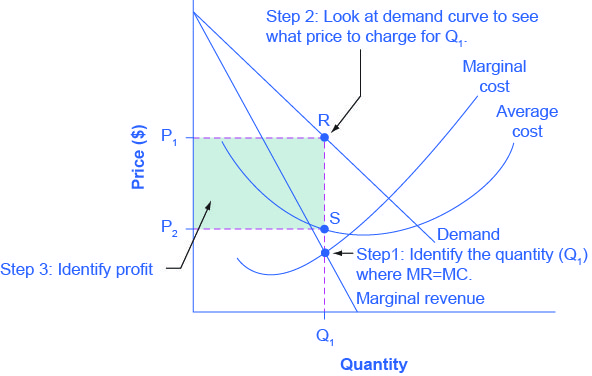
Even if you have a monopoly, your profit maximizing quantity is determined by where marginal revenue matches marginal cost. Then you charge as much as you can to sell that quantity. Everything else would lead you to a worse profit. You could have whacky looking demand curves, and yes it will result in a higher price and lower quantity than perfect competition, but the profit maximizing outcome will almost certainly be a wide distribution. Unless there is some weird negative network effect where someone gets benefit from others not having it. But in general, as a greedy business man, you want to be selling shovels during the gold rush.

To summarize, low marginal cost means high quantity, means relatively low price. That's why an insanely useful product like Microsoft office sells for something like $70 a year or $99 for a family plan. Slightly more for business but considering so much of the world is run on their software its an incredible bargain

http://pressbooks.oer.hawaii.edu/microeconomics2019/wp-conte...
Post reply on HN