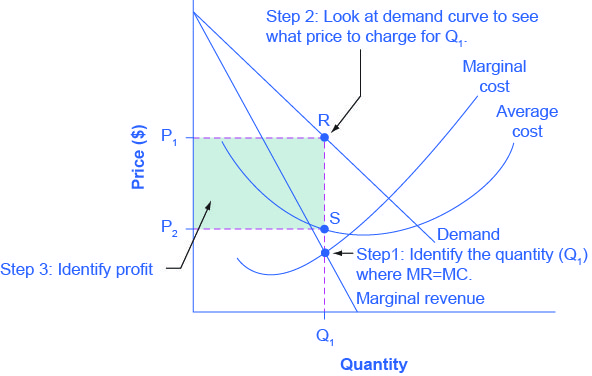
> This is just fundamentally not true or else all software would be sold for next to nothing. If a company is choosing between selling a billion copies of its software for $1 each or two copies of its software for $1b dollars each, it will choose to set the price at $1b.
Sure, you can make up numbers and have it say whatever you want.
> The sky-high potential of AGI means that a few very rich people/companies will be willing to pay an enormous amount of money to have a monopoly on the technology. That means the profit maximizing approach might be to put a huge price tag on the product.
Even if you have a monopoly, your profit maximizing quantity is determined by where marginal revenue matches marginal cost. Then you charge as much as you can to sell that quantity. Everything else would lead you to a worse profit. You could have whacky looking demand curves, and yes it will result in a higher price and lower quantity than perfect competition, but the profit maximizing outcome will almost certainly be a wide distribution. Unless there is some weird negative network effect where someone gets benefit from others not having it. But in general, as a greedy business man, you want to be selling shovels during the gold rush.
To summarize, low marginal cost means high quantity, means relatively low price. That's why an insanely useful product like Microsoft office sells for something like $70 a year or $99 for a family plan. Slightly more for business but considering so much of the world is run on their software its an incredible bargain
http://pressbooks.oer.hawaii.edu/microeconomics2019/wp-conte...