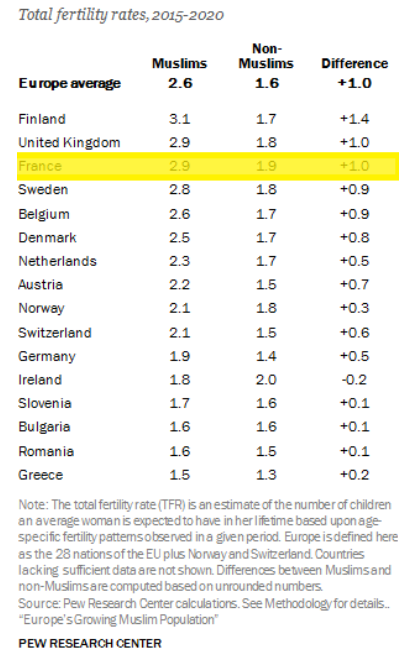
The book, "shall the religious inherit the world" is relevant. I'd be interested what happens when general birthrate declines and a religious group, that massively encourages tons of children, take larger voting percentages.
Interestingly, France happens to have among the highest fertility rates in Europe today. Doesn't seem to be more religious though.
France's baby bust
151–160 of 263 posts
Re: France's baby bust
#152Re: France's baby bust
#153So this guy makes a prediction, and his entire argument is proven false, but he apparently had an amazing PR firm so to this day his name is used in serious conversation.
Re: France's baby bust
#154Earlier quoted context omitted.
Sure, but for contrast Italia is a largely more catholic country than France [0], yet France has a higher fertility rate [1] So religion can be a factor, but there are so many other factors than can weight in the balance. [0] https://en.wikipedia.org/wiki/Catholic_Church_by_country [1] https://ec.europa.eu/eurostat/web/products-eurostat-news/-/d...
People can be nominally Catholic without doing a particularly good job of actually believing in and practicing the tenets of the religion. In fact, this is sort of the rule rather than the exception in much of Europe and North America.
Re: France's baby bust
#155Earlier quoted context omitted.
I'm not sure how you're getting to this enormous generalization. Seems to me that for the past century or so, liberal societies have been the dominant societies on the world stage. Which conservative, traditionalist societies are you thinking of that are more successful or have "higher fitness" than liberal societies? When I think of an archetypal "conservative, traditional" society, the first countries that spring t…
> Which conservative, traditionalist societies are you thinking of.. Legitimacy laws were still prevalent across the western world until the 1970's. Furthermore, abortion was basically illegal in Britain until 1967. In the year that Legitimacy ceased to have legal meaning in Britain, the fertility rate dropped below 2, where it remains today.
> It more and more seems like "traditional", conservative societies are more successful on aggregate.
Which is a much more general statement.
I see no evidence for that claim. Evidence that traditional values affect fertility rate does not provide evidence for this claim; for that you need at least some examples of traditional conservative societies outcompeting their more liberal contemporaries in some meaningful way.
Re: France's baby bust
#156> In 1700, almost 1 in 25 inhabitants on Earth, and one in five in Europe, was French. Today, less than a percent of humanity is French. Why did France’s population decline in relative terms so dramatically, and did it really mark the decline of France? It seems far-fetched to use global population as a relative indicator of France's "decline", where the global population exploded after the industrial revolution.
So this is why Europeans were able to colonize the entire world roughly in the 1700s.
An example involving France, and which had long lasting consequences: in 1830 France invaded and conquered Algeria. Looking at those with modern eyes one might think it should have been a massive war with an untenable outcome because France has a population of 68 million and Algeria has a population of 46 million... but in 1830 France had a population of about 33 million and had industrialised while Algeria had a population of only 3 million and still had an agrarian economy so the dynamic was completely different (although it still wasn't a walk in the park for the French).
Re: France's baby bust
#157> In 1700, almost 1 in 25 inhabitants on Earth, and one in five in Europe, was French. Today, less than a percent of humanity is French. Why did France’s population decline in relative terms so dramatically, and did it really mark the decline of France? It seems far-fetched to use global population as a relative indicator of France's "decline", where the global population exploded after the industrial revolution.
So this is why Europeans were able to colonize the entire world roughly in the 1700s.
Re: France's baby bust
#158The book, "shall the religious inherit the world" is relevant. I'd be interested what happens when general birthrate declines and a religious group, that massively encourages tons of children, take larger voting percentages.
There are a handful of modern religious and fundamentalist groups that sociologists study for this purpose: Mormons, ultra-orthodox Jews, evangelicals, etc. The interesting thing about these groups is that they exhibit “carrying limits”: they get to particular community sizes and begin to experience attrition through secularization.
Re: France's baby bust
#159Earlier quoted context omitted.
So this is why Europeans were able to colonize the entire world roughly in the 1700s.
The Industrial Revolution was why they were able to colonise the world. Being much, much more productive means you can afford a lot more bullets/cannon/artillery/small arms and you need less of your population as a share growing food. Europeans were better at war than anyone else because Europe was always at war somewhere. It was geographically fragmented enough that any one power becoming hegemonic never happened ag…
For example Ming China was the first gunpowder empire and was militarily competitive with if not superior to the European countries of the time. Qing China was caught resting on its laurels after it had accomplished the millennia-long Chinese goal of subduing all neighboring regions. In the case of China's defeat by European powers it was a combination of European ascendency and Chinese military stagnation at the time.
Re: France's baby bust
#160Earlier quoted context omitted.
The assumption that religion is something that people stick with is dubious, though. In the absence of coercion people will tend to abandon religion. Look at what's happening to Christianity in the US.
I thought the same, but real life experience shows that in my country (Romania) there is an increase of religion with age, especially for women; in other words, most women start being religious when they age and these days most of the religious traditions are maintained and transmitted by old women. I know many women that were secular in their 20-30, become religious at 50 and are regular churchgoers at 70. My mother…