Earlier quoted context omitted.
The United States was a conservative country at least until the 1960s
Not by the global standards of the 1960s.
France's baby bust
141–150 of 263 posts
Re: France's baby bust
#142Earlier quoted context omitted.
Catholic families tend to be very large. They tend to use contraception less and also have greater number of children per family. It’s still true today: https://ifstudies.org/blog/americas-growing-religious-secula...
Sure, but for contrast Italia is a largely more catholic country than France [0], yet France has a higher fertility rate [1] So religion can be a factor, but there are so many other factors than can weight in the balance. [0] https://en.wikipedia.org/wiki/Catholic_Church_by_country [1] https://ec.europa.eu/eurostat/web/products-eurostat-news/-/d...
Re: France's baby bust
#143Earlier quoted context omitted.
> why would we want to overpopulate? Half the reason we got out of the Malthusian trap is that we finally got enough people that specialisation and economies of scale start to pay off. Wanting to reduce the global population is like saying you want to eliminate economies of scale, which would make life harder for those who remain, not easier.
Our current economy is a pyramid scheme on a gigantic scale and dependent on an ever growing population. Since we live on a planet with a finite amount of resources we know infinite growth isn’t sustainable. If we don’t intervene at some point the whole system will inevitably collapse. The longer we wait, the more difficult it will be. Unfortunately we live in a gerontocracy where our leaders don’t care about what ha…
Re: France's baby bust
#144Earlier quoted context omitted.
Those political parties in France talk about “western culture” instead of “Christianity,” but western culture is fundamentally an outgrowth of Christianity. Even if you strip out the supernatural parts, a religion provides all sorts of notions about fairness, justice, forgiveness, family life, the rules and order, etc. People in Europe are still socialized into all that, even if they stop going to church. This is app…
> Even if you strip out the supernatural parts, a religion provides all sorts of notions about fairness, justice, forgiveness, family life, the rules and order, etc. Most people would call that a culture. One were most people do not go to church on Sunday and politicians, even if they’re from a religious background, like Angela Merkel, don’t ever talk about God. And one that is very different from the one across the…
If you look, you can definitely religious people but it's not most people or even close. The one large exception to this is the large number of immigrants who were much more likely to be religious and church-going.
Re: France's baby bust
#145Earlier quoted context omitted.
There are a handful of modern religious and fundamentalist groups that sociologists study for this purpose: Mormons, ultra-orthodox Jews, evangelicals, etc. The interesting thing about these groups is that they exhibit “carrying limits”: they get to particular community sizes and begin to experience attrition through secularization.
This does not accord with the Israeli experience. The Haredim have grown enough as a proportion that they shifted the Israeli median voter substantially to the right.
Re: France's baby bust
#146Earlier quoted context omitted.
The Industrial Revolution was why they were able to colonise the world. Being much, much more productive means you can afford a lot more bullets/cannon/artillery/small arms and you need less of your population as a share growing food. Europeans were better at war than anyone else because Europe was always at war somewhere. It was geographically fragmented enough that any one power becoming hegemonic never happened ag…
The timing is wrong though. Industrial Revolution started in 1760. By that time the British had already laid the foundation for their rule of India, and the other powers also were well on their way to colonization. In fact, looking at the timing, one could almost make the argument that the Industrial Revolution was the effect of colonization and exploitation of the rest of the world and not the cause.
Re: France's baby bust
#147Earlier quoted context omitted.
If the explosion of the global population is driven by the industruial revolution, then it would've impacted France's population the same way. So it makes sense to compare this way.
France's population exploded sooner.
The population explosion that's discussed in the article (the population dividend of the demographic transition) just never happened in France - which is the whole point of why its relative standing dropped so much over the past two centuries compared to other hitherto much smaller countries such as England and Germany.
Re: France's baby bust
#148So, the demographic transition took place exceptionally early in France, but why? In my research, I argue that the diminished sway of the Catholic Church, nearly 30 years before the French Revolution, was the key driver of the fertility decline. It more and more seems like "traditional", conservative societies are more successful on aggregate. If they are beneficial to the individuals comprising them, this is a matte…
I'd love to see some citation for that since most of the ultra conservative countries around the world are failing states both economically and societally. Everything from Iran, Iraq to European Hungaries to US bible belt states, you can pretty much directly map failure to fringe conservatism.
Economics:
China: Life in a mid- to mega-size city is already pretty good. Yes, it isn't 50K EUR per year, but 10K EUR per year is solid middle class.
India & Indonesia: Life in a mid- to mega-size city is meh-to-OK. In the next decade, urban incomes will very likely double. After, it will be close to China today.
Socially:
All three: Family structures are incredibly deep and supportive -- way deeper than most highly-advanced countries. Part of that comes from strong religious traditions from Taoism/Confucianism, Hinduism, Islam, etc. The lack of social safety net is mostly handled by wider family.
I have much less personal experience with Malaysia, Sri Lanka, Maldives, UAE, Qatar, Kuwait, and Saudi Arabia, but I guess their story is similar to the above three, but higher income.
Re: France's baby bust
#149Earlier quoted context omitted.
So this is why Europeans were able to colonize the entire world roughly in the 1700s.
The Industrial Revolution was why they were able to colonise the world. Being much, much more productive means you can afford a lot more bullets/cannon/artillery/small arms and you need less of your population as a share growing food. Europeans were better at war than anyone else because Europe was always at war somewhere. It was geographically fragmented enough that any one power becoming hegemonic never happened ag…
Spain and Portugal did it first, long before Industrial revolution (which Spain had much much later and only halfway, and Portugal never had at all). They did it because they could: finishing reconquest of their territories from Arabs in the late XV century, they only saw foreign expansion as continuation of the same trend: Christendom acquires more land from the infidels, with divine assistance, they saw it as their natural life role and mission and same thing they kept doing for 700 years before, just on land.
Then, Netherlands, UK and later France acquired some territories - Netherlands for the purpose of trade (was before Industrial revolution and industry wasn't involved), UK because of religious issues - to push out people of "wrong" religions, like Puritans, as far away as possible, and France, well, because they saw it was going fashionable and they sort of felt compelled to do the same not properly realising why (resulting in the most ridiculous and useless empire imaginable).
Finally, Germany did it when they got so belatedly reunified after 1870 - they simply happened to grab some colonies from France because they won the Franco-Prussian war. Also never figured what to do with those.
In every case, only with the latter part of British colonialism, industry played some role (when colonies were used as source for industrial raw materials e.g. cotton from U.S. South), or market to sell them (India). Military capabilities brought forward by industrialisation, never had a role properly.
Re: France's baby bust
#150Earlier quoted context omitted.
Catholic families tend to be very large. They tend to use contraception less and also have greater number of children per family. It’s still true today: https://ifstudies.org/blog/americas-growing-religious-secula...
Sure, but for contrast Italia is a largely more catholic country than France [0], yet France has a higher fertility rate [1] So religion can be a factor, but there are so many other factors than can weight in the balance. [0] https://en.wikipedia.org/wiki/Catholic_Church_by_country [1] https://ec.europa.eu/eurostat/web/products-eurostat-news/-/d...
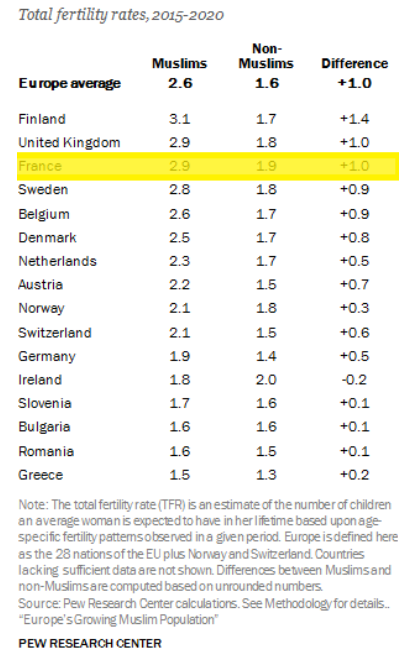
France fertility rate are boosted by its Muslim population https://mythdetector.ge/wp-content/uploads/2019/07/inline-im....