Live data from Hacker News

Analysis finds Australia’s inflation being driven by company profits, not wages

theguardian.com

271–280 of 316 posts

Re: Analysis finds Australia’s inflation being driven by company profits, not wages

#271
post #264

Earlier quoted context omitted.

>both supply and demand for eggs [...] have not changed much https://en.wikipedia.org/wiki/Avian_influenza#United_States_...

Yes, they euthanized a bunch of chickens, and yet total egg output remained basically the same . So where did the inflation come from? Why are egg producers suddenly recording record profits?

>and yet total egg output remained basically the same

source? Also, due to how price elasticity curves work, even if production is "basically" the same, it doesn't necessarily mean that prices would also be "basically" the same. If demand is inelastic, buyers will bid up prices to astronomical levels.

Re: Analysis finds Australia’s inflation being driven by company profits, not wages

#273
post #261

Earlier quoted context omitted.

Thanks for answering. > Employees can import foreign labour which has the effect of putting downward pressure on wages. You didn’t cite any sources here, and according to [1] this is wrong. In response to your comments about the rental market, I noticed you picked a source that is overwhelmingly anti-immigration. (I counted 4 more articles either linked or ‘recommended’ that described in varying terms how immigration…

I didn't think I needed to provide evidence, because it is common sense driven by basic supply and demand. You want a developer, then if all or nearly all developers are employed you need to offer higher wages to them to defect to your company. If however you can import an immigrant and pay them the same or lower wage (which is better than they get in their home country), then suddenly you don't need to offer a highe…

The comment you are replying to provided links that include actual evidence to the contrary.

Your reasoning is acknowledged in those links, and then they explain that this narrative sounds good but the data proves it wrong.

Some things really are mind boggling :)

Re: Analysis finds Australia’s inflation being driven by company profits, not wages

#274
Wikipedia:

> The Australia Institute is a left-wing public policy think tank...

This is the only conclusion this organization could ever be expected to reach.

In any case inflationary environments tend to be good for profits, because production takes place over time. Inputs were purchased at a lower price level than that under which final goods and services are sold.

Re: Analysis finds Australia’s inflation being driven by company profits, not wages

#275
post #266

Earlier quoted context omitted.

> Qantas has raised prices to ensure the flight demand meets what it can supply. This is weasly language for "price gouging". There's literally no problem with Qantas just selling the seats they had at reasonable prices and then saying, "sorry, no more seats available". Instead, you're trying to portray it as totally natural and just that they take advantage of any circumstances to squeeze as much out of their custom…

>This is weasly language for "price gouging". There's literally no problem with Qantas just selling the seats they had at reasonable prices and then saying, "sorry, no more seats available". >Instead, you're trying to portray it as totally natural and just that they take advantage of any circumstances to squeeze as much out of their customers as possible. Would you not have done the same? Seeing that we're on HN, the…

No, I haven't done the same, for years in fact. But that's besides the point, because individuals are simply not in the same power bracket as powerful corporations that dominate whole markets, particularly when corporations have a proven track record of behaving unethically.

Re: Analysis finds Australia’s inflation being driven by company profits, not wages

#276

Earlier quoted context omitted.

If it works at $100, why not? As long as you're clear about what tradeoffs you're making, and as a society we still want no employment effect, if it works at $100, what's the problem? You only have something to discuss if it's clear that unemployment will rise, and even so you need to decide how much is tolerable in exchange for whatever you get out of raising the minimum wage.

Do you have even the slightest doubt that unemployment would rise significantly if the minimum wage were suddenly raised to $100/hr? I am certain that it would.

My guess is it would. But the point isn't whether it should be $100, my point is we should use evidence to tell us what we're trading for what. If it's $100 minimum and great depression, I want to know that. If it's $100 and unemployment grows by 2%, I want to know that.

If we don't use evidence we choose blindly.

Re: Analysis finds Australia’s inflation being driven by company profits, not wages

#277
post #2

what about the money printing

If that money was given to people who spent it on things they would have bought anyway if they weren't off work due to the pandemic restrictions, then it won't increase inflation. If it is spent on things they wouldn't have normally bought, then it increases inflation.

Re: Analysis finds Australia’s inflation being driven by company profits, not wages

#278
post #263

Earlier quoted context omitted.

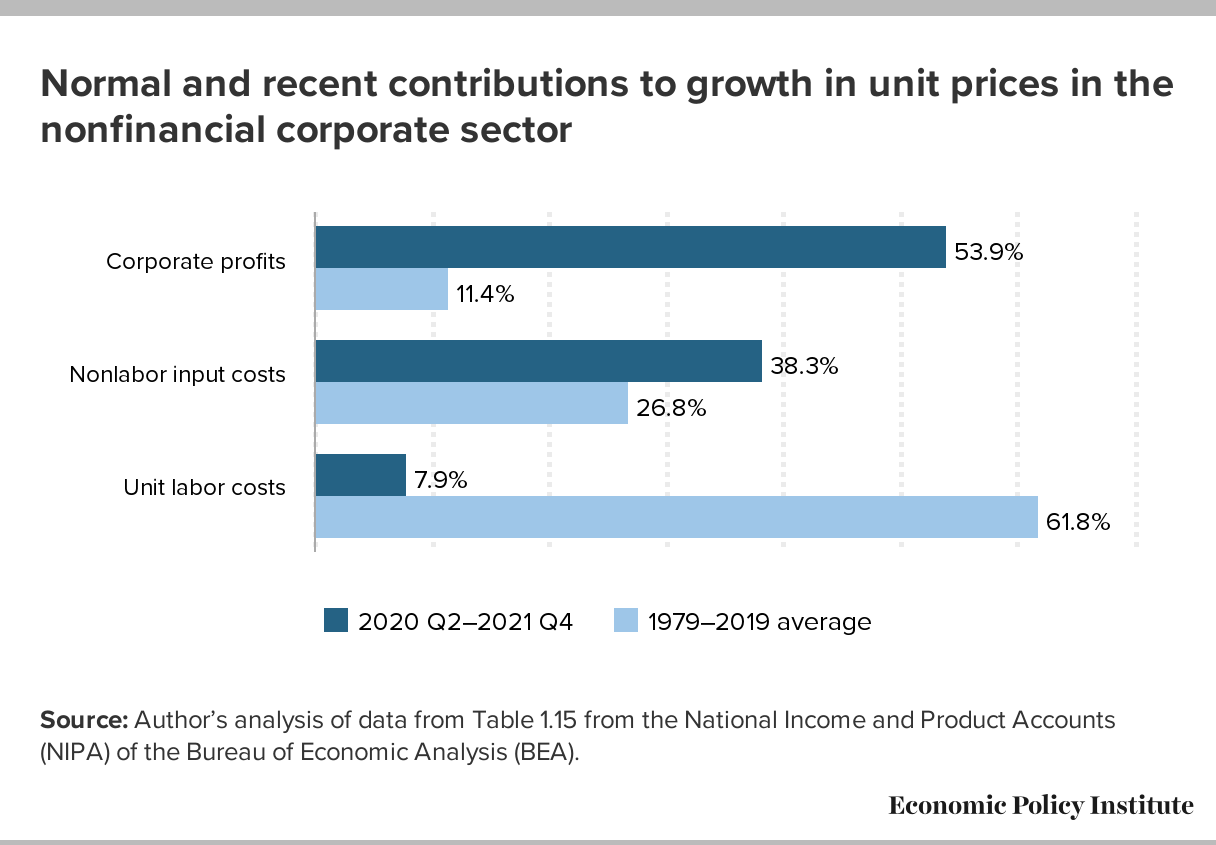
I won't speak to Australia, but Rep. Porter did a decent job of that here: https://youtu.be/udITRL9-t08

I'm not sure whether youtube is broken for me, but the linked video caps out at 480p resolution and on top of that it's letterboxed. As a result it's impossible to see what the chart is actually saying, or where the data is sourced from. Reading the transcript, the date range for the figures is "pandemic period" and "recent period", which means the comparison is probably bunk as a result of cherry picking.

Right, so instead of taking 5 seconds to search youtube for a better copy of this clip which is everywhere, you'll just assume your prejudice is correct? I don't know where you got your date ranges:

https://www.youtube.com/watch?v=0ixmqzjvb7k

Re: Analysis finds Australia’s inflation being driven by company profits, not wages

#279
post #266

Earlier quoted context omitted.

>This is weasly language for "price gouging". There's literally no problem with Qantas just selling the seats they had at reasonable prices and then saying, "sorry, no more seats available". >Instead, you're trying to portray it as totally natural and just that they take advantage of any circumstances to squeeze as much out of their customers as possible. Would you not have done the same? Seeing that we're on HN, the…

No, I haven't done the same, for years in fact. But that's besides the point, because individuals are simply not in the same power bracket as powerful corporations that dominate whole markets, particularly when corporations have a proven track record of behaving unethically.

>No, I haven't done the same, for years in fact.

Note this isn't limited to job hopping. If you saw the red hot job market and asked for a raise, that's arguably the same.

>But that's besides the point, because individuals are simply not in the same power bracket as powerful corporations that dominate whole markets, particularly when corporations have a proven track record of behaving unethically.

What are you trying to say here? That corporations are unethical and as a result shouldn't be conferred the right to raise prices? Or that price rises in absence of increased costs doesn't count as price gouging, unless you also have "power"?

Re: Analysis finds Australia’s inflation being driven by company profits, not wages

#280
post #263

Earlier quoted context omitted.

I'm not sure whether youtube is broken for me, but the linked video caps out at 480p resolution and on top of that it's letterboxed. As a result it's impossible to see what the chart is actually saying, or where the data is sourced from. Reading the transcript, the date range for the figures is "pandemic period" and "recent period", which means the comparison is probably bunk as a result of cherry picking.

Right, so instead of taking 5 seconds to search youtube for a better copy of this clip which is everywhere, you'll just assume your prejudice is correct? I don't know where you got your date ranges: https://www.youtube.com/watch?v=0ixmqzjvb7k

>Right, so instead of taking 5 seconds to search youtube for a better copy of this clip which is everywhere, you'll just assume your prejudice is correct?

No, if the source you provided doesn't convey enough information, I'll assume that your claim is unsupported and respond accordingly. I'm not going to wade through the dumpster fire that is youtube search to try to do my opponent's work.

>I don't know where you got your date ranges:

From my previous comment:

>Reading the transcript, the date range for the figures is "pandemic period" and "recent period"

They correspond to literally the first few lines of the transcript

    0:00 according to this chart what is the
    0:02 biggest driver of inflation during the
    0:05 pandemic the blue is the dark blue is
    0:08 the recent period
>https://www.youtube.com/watch?v=0ixmqzjvb7k

I traced down the original source to be: https://files.epi.org/charts/img/248291-29919.png

I don't see how this addresses my claim that the data was cherry picked. If anything it strengthens it.

1. the date ranges chosen for the dark blue period starts at 2020 Q2 and ends at 2021 Q4. This is an unusual date range to pick. Most analysis use round numbers and/or whole years. The start date conveniently corresponds to the trough of the pandemic recession period.

2. the date ranges chosen for the light blue period covers a 20 year period. This date period probably isn't cherry picked, but comparing long run data with short run data is inevitably going to show discrepancies, since long run data is less volatile than short run data.

Given that the BEA publishes such data on a quarter to quarter basis, they could have easily made a line chart showing the data across two decades. The fact that they chose to use a bar graph that only shows numbers for two suspiciously chosen time periods, and their overall reputation[1] makes it hard to take the chart at face value.

[1] https://en.wikipedia.org/wiki/Economic_Policy_Institute
Post reply on HN