Earlier quoted context omitted.
And its going to be a very big moment, since V3 effectively bans Adblockers and website redirect extensions. It might increase Firefox adoption if it actually happens.
- bans adblockers that use their own matching engine - bans website redirect extensions that can't use declarativeNetRequest action.redirect https://stackoverflow.com/a/66394857/3878893
HTTPS Everywhere will sunset in January 2023
131–140 of 148 posts
Re: HTTPS Everywhere will sunset in January 2023
#132Earlier quoted context omitted.
Eh, kind of. It's successful as far as the Internet, which is great. But Internet web pages isn't everything. There's still a real issue with infrastructre that has web configuration. Everything from home routers to video cameras and so on. Not being able to ship with a certificate that passes browser security checks is a problem that essentially nobody has addressed. When people connect to an IOT device, they need t…
Couldn't browsers just designate the .local tld to not check for SSL certs and enforce that it resolves to an IP on the current network? Seems like a simple solution for this.
However precisely because .home.arpa domains are non-unique is is forbidden by the relevant RFC to treat it specially for security. Because with a roaming device, when out on say an public attacker controlled wifi, the name might resolve to something malicious under attacker control, and doing something automatically trusting self signed certs would make it more likely that attacks using such devices could succeed.
If a mechanism for securely identify exactly which home network you are connected to is eventually discovered, then this limitation can be lifted, with the user specifically whitelisting trusted home networks.
Re: HTTPS Everywhere will sunset in January 2023
#133Earlier quoted context omitted.
That's a thing for local software to decide. It's also something that can be done with a level of reliability that will impress incredulous people. But that there will always be somebody to complain that is not following the standard recommendations.
In that case you don't need a certificate. Just check that the .local FQDN's IP is on a local network. 1. Look up all local interfaces' networks (IP & subnet mask) 2. Determine if .local IP is within subnet range of one of the interfaces 3. If .local IP is not on a subnet of a local interface, drop the connection This is still "host-based networking" and there's always the possibility a rogue network could be attache…
Re: HTTPS Everywhere will sunset in January 2023
#134Earlier quoted context omitted.
A permanent redirection before setting the correct headers is the best you can do at the server side. Yes, the user is using insecure practices, and no, you can't correct it on your server.
I am arguing that the best you can do is not even have HTTP enabled. A permanent redirect is the second best ;) And yeah, most practical for commercial entities (which is why I highlighted what I do for my personal sites).
For the first time - you're affected either way.
For the second time - if you still have the permanent redirect cached, you avoid the mitm.
Disabling your own http only helps the attacker in specific situations.
Re: HTTPS Everywhere will sunset in January 2023
#135Earlier quoted context omitted.
The year 2015 wants its flamewar back.
I was thinking about this classic article [0] that gets linked whenever people talk about HTTPS? If so, that's a 2017 flamewar. [0] http://n-gate.com/software/2017/07/12/0/ (NOTE: this site tracks if you come from HN and sets a cookie. You'll probably need to open it in incognito)
Re: HTTPS Everywhere will sunset in January 2023
#136Earlier quoted context omitted.
I am arguing that the best you can do is not even have HTTP enabled. A permanent redirect is the second best ;) And yeah, most practical for commercial entities (which is why I highlighted what I do for my personal sites).
No, you're actually less secure without HTTP. Scenario: someone figure out how to mitm your http traffic. You visit the page: For the first time - you're affected either way. For the second time - if you still have the permanent redirect cached, you avoid the mitm. Disabling your own http only helps the attacker in specific situations.
But ultimately, browsers have to default to HTTPS for a guaranteed "protection" from the start (whether that's through HSTS preload lists or simply by defaulting to HTTPS, does not matter much).
Re: HTTPS Everywhere will sunset in January 2023
#137Earlier quoted context omitted.
I am arguing that the best you can do is not even have HTTP enabled. A permanent redirect is the second best ;) And yeah, most practical for commercial entities (which is why I highlighted what I do for my personal sites).
The best you can do is set HSTS and redirect from http to https. You not serving http won't prevent a MITM from serving http to the victim.
Can't they similarly serve HTTP data without any HSTS headers? Or do browsers also check HTTPS for any HSTS headers on the same IP and cross-compare?
Re: HTTPS Everywhere will sunset in January 2023
#138Earlier quoted context omitted.
> I mentioned this above, but when was Debian ever doing this? I They are still doing it! On my system (this one's not Debian, but KDE Neon) $ cat /etc/apt/sources.list deb http://archive.ubuntu.com/ubuntu/ focal main restricted universe multiverse deb http://security.ubuntu.com/ubuntu/ focal-security main restricted universe multiverse > That's not what HTTPS protects against, HTTPS is designed to protect against MI…
> They are still doing it! No, they're not! Debian uses PGP and signature verification to protect against MITM attacks because it is critically important for software downloads to be protected against MITM attacks. Now, Debian does not use HTTPS in specific to protect against MITM attacks because they have another method baked into the package managers that people are using. It does not follow that HTTP is secure, it…
so YES, they are still doing it.
thanks for confirming.
Anyway, how do you donwnload those PGP keys in your opinion?
http://subkeys.pgp.net/keys/ http://pgp.mit.edu/ http://keyserver.ubuntu.org
Why they do it?
because the heavy cryptographic computation this way is done on the client, saving computer cycles on the packages mirrors that more often than not are kept alive by volunteers using their own money and time.
> If your website is accessible to normal browsers on the public Internet, than you're not on a network where that's not possible.
*If you are running a network where that's not possible,*
again, thanks for confirming it.
anyway, I could not care about MITM attacks if my website is my personal blog, running on a PI in my living room.
It's the network job to ensure security from MITM, not the website owners'.
> Most free hosts I've looked at recently from Github pages to Netlify have automatic background SSL management for free with zero configuration from the user
And now you have to trust them too, it's not "your personal website" anymore.
Talking about trusting trust... your solution is more delegation to unknown entities.
Doesn't sound so convincing to me.
> No, HTTPS encrypts data according to the certificate authority
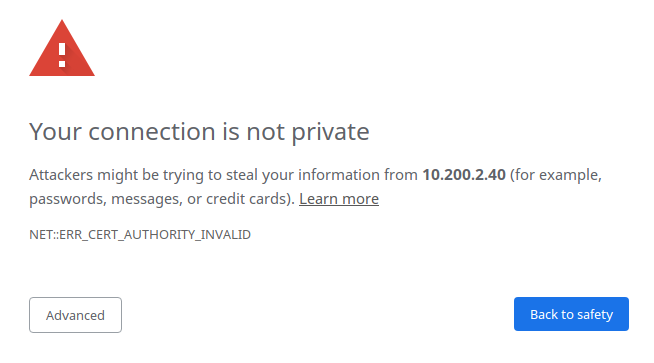
No, HTTPS works with self signed certs too, it's browsers that don't want you to and show a scary popup like this
https://help.univention.com/uploads/default/original/2X/5/5e...
Which is not even true, the connection is private, it is simply privately private and not "trusted" by any know CA.
which could not be a problem if I trust the website and who runs it.
But, again, the scary warning page will scare people away, while the connection is working as intended.
> I was kind of leaving privacy off the table
You are confusing privacy with secrecy.
HTTPS is not private, the connections being made are still visible.
> you don't understand what "panacea" means
I'm Italian with Greek roots, we literally invented the word.
Its original meaning is "plants that cure everything".
That's why my remarks.
It's still a plant name! (https://www.google.com/search?q=p%C3%A0nace)
> Rejecting basically free cryptography that substantially improves security
Yeah, I imagine you lock yourself in your house and set the alarm every time you exit from a room and then disable it every time you enter, after unlocking the door.
I'm sure you do it, it's free, it improves security!
> People being so concerned about centralization that they start sending messages in plain-text and start arguing with people online that sending messages in plain-text is somehow better for decentralization is at best misguided.
I know how you feel in your paranoia fueled World and I feel for you, but I tell you, dear friend, that you're wrong.
Nobody said what you're saying they did.
Use the easier solution available given the circumstances is simply sign of intellect.
You're not stupid, I'm sure of it, so why you acting like you were?
Re: HTTPS Everywhere will sunset in January 2023
#139Earlier quoted context omitted.
> HTTP is not ok actually, it is. HTTP is perfectly fine. [1] > Anyone can ready / modify what is being sent Anyone can break a window and enter my house. But I haven't aired a private army to patroll the windows. NSA can break HTTPS, TGF exists and China Trusted SSL Certificates are a thing. False sense of security is often more dangerous than a real sense of insecurity. Edit: [1] how many of you don't terminate SSL…
HTTP has been used as an attack vector in the past and there’s no reason to think it won’t be again in the future. HTTPS on your site protects the rest of us from it being used by things like China’s Great Cannon.
so has been HTTPS
> HTTPS on your site protects the rest of us from it being used by things like China’s Great Cannon.
I'm not scared by China, I'm scared by the fact that NSA already controls some of the certs in the so called "trusted" authorities, because, you know, "matter of national security" or "patriot act".
Re: HTTPS Everywhere will sunset in January 2023
#140Earlier quoted context omitted.
> HTTP is not ok actually, it is. HTTP is perfectly fine. [1] > Anyone can ready / modify what is being sent Anyone can break a window and enter my house. But I haven't aired a private army to patroll the windows. NSA can break HTTPS, TGF exists and China Trusted SSL Certificates are a thing. False sense of security is often more dangerous than a real sense of insecurity. Edit: [1] how many of you don't terminate SSL…
> how many of you don't terminate SSL at load balancer? Oof, this just reminds me of the whole PRISM thing [0] where NSA was tapping inter-DC fiber links and Google wasn't encrypting (some of) the traffic between DCs [0] https://slate.com/technology/2013/10/nsa-smiley-face-muscula...
But there's only a few Google around.
Besides, NSA can (and probably already is) collect encrypted streams and then try to break them offline.
Real time is not an hard requirement for them.
if what you are doing doesn't require secrecy, HTTP could suffice.
Imagine you built an app for weather reporting, the app downloads static json from a server using the hardcoded ip address.
HTTPS would add no benefit, worst that can happen is that someone hijacks the ip address (for some of the users, it's not possible to do it worldwide) and point the app to the wrong jsons, that might or might no be valid for the app.
Which is a lot of effort to break a weather app...