Live data from Hacker News

What the world will be like in a hundred years (1922)

loc.gov

321–330 of 659 posts

Re: What the world will be like in a hundred years (1922)

#321
Somehow ironically the writer of that article, W L George, died 4 years later aged 43 on "pneumonia and heart failure" and "had been ill from the last twelve months" [0].

It reads like a high-school assignment in which "100 years from now" is entirely used as a narrative device and the author with his literary skill set kind of seemed bored with it and wants to just get over with.

He basically mirrows the sentiment of his time by extrapolating - with hardly any spin of his own - the low hanging fruits: new rays, wireless technology, movies with sound & color, ease of housework (compressed papier mache: Ikea?), community dwellings, "servant problem", everything you need in a pill, city roofed with glass (his own spin?) ...

His view that 1822 (Jefferson) is more dissimilar to 1922 than 2022 will be to 1922 (for a little girl) is weirdly off. He does not go into detail as to why and in which fundamental ways.

"The more we discover the less is left" seems even more absurd and goes contrary to the open-endedness of the scientific inquiry (which he praised beforehand): "the more we discover the more questions arise".

Finally when turning to political issues his narrating device serves only to illuminate his own (political/societal) views: emanicaption of women (from 20.000 years of slavery), tendency for socializations (not socialism!), (unconscious) nationalizing of important industries, "Anti-Trust Acts" in which the State limits profits and arbitrages between industries and workers, international trade in the hands of "controlled combines" (globalization) as a pacifying force, political conditions (nations) as a driver for war. Well, as a witness to WWI, WWII surely had to be "horrible beyond my conception".

The potential of America to immense wealth ("most enterprising creature") away from a euro-centric (and partly his feminist views) are imho his most refreshing views.

As a necessary flattery for the reader he goes on to predict an american flowering in literature and arts ("infinitely more than they are producing today" sounds more like an insult by an Englishman ;)).

And by ending with "there will be no more things one can't say and things one can't think" and "a great liberalism of mind will prevail" I can only reply 100 years later with Goethe's 200 years old Wahlverwandschaften[1] and one prominent slogan of Occupy Wall Street: "None are more hopelessly enslaved than those who falsely believe they are free."

("Niemand ist mehr Sklave, als der sich für frei hält, ohne es zu sein")

[0]http://paperspast.natlib.govt.nz/newspapers/TS19260408.2.125...

[1]http://www.zeno.org/Literatur/M/Goethe,+Johann+Wolfgang/Roma...
Re: What the world will be like in a hundred years (1922)

#322

Earlier quoted context omitted.

This is a very hard conversation to have on HN. It is impossible to consider that the whole of society has been created and planned in advance. To think that the upper classes manage everyone (they always did), that the schooling system produces people that are incapable of seeing the outside the box (and yet believe that they are free, nay - they 'know' it), that finance is the main weapon in the wealth extraction,…

Yes. Those that have the power to trick others into giving them even more power have little restraining them from doing so. It's also complicated by the fact that those who push against it haven't exactly made a name for themselves as reasonable people (at least the most vocal ones haven't) leading to derision of "freedumbs" and so forth. I mourn the dearth of different perspectives and not assuming everyone is on a…

I mean, "liberty" is exactly allowing people to convince each other to exchange things. Some people might get the short end, but does that mean it's not free exchange? Or does that mean liberty itself is not an aim worth pursuing?

Re: What the world will be like in a hundred years (1922)

#323
post #9

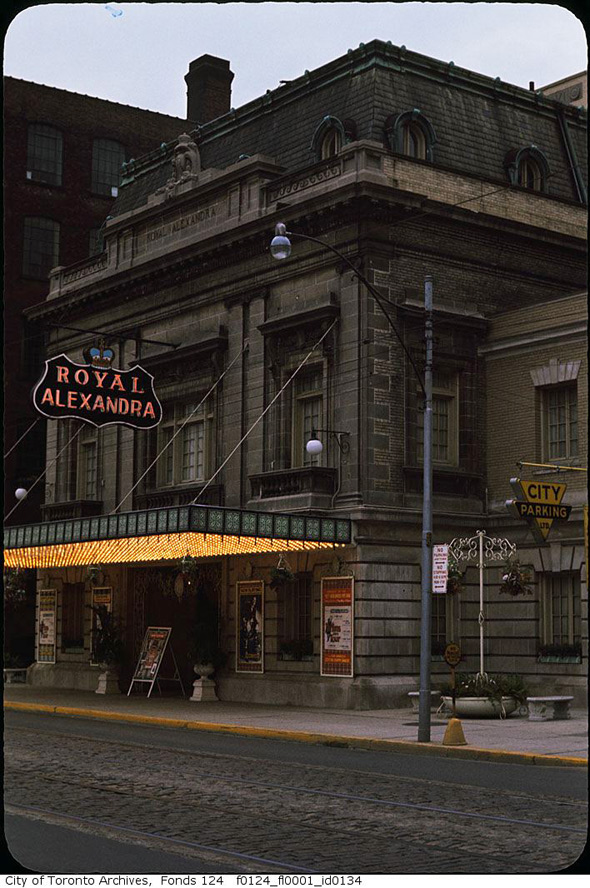
The "less cleaning due to less coal" part is not something we really think much about these days, but the older limestone buildings can really show the difference. Here's a view with the old and either pressure-washed or redone wall: https://maps.app.goo.gl/Wso9gae4JPsN6NaG6 and that's on a residential side street... Imagine getting your clothes slowly covered with it every time you go out.

That was one of the most striking differences I noticed when I saw a bunch of photos from c. 1970 of my hometown (Toronto). Everything that wasn't freshly painted was grubby in a way you don't see anymore here.

1971: https://www.blogto.com/upload/2014/03/20111020-royal-alex-f0...

2009: https://upload.wikimedia.org/wikipedia/commons/7/71/Royal_Al...

We phased out most coal in the 70s with the last eliminated in the early 2000s. I do not miss the vibrant orange sunsets in summer.

Re: What the world will be like in a hundred years (1922)

#324

Loved the poetic tone in the writing (1992). A lot less try than today’s writing. What caused writing tone to shift over the century?

People having less attention span (instant gratification), favouring utility and efficiency over aesthetics.

Re: What the world will be like in a hundred years (1922)

#325

Earlier quoted context omitted.

> the United States is still one of the most free ... countries on the planet. By what metric? More importantly by what magnitude? Would "in the top 20" count? Axross 200 world countries maybe, but to patriotic Americans who speak about freedom abstractly, knowing that they are 16th in democracy [0], 44th in press freedom [1], and 20th in economic freedom [2], probably wouldn't cut it as "one of the top". [0] https:/…

Those rankings are very biased. The press one used to penalize countries at one point for not having journalist unions (don't know if they still do). As an example, the US press was allowed to publish on the Snowden leaks but in the UK policemen forced The Guardian to smash their hard drives. UK is 11 places above the US: https://rsf.org/en/ranking/2021 The freedom ones often pick and choose freedoms. For example: no…

>The freedom ones often pick and choose freedoms.

Is there another way to index multiple countries and measure against each other?

Sounds like you might disagree with the freedoms they chose rather than the process of defining and measuring "freedom." That may be an expression of your own bias.

Re: What the world will be like in a hundred years (1922)

#326
post #159

Earlier quoted context omitted.

> Those Americans will know that it is practically certain that they will die much in the same position as the ones in which they were born. Those Americans will therefore be less enterprising and much more pleasure loving. You can see this today with the anti-work movement and the overindulgence in tv shows, movies, porn, junk food, social media, and video games. All these things are corrupting the future generation…

Some, no doubt, will choose a less creative path, but we also have evidence in history that people, who have the privilege of not worrying about their daily bread, also choose to spend their time in pursuit of sciences, arts, etc and many things not practical for them in regular employment and that advance all people.

Those activities are fine and well. I never stated anything against those things. My point, that you missed, is that an overindulgence in modern media entertainment will lead people down a spiral of short-term pleasure seeking that can compromise their long-term creative potential.

Re: What the world will be like in a hundred years (1922)

#327

Earlier quoted context omitted.

> Welcome To 2030: I Own Nothing, Have No Privacy And Life Has Never Been Better Let me translate “you are slaves and you rent everything. We base your ability to purchase on a social credit score. But we let you rent houses in our artificially limited VR world.” I don’t make much of predictions like these. It’s ALWAYS a safe bet to assume people will lose liberty. To the point the FED was created in 1913, research w…

Any attempt to depict the US as a free country prior to 1920 is a nonstarter. There was slavery, Jim Crow, and women could not vote. Seriously, give me a break.

It was a free country, for a subset of the population. I would suggest that the idea of liberty, the definition, was as worthy then as it is now. I would also completely agree with the expansion of the people who are entitled to it.

Re: What the world will be like in a hundred years (1922)

#328
Fascinating. I guess about one third of his predictions were correct. Eye-opening moments for me:

- "white countries"

- "radial energy"

- "the servant problem"

- no smoke in the house, "perhaps not even tobacco"

- "the child is likely to be taken over by the State"

- His vision of a house filled with frequently replaced disposable surfaces

- "king of Jugo-Slavia" [will still reign]

- "the American race [will become homogenous]"

- "there will be no more opportunity [in America]" but that's a good thing

Re: What the world will be like in a hundred years (1922)

#329

Earlier quoted context omitted.

> inflationary monetary policy is wealth transfer to the upper class without people realizing it. Going to need some evidence to back up that statement. Without centralized banking you essentially have no set policy one way other the other. I can understand why one would take issue with the current governance structure, but I don’t agree that letting money randomly fluctuate with no mechanisms for intervention to be…

> no set policy one way other the other Isn't that the idea of liberty though? No central authority deciding what is a "good thing" - just keeping the peace.

That's one definition of liberty, but not the only one. I'd propose the alternative: Liberty is the freedom to take actions in society as it exists. Therefore a society that had greater prosperity has greater Liberty.

You sort of admit as much, what is keeping the piece but ultimately deciding which things are good things or not?

Re: What the world will be like in a hundred years (1922)

#330
post #198

Earlier quoted context omitted.

If you think about what they didn't have in 1822 that they did have in 1922: - Radio - Movies - Motorized Rail Transit - Airplanes - Blimps - Recorded Audio - Electrification (esp. lighting) - Telephony - Cars - Subways - Fax - Early Television - Telegraph - Skyscapers - Underwater tunnels - Air Conditioning - Elevators - Modern Hospitals - Machine Guns, Tanks, Dreadnoughts and other tools of modern war - Stock Ticke…

This exact prediction was made in the 1922 article.

That's what this thread is about. Parent of my comment was disputing that prediction from the article, and I presented a counter-argument.
Post reply on HN