Live data from Hacker News

Too many new papers may mean novel ideas rarely rack up citations

blog.pnas.org

131–140 of 241 posts

Re: Too many new papers may mean novel ideas rarely rack up citations

#131
post #80
post #47

Earlier quoted context omitted.

I don't understand why consensus jumped to the conclusion that there must be a new form of undetectable matter instead trying to figure out what we don't know about gravity. Theoretical particle physics is even worse. There haven't been any advances since the 1970's. Experimental particle physics has done a great job in verifying/testing the predictions from the 1960's/1970's but theoretical physicists are stuck in a…

> I don't understand why consensus jumped to the conclusion that there must be a new form of undetectable matter instead trying to figure out what we don't know about gravity. Is it implied in "I don't understand" that "it's not understandable?" There is quite a bit of evidence that point towards dark matter and away from problems in our theories of gravity. We have direct evidence for forms of matter that do not int…

Most notably if it was just gravity then we'd expect the effect to be more homogeneous. But with dark matter distribution it isn't. The distribution of dark matter is highly non-homogeneous and acts just like matter does, creating webs and clumps. It would be weird for a field to do this, especially since fields are associated with particles (we still haven't found the graviton, which is the exception to that statement, so far. But we also don't expect to find it without a substantially larger accelerator. One that would be difficult to build on earth)
Re: Too many new papers may mean novel ideas rarely rack up citations

#132
post #129

Earlier quoted context omitted.

What do you mean there are “no constraints” on dark matter. There are plenty of constraints. I think you just have no idea what you are talking about.

For example, how much of it there can be or where it comes from. Contrast with Neutrinos. But you are correct, I don't know what I am talking about which is why my comments were phrased in the form of a question or literally with the words "I don't understand"

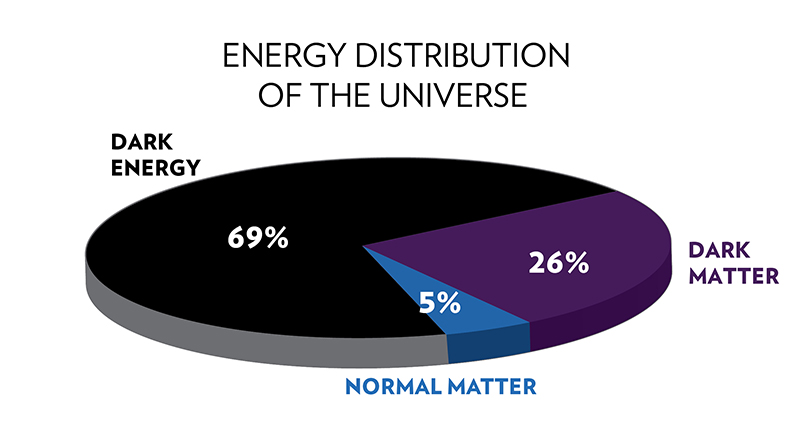
how much of it there can be

Something like this?

https://chandra.harvard.edu/xray_astro/dark_energy/chart.jpg

Re: Too many new papers may mean novel ideas rarely rack up citations

#133

Earlier quoted context omitted.

Then you don't know what normal academia is like.

I have worked in academia. I can't think of a single prof like that in my department. They exist, but that's not why people choose to spend decades of their life in poor paying jobs.

This is likewise anecdata. Experiences vary, so I don't know if I'd throw "normal academia" out there without having a full view of the sector as a whole, which few if any do.

Re: Too many new papers may mean novel ideas rarely rack up citations

#134

This article and the HN discussion (as I write this) themselves illustrate a major component of the problem, with rich irony. The full title of the article is "Is scientific progress waning? Too many new papers may mean novel ideas rarely rack up citations". As submitted, the first, generic, clause was chosen. The second, more specific clause, might at least tip off readers that there's something more afoot. The arti…

Ok, we've changed from the title to the subtitle above. Thanks!

More than 30 stories make the front page per day - how many depends on how you want to count them, but actually 30 would be the lower bound of all such numbers.

Re: Too many new papers may mean novel ideas rarely rack up citations

#135

Earlier quoted context omitted.

I have worked in academia. I can't think of a single prof like that in my department. They exist, but that's not why people choose to spend decades of their life in poor paying jobs.

This is likewise anecdata. Experiences vary, so I don't know if I'd throw "normal academia" out there without having a full view of the sector as a whole, which few if any do.

[deleted]

Re: Too many new papers may mean novel ideas rarely rack up citations

#136
post #47

One thing obvious is the breakdown between theory and experiment in physics. Newton's great accomplishment was discovering a link between terrestrial and extraterrestrial physics. Today on the large scale we see it takes multiple kinds of "dark matter" to explain the rotation of galaxies, structure of galaxy clusters, and cosmology. "Dark matter" evades any attempt to detect it on Earth. Einstein's prediction of how…

I don't understand why consensus jumped to the conclusion that there must be a new form of undetectable matter instead trying to figure out what we don't know about gravity. Theoretical particle physics is even worse. There haven't been any advances since the 1970's. Experimental particle physics has done a great job in verifying/testing the predictions from the 1960's/1970's but theoretical physicists are stuck in a…

Well you never really “see” anything, you see effects of a thing. Especially at the edges of physics where all the low hanging fruit is understood.

We see an effect which isn’t accounted for by the things we understand well and come up with several theories to explain that effect. Eventually we gather enough evidence to confirm or deny those theories and science marches on.

There are several theories as to what causes the effects that are primarily attributed to dark matter, by no means is it settled. But the theory that fits the best is that there is quite a lot of mass out there that we can only observe so far by large scale gravitational effects on matter we can see more easily.

Sure, it could be something else but a really convincing candidate hasn’t come up.

We’re in the same situation physics was in towards the end of the 19th century. It seems like physics is nearly “done” with only a handful of odds and ends left unexplained. Maybe it is, maybe we’ll get a breakthrough that opens up a whole new world of physics. It’s hard to be sure but over and over we keep probing and not really finding significant “new physics”.

Re: Too many new papers may mean novel ideas rarely rack up citations

#137

Earlier quoted context omitted.

What kind of comments does HN select for?

Shitting on academia is certainly one of them, but lets look at the merit of each comment for themselves. As someone with a lot of friends in academia, but luckily not dependent on it myself, I was quite shocked by the amount of politics, polishing, neck rubbing etc. going on. Scientists present as very clean and orderly to the outside, but the process of writing a paper and getting it published is usually super mess…

>Scientists present as very clean and orderly to the outside, but the process of writing a paper and getting it published is usually super messy.

Just like cooks!

Re: Too many new papers may mean novel ideas rarely rack up citations

#138
post #47

One thing obvious is the breakdown between theory and experiment in physics. Newton's great accomplishment was discovering a link between terrestrial and extraterrestrial physics. Today on the large scale we see it takes multiple kinds of "dark matter" to explain the rotation of galaxies, structure of galaxy clusters, and cosmology. "Dark matter" evades any attempt to detect it on Earth. Einstein's prediction of how…

I don't understand why consensus jumped to the conclusion that there must be a new form of undetectable matter instead trying to figure out what we don't know about gravity. Theoretical particle physics is even worse. There haven't been any advances since the 1970's. Experimental particle physics has done a great job in verifying/testing the predictions from the 1960's/1970's but theoretical physicists are stuck in a…

There's a lot of different data out there and a lot of different theories. The dark matter hypothesis fits a lot of the data really well with a very simple model, few extra constraints or variables.

The alternative theories don't fit the entire set of data as well. Or they do, but by choosing additional complexity, rules, constants that are chosen to make the model work, but can't be explained otherwise.

Dark matter isn't a full explanation, no doubt, but imho it's the best we have.

Re: Too many new papers may mean novel ideas rarely rack up citations

#139
post #9

I think this comes down to the growth of scientific management and technocracy in research and that bureaucracy's attempt to fight over dwindling public funding for the sciences coupled with lack of private non-commercial sources of funding. Universities are mostly made up of managers or researchers that end up acting like managers in order to justify their position. This leads to a set of bureaucratic rules for scie…

> Disagreement, the possibility to be stupid and wrong, and the ability to take random choices based on intuition are eliminated when the majority of a field acts like scientific managers. How do we democratize physical sciences in the same way as CS? My bet would be on the combination of the two (simulation) and providing the high-level tools to the masses.

By focusing on Small Science. Big Science needs big money, big equations, big machines, big careers, big meetings, etc, so big science should be last resort. Make experiments cheap, cheap enough that it becomes embarrassing not to double check. Cheap enough that half of the comments in a science article are about people doing the experiment themselves right there.

Re: Too many new papers may mean novel ideas rarely rack up citations

#140

No, it isn't waning. There are struggles, but that doesn't mean its waning. We're having massive progress in medicine, space, cosmology, environment, biology, food, transportation. Hell, the only thing that's waning is public perception of science and that seems to be a deliberate political attack.

Agreed. I only see my little corner of biology, but I am continually astonished at what is being learned. Often times the pace of learning and the diversification is such that I often don't find out about significant discoveries until a couple years after they happen, and I can still bring the ideas to others years later after that and people will say "holy crap that's amazing, I can't believe I hadn't heard of that.…

Biology is one field that seems to be making massive breakthroughs recently. On the other hand, it seems like a lot of theoretical sciences like Physics haven't have similar breakthroughs in decades.
Post reply on HN