Live data from Hacker News

Alibaba Open Source XuanTie RISC-V Cores, Introduces In-House Armv9 Server Chip

fuse.wikichip.org

131–140 of 164 posts

Re: Alibaba Open Source XuanTie RISC-V Cores, Introduces In-House Armv9 Server Chip

#131
post #5

Intel is gonna be in deep trouble in couple of years. They are the PowerPC of modern era. IDK what held them back from reimagining the architecture for less power hungry processors and tooling. With Mac mainstream switching to ARM and Microsoft doing something similar, I think within next 5 - 10 years ARM is gonna take over Intel architecture in general.

Macs are still a relatively small (but profitable) chunk of the computing world. The ground Intel has lost in desktop and mobile is more than made up for by their utter dominance in server. Intel also has a lot of plays that should bear fruit in holding or retaking ground on consumer compute in the next few years: 1) Arc GPUs. Looks like they will be seriously disruptive. 2) Hedging their process node bets by using T…

Ctrl+F'd Graviton and found disappointingly few results.

The server marketplace is shifting, slowly, but it is happening.
Re: Alibaba Open Source XuanTie RISC-V Cores, Introduces In-House Armv9 Server Chip

#132

Earlier quoted context omitted.

Macs are still a relatively small (but profitable) chunk of the computing world. The ground Intel has lost in desktop and mobile is more than made up for by their utter dominance in server. Intel also has a lot of plays that should bear fruit in holding or retaking ground on consumer compute in the next few years: 1) Arc GPUs. Looks like they will be seriously disruptive. 2) Hedging their process node bets by using T…

> 1) Arc GPUs I've been hearing the same story for 10+ yrs on how Intel is going to disrupt the GPU market any day now. For real. Remember Larrabee? It's not going to happen. Intel is not good at disruption. They're good at several things. But not disruption.

"This time fer sure, Rocky!"

Seriously. "More cache on die?" reminds me of the scene in "Smokin' Aces" ... "we did that. all of it."

Intel is ossified so totally that the top i dunno how many layers will have to be brutaly cleaved off it before the remaining pieces can hope to be productive again.

Re: Alibaba Open Source XuanTie RISC-V Cores, Introduces In-House Armv9 Server Chip

#133
post #45

Earlier quoted context omitted.

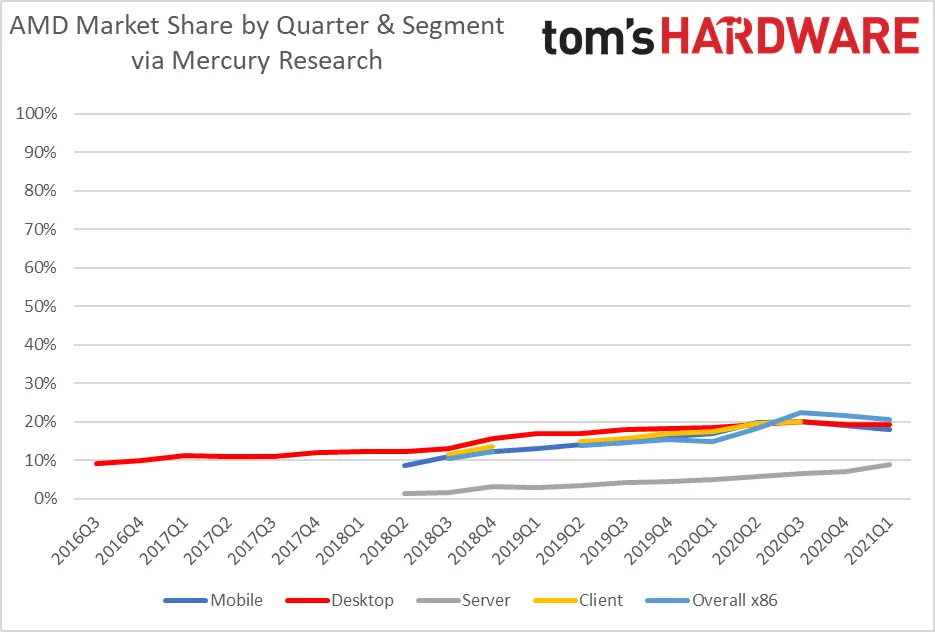
Server marketshare has been fairly sticky -- despite AMD offering low-risk, same ISA migration, and attractive pricing, the server market was relatively slow to adopt Zen.

OTOH, new HPC systems have been quick to adopt Zen in the form of dual-socket EPYC nodes. Actually if you look at the current top 10 supercomputers, only 2 are Intel. The rest are custom ARM or RISC CPUs (in Japan and China), IBM Power9, or AMD EPYC.

HPC is a special industry in that regard. HPC is know to take well managed technical risks such as building custom CPUs (A64FX in Fugaku) or using less popular architectures (SPARC, Power). If one can be certain that with enough coding hours codes can be adapted to run on those platforms and they will end up faster more exotic hardware will be bought or considered. Nation level HPC projects are not conservative, Industrial HPC maybe a bit more so.

Re: Alibaba Open Source XuanTie RISC-V Cores, Introduces In-House Armv9 Server Chip

#134

Earlier quoted context omitted.

In CPU choices, when Apple have lead (PowerPC) nobody followed. Their other CPU choices have hardly been brave. 6502? Not the first. 680x0? Followers. Intel they were way behind and all their laptop and desktop gear was a generation behind everything other companies were using. Phones bit of a mixed bag but their computing gear has always been a bit old hat since the 1980s. The M1 is the first time since PowerPC they…

https://en.m.wikipedia.org/wiki/MessagePad

Irrelevant, Palm did it better.

No one got a Newton, but every mid-boss or manager got a Palm.

Re: Alibaba Open Source XuanTie RISC-V Cores, Introduces In-House Armv9 Server Chip

#135
post #105

Earlier quoted context omitted.

Which units is that? Mine does return stuff in Euros but with a fraction.

GNU Units version 2.19 with readline, with utf8, locale en_IE and no customizations. units '500W * 1 year * 0.20/kWh' '1' would also work.

Do you have a custom ~/.units file?

    user@xirl>units '500W * 1 year * 0.20/kWh' '1'
        * 876.58128
        / 0.0011407955

Re: Alibaba Open Source XuanTie RISC-V Cores, Introduces In-House Armv9 Server Chip

#136
post #98

What does it mean by open sourcing chips? Does that mean I can bring the source to fabs and fabricate them out?

I don't think so. You still need at least "millions of dollars" and some experienced dev staff (most likely snatched from the big guys) if you plan on making anything competitive with intel, arm, or apple.

Re: Alibaba Open Source XuanTie RISC-V Cores, Introduces In-House Armv9 Server Chip

#137
post #68
post #45

Earlier quoted context omitted.

Server marketshare has been fairly sticky -- despite AMD offering low-risk, same ISA migration, and attractive pricing, the server market was relatively slow to adopt Zen.

I think this is largely just lag between orders for new xen parts and the capacity coming online. I would expect to see a lot of xen processors in fleets being built today.

> I think this is largely just lag between orders for new xen parts and the capacity coming online.

That may be a piece of it, but I think there's a little more. AMD released the first generation of Epyc processors in June 2017. They didn't see much adoption for years.[1]

[1]: https://cdn.mos.cms.futurecdn.net/vono9miWH83ZVeqRfE9CCV-970...

Re: Alibaba Open Source XuanTie RISC-V Cores, Introduces In-House Armv9 Server Chip

#138
post #5

Intel is gonna be in deep trouble in couple of years. They are the PowerPC of modern era. IDK what held them back from reimagining the architecture for less power hungry processors and tooling. With Mac mainstream switching to ARM and Microsoft doing something similar, I think within next 5 - 10 years ARM is gonna take over Intel architecture in general.

Macs are still a relatively small (but profitable) chunk of the computing world. The ground Intel has lost in desktop and mobile is more than made up for by their utter dominance in server. Intel also has a lot of plays that should bear fruit in holding or retaking ground on consumer compute in the next few years: 1) Arc GPUs. Looks like they will be seriously disruptive. 2) Hedging their process node bets by using T…

> The only magic in the wins AMD and Apple have had the last few years have been in them being effectively a manufacturing process node ahead of Intel.

Except for all the features on the chips, differing design philosophies, and peripheral interconnects, sure the only difference is manufacturing node. But what have the Romans ever done for us?

Re: Alibaba Open Source XuanTie RISC-V Cores, Introduces In-House Armv9 Server Chip

#139

Earlier quoted context omitted.

Macs are a small market, but Apple definitely sets trends. Once they adopt a technology, people "know" it works and it's safe to switch. If servers can run on cheap ARM hardware that uses less electricity and runs far cooler without much of a performance difference, that's a massive improvement. Electricity savings would more than justify a switch. Apple has shown that it's possible at the desktop/laptop level. Now t…

In CPU choices, when Apple have lead (PowerPC) nobody followed. Their other CPU choices have hardly been brave. 6502? Not the first. 680x0? Followers. Intel they were way behind and all their laptop and desktop gear was a generation behind everything other companies were using. Phones bit of a mixed bag but their computing gear has always been a bit old hat since the 1980s. The M1 is the first time since PowerPC they…

> In CPU choices, when Apple have lead (PowerPC) nobody followed.

PowerPC was developed by IBM. Apple got involved when Motorola could not deliver a faster 68k to beat Intel's 486 which was passing 50MHz. So they joined IBM along with Motorola and formed the AIM alliance (Apple, IBM, Motorola) to build better processors.

> The M1 is the first time since PowerPC they took a risk.

There's little to no risc (buh-dum-tish) in moving to Arm these days. It's a well supported and understood architecture and found everywhere.

> I really want a linux powered ARM workstation but Apple aren't going to make that.

Apple has the power to steer its own ecosystem. When AMD was working on its Arm A series server processors I kept thinking "This sounds like a backwards approach destined to fail. Why not start by making a performant Arm SoC with 2-4 cores and GPU with a TDP of 10-20W? Target it at consoles/tv/laptops/desktop computing and jump start the desktop Arm market which will naturally lead to demand for Arm servers." The Idea was an Arm SoC that could fill the gap between low power/performance Arm SoC's for mobile/embedded and the power hungry yet performant x86 chips. Basically an AMD version of the M1. That could have really changed things but the big issue AMD would face is where's the Arm Desktop software ecosystem? That's why Apple can take these "risks", they have full control over the whole stack.

Re: Alibaba Open Source XuanTie RISC-V Cores, Introduces In-House Armv9 Server Chip

#140

Earlier quoted context omitted.

Low-end ARM chips are everywhere as generic microcontrollers in things you probably only barely think about as having electronic components at all. The next vacuum cleaner I buy will probably have an ARM in it.

But that's mostly phenomenon of this new smartphone era. That market used to be completely dominated by 8bit or 16bit Atmels and PICs (an probably still is, but ARM is gaining market share fast).

It's not just smartphone knock-on, although that does help. The chips in question aren't smartphone class. When I've spoken to people about it, it's more a matter of toolchain, price, and compute power: the tools are familiar (it's just GCC, not something manufacturer-specific), at interesting volumes they're within spitting distance of the others for price, and if it turns out you need more CPU than you originally thought there's usually miles of headroom. The idea of "just go straight to ARM from the start, it's not worth bothering with microcontrollers" is the mantra they go by.

There are still a load of jobs you wouldn't do that for, but the list is short and getting shorter.

Post reply on HN