Live data from Hacker News

Yamaha DX7 Technical Analysis

ajxs.me

11–20 of 130 posts

Re: Yamaha DX7 Technical Analysis

#11
post #3

> In mathematical terms, FM synthesis is achieved by using the instantaneous amplitude of a sound wave (the modulator) to adjust the rate of change in the phase angle of another wave (the carrier). > As convoluted as this sounds, it makes more sense when visualised: [1] ...but does it?? [1] https://ajxs.me/static/img/articles/dx7_technical_analysis/f...

Idk what's going on with the modulated carrier in that image. Here's a better visualization: https://flypaper.soundfly.com/wp-content/uploads/2017/09/AM_...
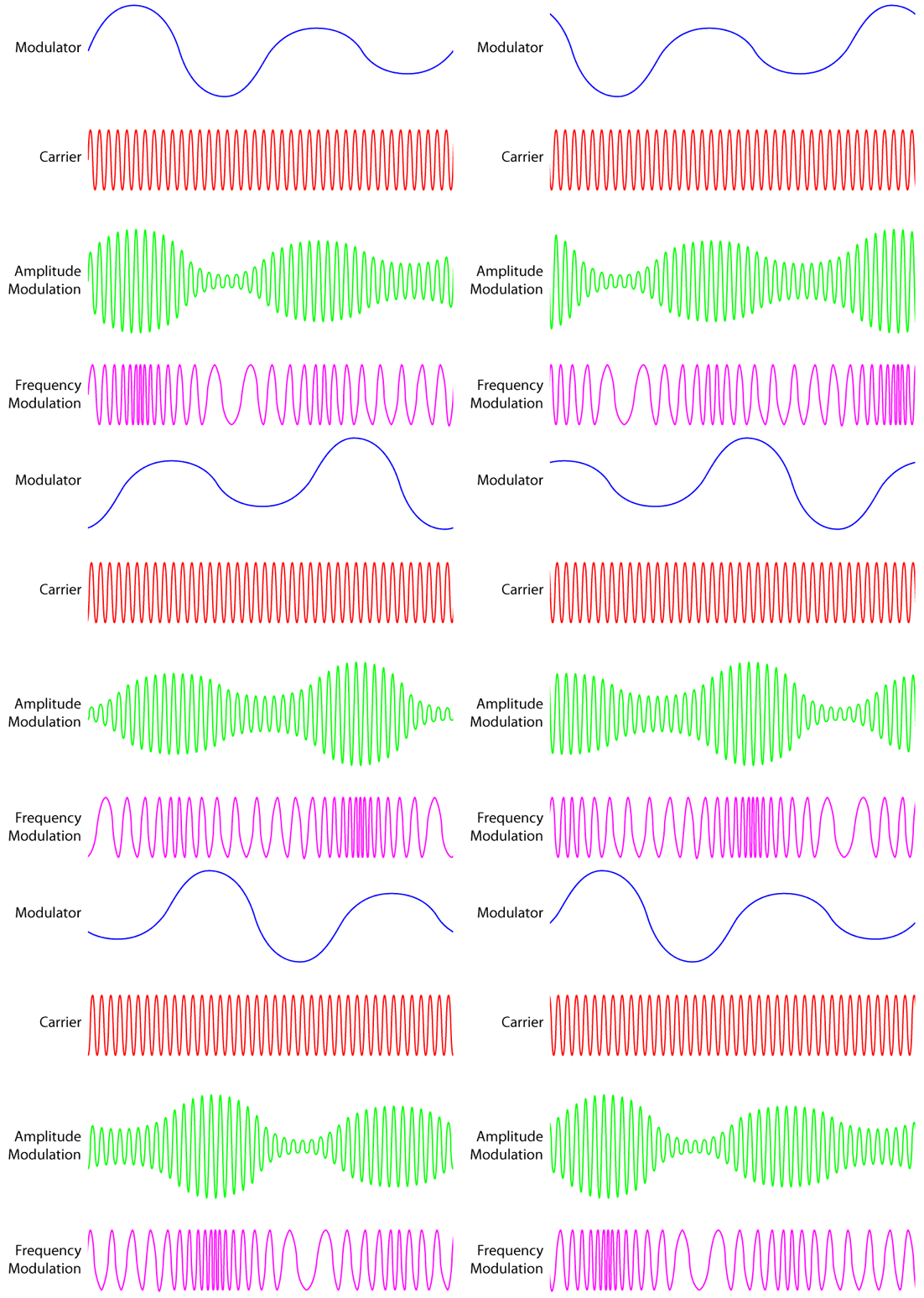
Notice how, when the modulator wave is at its top the FM wave is very short, and when the modulator wave is at its bottom the FM wave is very long.

FM = adjust the frequency (width) of the carrier based on the absolute value of the modulator.

Re: Yamaha DX7 Technical Analysis

#12
post #4

Plogue, a Canadian software company, have recently released a (software) emulation of the DX-7 in excruciating detail. Here you can see part of the trouble they went through: https://www.youtube.com/watch?v=XJ97iXQrqzw . Suffice to say that they used a logic analyzer to discover gritty details that no other analysis of the DX-7 I know has ever paid attention of.

Thank you, most interesting.

Re: Yamaha DX7 Technical Analysis

#13
post #7

Earlier quoted context omitted.

That’s amazing. How does a person learn to repair older electronics tech like that?

It's the level of tech that I grew up with so I'm not sure where you'd learn it other than just to get your hands on one and to start digging in. Very few tools required if you stick to the test-and-replace-subsystems level, a screwdriver, a good DVM, a soldering iron (a good one, preferably one that is isolated from mains), a lot of spare time and a notebook so that you can keep track of what you find and build up a…

You don't happen to have a hi-hat decay slider for an MPC60 lying around? Can't find a replacement for the life of me, and I've taken to sad attempts like this when the opportunity arises :D

Re: Yamaha DX7 Technical Analysis

#14
post #4

Plogue, a Canadian software company, have recently released a (software) emulation of the DX-7 in excruciating detail. Here you can see part of the trouble they went through: https://www.youtube.com/watch?v=XJ97iXQrqzw . Suffice to say that they used a logic analyzer to discover gritty details that no other analysis of the DX-7 I know has ever paid attention of.

Another venerable DX7 software emulation worth mentioning is the free and open source Dexed[0], which also doubles as a patch librarian for a real DX7.

[0] https://asb2m10.github.io/dexed/

Re: Yamaha DX7 Technical Analysis

#15
post #3

> In mathematical terms, FM synthesis is achieved by using the instantaneous amplitude of a sound wave (the modulator) to adjust the rate of change in the phase angle of another wave (the carrier). > As convoluted as this sounds, it makes more sense when visualised: [1] ...but does it?? [1] https://ajxs.me/static/img/articles/dx7_technical_analysis/f...

Idk what's going on with the modulated carrier in that image. Here's a better visualization: https://flypaper.soundfly.com/wp-content/uploads/2017/09/AM_... Notice how, when the modulator wave is at its top the FM wave is very short, and when the modulator wave is at its bottom the FM wave is very long. FM = adjust the frequency (width) of the carrier based on the absolute value of the modulator.

Author here: Thanks for pointing this mistake out! I'm not sure how I didn't validate this. I believe the mistake lies in the absolute value aspect of the formula. Unfortunately I can't find the script I used to create those diagrams. I've been meaning to revisit this article, and update it with some of my more recent discoveries. I'll make sure to update this when I do so!

Re: Yamaha DX7 Technical Analysis

#16
post #3

> In mathematical terms, FM synthesis is achieved by using the instantaneous amplitude of a sound wave (the modulator) to adjust the rate of change in the phase angle of another wave (the carrier). > As convoluted as this sounds, it makes more sense when visualised: [1] ...but does it?? [1] https://ajxs.me/static/img/articles/dx7_technical_analysis/f...

"rate of change of the phase angle" is just a convoluted way of saying 'frequency'

Re: Yamaha DX7 Technical Analysis

#17
post #15

Earlier quoted context omitted.

Idk what's going on with the modulated carrier in that image. Here's a better visualization: https://flypaper.soundfly.com/wp-content/uploads/2017/09/AM_... Notice how, when the modulator wave is at its top the FM wave is very short, and when the modulator wave is at its bottom the FM wave is very long. FM = adjust the frequency (width) of the carrier based on the absolute value of the modulator.

Author here: Thanks for pointing this mistake out! I'm not sure how I didn't validate this. I believe the mistake lies in the absolute value aspect of the formula. Unfortunately I can't find the script I used to create those diagrams. I've been meaning to revisit this article, and update it with some of my more recent discoveries. I'll make sure to update this when I do so!

Link to the Chowning paper[1] is broken too; hazarding a guess that neither AES nor Prof. Fessler would mind.

[1] https://web.eecs.umich.edu/~fessler/course/100/misc/chowning...

Re: Yamaha DX7 Technical Analysis

#18
post #3

> In mathematical terms, FM synthesis is achieved by using the instantaneous amplitude of a sound wave (the modulator) to adjust the rate of change in the phase angle of another wave (the carrier). > As convoluted as this sounds, it makes more sense when visualised: [1] ...but does it?? [1] https://ajxs.me/static/img/articles/dx7_technical_analysis/f...

It helps me to think of the difference between AM and FM radio.

In an AM radio signal, the frequency of the carrier is constant; the amplitude of the audio modulates the amplitude of the carrier.

In an FM radio signal, the amplitude of the audio modulates the frequency of the carrier. That's the difference!

In musical terms, I very much like some analog, and some FM, synthesizers. But certainly, back in the day, getting some rich sounds out of FM synths was a lot cheaper than analog. (Just in terms of the cost of patch cords alone ;-) Without Chowning there wouldn't have been a synthpop era!

Re: Yamaha DX7 Technical Analysis

#19
post #5

Awesome -- the DX7 had a huge musical impact.

I repair them to keep them in play, impossible to get some of the parts so I tend to use one that is too far gone to repair a number (usually three or so) of others and then I still end up with some more spares that might come in handy later. They are incredibly durable, one that I got had been in a fire but it still worked, even though more than half of the keyboard had been burned off. The mainboard went on to repa…

Only original DX7's, or also the DX7ii?

Opening up the DX7ii (and other synths from the same time) is a pain compared to the nice hinge construction you get on the original DX7.

Post reply on HN