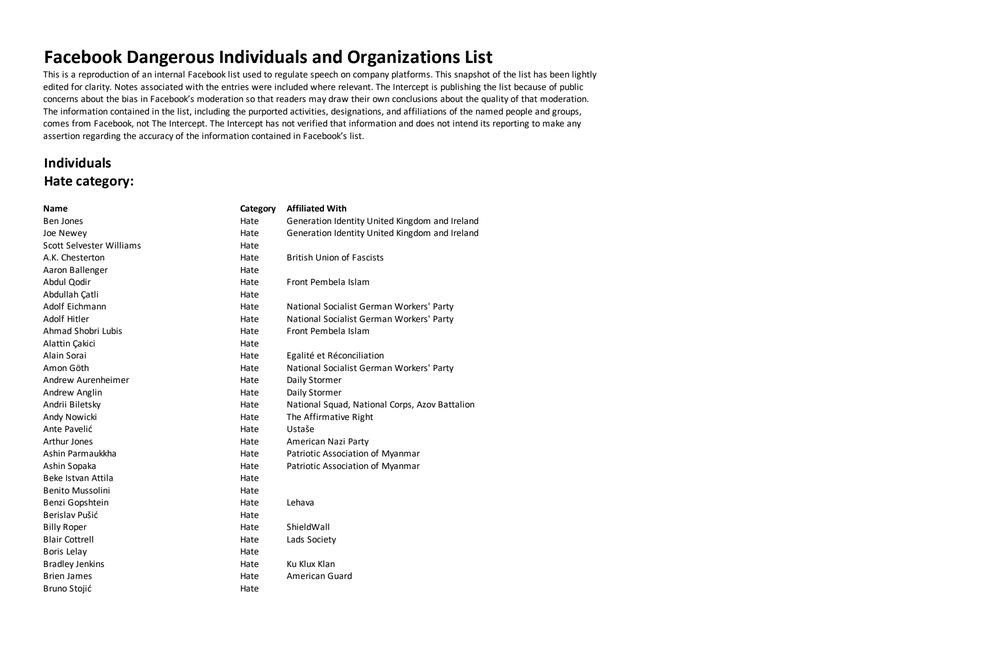
There's a lot of potential for false positives in a list like this.
"Houthis", one of the groups in the "Terror" list, is actually the name of an ethnicity in northern Yemen (which is currently in insurrection against the Saudi-backed government of Yemen). "Ammar", another, is also the name of the prostitutes' union here in Argentina, AMMAR, which is not to my knowledge a violent group (despite having had one of their leaders assassinated). "Taliban" literally means "seminary students". I'm guessing there are a lot of "Tamil Foundations for X" in India, given that there are almost 80 million Tamils in India, Sri Lanka, and Malaysia. 5 million people live in Michoacán, and any of their families would be a "familia michoacana" in Spanish. "Sureños" are people from the South, which could mean South America or the Southern United States. "Asatru" is commonly used as the term for attempted revivals of pre-Christian Scandinavian religion (you know, the one with Thor and Freya and Odin); some factions are super racist (this is why Nazi SS uniforms used the "S" rune) while others reject racism. It's easy to imagine French speakers seeking "egalité et réconciliation" without endorsing the hate group. And of course there are a number of people out there named "Ben Jones", "Arthur Jones", "Charlie Fox", "Ian Stuart", "James Mason", "Jared Taylor", "Mario Machado", "Richard Spencer", "Robert Ray", "Alejandro Estrada", "Mario Jackson", "Omar Romero", "Abdul Aziz", "Abdul Jabbar", "Hafiz Saeed", "Mohammad Hejazi", "Mohammed Omar", and "Omar Hussain", and any of the numerous Hassans from Baghdad could reasonably be called "Hassan al-Baghdadi".
In many cases the names on the list are of people who died many generations ago, so the evident intent is not even to prevent them from setting up Facebook accounts, but to prevent others from discussing them on Facebook; that is, to suppress comments like this one.
— ⁂ —
However, aside from questions of false positives, the broader issue is that nominally the issue over which the Cold War was fought was over whether to have such a list of prohibited groups and dangerous individuals whose voice was too dangerous to allow people to hear it, or subjects too dangerous to allow people to discuss them; the USSR argued that it was essential, the US that it was intolerable, in both cases somewhat inconsistently. This theory of liberalism was fundamental to the foundation of the US — not, as some would argue, as a mere limitation on government action, but as a fundamental aspect of what distinguishes a good society from a bad one.
So it's disquieting to see liberalism so thoroughly rejected by modern centralized communications media.