Live data from Hacker News

In 2009, Two Nuclear Submarines Collided Under the Sea (2016)

nationalinterest.org

51–60 of 108 posts

Re: In 2009, Two Nuclear Submarines Collided Under the Sea (2016)

#51

Pie in the sky ideas here... but how far is active sonar effective for? Can you launch a probe that enables active sonar some 50-100 miles away, and radios the results back? Or would the depth prevent any type of radio communication...or is active sonar not that long-range? This whole field is really fascinating to think about.

The effective range of active sonar varies tremendously based on many factors: power output, microphone sensitivity, signal processing, bottom contour, water temperature, ambient noise, etc. There is no typical range. Aircraft can drop active sonobuoys but they're very expensive and in limited supply. Use of active sonar is restricted in many areas due to impact on marine life.

Water blocks all radio traffic except for extremely low frequency. The bandwidth on that is too low to use as an effective navigation aid, and transmissions can only be sent from large facilities on land. Some submarines can also send up floating antennas on towed buoys but they prefer not to do so due to the risks of detection and entanglement.
Re: In 2009, Two Nuclear Submarines Collided Under the Sea (2016)

#52
post #13

Earlier quoted context omitted.

Sounds like the FAA altitude problem all over again. As altimeters got more accurate, the odds that you were flying at exactly 28000 feet went up. If an air traffic controller fucks up and puts two planes at 28000ft, they can now collide because they're ±10ft instead of ±200ft. That was the RCA of that mid-air collision over Brazil a while back. The more you try to control a thing the more problems you can have. A pa…

These days there are special collision avoidance systems on big commercial planes: TCAS II provides the pilot with specific instructions on how to avoid the conflict with traffic. These instructions are known as a “Resolution Advisory” (RA) and may instruct the pilot to descend, climb, or adjust vertical speed. TCAS II systems are also able to communicate with each other to ensure that the RA provided to each aircraf…

TCAS does not work if your transponder (or theirs) is off, which is how that collision in Brazil happened.

https://en.wikipedia.org/wiki/Gol_Transportes_A%C3%A9reos_Fl...

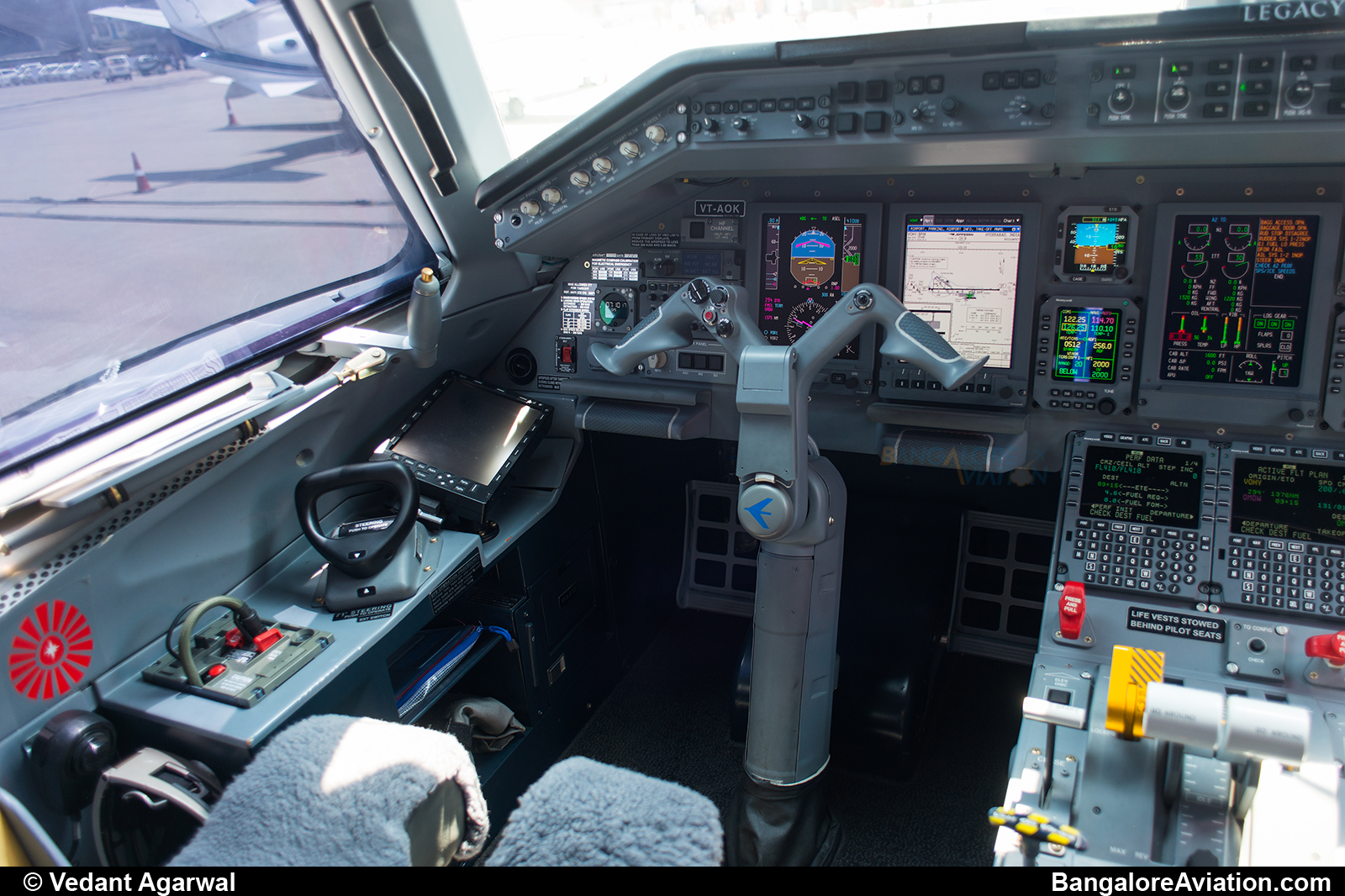
The Legacy's pilot footrest places the end of your shoes dangerously close to the transponder standby button.

https://www.bangaloreaviation.com/wp-content/uploads/2014/04...

The footrest is below the white screen with the navigational chart on it. The radio and transponder panel is the black screen to the right of that, with the yellow and green text on it. The 0512 is your transponder code (squawk); the button to the left of that and down one row turns it off.

This resulted in the Legacy losing its TCAS ability, and the 737 it collided with being unable to see the Legacy.

Re: In 2009, Two Nuclear Submarines Collided Under the Sea (2016)

#53
post #38

Earlier quoted context omitted.

How would the proximity sensors work? The can’t go active sonar…

Optical, perhaps? How much light is at these depths? How do the subs avoid terrain?

Subs avoid terrain using charts and dead reckoning, including inertial navigation systems. They typically come to periscope depth occasionally to get a navigational fix. In 2005 a US submarine allided with an underwater mountain due to a navigational error.

https://www.cbsnews.com/news/whos-to-blame-for-sub-accident/

There is little or no light at typical operating depths. Lidar can work to a limited extent in some water conditions but it's not something to rely upon for collision avoidance.

Re: In 2009, Two Nuclear Submarines Collided Under the Sea (2016)

#54
post #29

Earlier quoted context omitted.

Surely not. The submarine with the larger more sensitive instruments in a quieter environment ought to be able to detect sound levels below that which their active opposition can. If X amount of noise-energy hits the submarine, it only reflects Y Both of these weigh in favor of the submarine detecting the searcher before the searcher detects the submarine.

... so the sub discovers the active buoy 0.66 seconds sooner for every kilometer of distance between them. I don't imagine that knowing you'll be detected 40 seconds before they know you've been detected changes the tactical situation a whole lot.

No, nothing I was talking about was related to the speed of sound in water (which is where I assume you're getting 0.66 seconds/km, since it's about right). I agree the speed of signal propagation seems unlikely to matter much in most situations.

Re: In 2009, Two Nuclear Submarines Collided Under the Sea (2016)

#55
post #47
post #29

Earlier quoted context omitted.

Surely not. The submarine with the larger more sensitive instruments in a quieter environment ought to be able to detect sound levels below that which their active opposition can. If X amount of noise-energy hits the submarine, it only reflects Y Both of these weigh in favor of the submarine detecting the searcher before the searcher detects the submarine.

I'm fully willing to admit I'm talking out my ass here, but does it not make sense to assume that both a) the active drones are going to be much faster than a submarine trying to maintain silence, and b) there are likely to be many drones converging from different directions if they're searching a known submarine parking spot? Still seems like advantage drones to me

I'm not more of an expert of submarine tactics than you are, I was just taking issue with the physical claim that they already know where you are by the time you hear them.

Re: In 2009, Two Nuclear Submarines Collided Under the Sea (2016)

#56
post #54

Earlier quoted context omitted.

... so the sub discovers the active buoy 0.66 seconds sooner for every kilometer of distance between them. I don't imagine that knowing you'll be detected 40 seconds before they know you've been detected changes the tactical situation a whole lot.

No, nothing I was talking about was related to the speed of sound in water (which is where I assume you're getting 0.66 seconds/km, since it's about right). I agree the speed of signal propagation seems unlikely to matter much in most situations.

My point is in this scenario there's no appreciable difference between "if you can hear them, they've already found you" and "if you can hear them, they'll find you in 40 seconds"

The observation that they are "detecting the searcher before the searcher detects the submarine" is academic and inconsequential when we're talking about such a negligible amount of time between detections.

Re: In 2009, Two Nuclear Submarines Collided Under the Sea (2016)

#57
post #54

Earlier quoted context omitted.

No, nothing I was talking about was related to the speed of sound in water (which is where I assume you're getting 0.66 seconds/km, since it's about right). I agree the speed of signal propagation seems unlikely to matter much in most situations.

My point is in this scenario there's no appreciable difference between "if you can hear them, they've already found you" and "if you can hear them, they'll find you in 40 seconds" The observation that they are "detecting the searcher before the searcher detects the submarine" is academic and inconsequential when we're talking about such a negligible amount of time between detections.

But there is an appreciable difference between "if you can hear them, they've already found you", and "if you can hear them, they might never find you because you can see them looking from farther away than they can see, and they might just be outright searching the wrong area".

All my arguments went to the latter kind of problem, not the former. Your 40 seconds number seems to be based on the speed of signal propagation, not the range at which things can be detected.

Even in the event where they do find you, the arguments I gave would suggest that it would take vastly longer than the speed of signal propogation to do so, because they would have to move closer to you. Giving you substantially more notice than 40 seconds.

Re: In 2009, Two Nuclear Submarines Collided Under the Sea (2016)

#58
post #38

Earlier quoted context omitted.

> ...They're basically swimming blind. It did appear just like that. Shouldn't there be some proximity sensors to avert collisions with massive bodies? After all in the aftermath both subs were rendered mission incapable.

How would the proximity sensors work? The can’t go active sonar…

Low power high freq radio waves? These should rapidly attenuate underwater, so not much of giveaway, but could be enough for proximity scans around the sub.

Is there some spectrum of emissions from an even stealthy sub, some kind of "local presence"? The immediate massive obstacles would result in distortions to such a self-presence profile. So the sensors could be trained to detect such local distortions, almost like some fish have a lateral line of nerves supposedly helping detect current flows etc. [1].

[1]:https://en.m.wikipedia.org/wiki/Lateral_line

Re: In 2009, Two Nuclear Submarines Collided Under the Sea (2016)

#59
post #57

Earlier quoted context omitted.

My point is in this scenario there's no appreciable difference between "if you can hear them, they've already found you" and "if you can hear them, they'll find you in 40 seconds" The observation that they are "detecting the searcher before the searcher detects the submarine" is academic and inconsequential when we're talking about such a negligible amount of time between detections.

But there is an appreciable difference between "if you can hear them, they've already found you", and "if you can hear them, they might never find you because you can see them looking from farther away than they can see, and they might just be outright searching the wrong area". All my arguments went to the latter kind of problem, not the former. Your 40 seconds number seems to be based on the speed of signal propaga…

I see where you're coming from. Good points.

I was taking it for granted that knowing the location of an unmanned, expendable sonar buoy or probe before you're discovered is not tactically important.

Now that you have me thinking, it would clearly allow you to stay out of detection range if you had the good fortune for their pings to initiate within your detection range but outside theirs.

Re: In 2009, Two Nuclear Submarines Collided Under the Sea (2016)

#60

Earlier quoted context omitted.

Let me get this straight - there's a technique for detecting changes in the surface temperature of the water from a submarine that's probably hundreds of meters below the surface?

Yes. There are also magnetic anomaly detectors (MAD) and various wake detection approaches. Do these work all always? Probably not. But they work often enough to be researched and used. https://m.youtube.com/channel/UC9bMgCQyFNaMPsK9GtzM5dQ is a good starting point.

That's an entire YouTube channel. Where in this mess of videos can I find a reference to thermal detection of submerged submarines, please?
Post reply on HN