Live data from Hacker News

Observation-based early-warning signals for a collapse of the Gulf Stream

theguardian.com

311–320 of 441 posts

Re: Observation-based early-warning signals for a collapse of the Gulf Stream

#311
post #236
post #177

Earlier quoted context omitted.

There is simply no simple way to address Climate Change like there was with CFC's in the 90s. - 1/3 of emissions come China which has an autocratic leadership accountable neither to its people or the global community. - 70% of emissions come from energy consumption. 35% of all emissions is electricity and heat, and another 15% is construction + manufacturing. - Even if every mode of transportation was fully electric…

Revenue neutral carbon taxes are by far the best solution. They’re in fact very progressive - the poor consume less than the rich, and rich “hobbies” have greater proportional CO2 emissions - think supercars, yachting, flying business or private. So the poor will receive more in CO2 “income” than they’ll pay in CO2 tax. The only difficulty is border control - how to prevent manufacturers simply escaping to CO2-tax-fr…

Revenue neutral is a campaign slogan and nothing close to the policies that are typically put forward. I'm not saying there is no such thing as revenue neutral carbon tax, but when the rubber hits the road, revenue neutral on the campaign trail becomes a normal tax with a few token rebates.

In the higher up the income distribution the percentage of a person's income spent on consumption decreases, as highest earners typically put their money into wealth generating assets. So a smaller percentage of their income is actually taxed.

If you make 30k a year, you are spending everything you make on essentials. They're for the full amount of your earnings will be taxed by any consumption tax. If you make 300K a year, even if you spend 2/3 of it on consumption you are still being taxed at a lower rate.
Re: Observation-based early-warning signals for a collapse of the Gulf Stream

#312

Earlier quoted context omitted.

What I've done: - designed and built a house on renewable energy - designed and built a windmill Unfortunately both of these I have had to abandon, the former because it is on the wrong continent compared to where I am today, the latter because of permitting hassles. - I do have the maximum surface of the roof covered in solar panels, a good 2500W peak. - transport myself everywhere I can using bicycle / e-bike ( - e…

The only thing that would actually make a difference is going full nuclear. But the greens put a stop to that, so I find it hard to take them - and anyone else who, like you, writes paragraphs about things that in reality do not matter - seriously.

This is a very naive view of things, which given your comment history (inane one-liners without even a short moment to compose something more substantial and with more thought about it) seems to be your model.

Going 'full nuclear' without capping the per-capita energy budget is still going to release a very large amount of energy. Besides that heating in many places is based on natural gas. Then there is the per kilo-watt hour cost of nuclear energy which is way higher than solar or wind when taken over the full lifetime of the installation including the eventual cleanup / disposal.

Nuclear energy is an option but it isn't the only option and it has serious drawbacks, just like every other option on the table today.

The best thing we can do is to limit our consumption. But that's easy to say from the point of view of the developed world, where consumption is excessive. It will be more than offset by the developing countries gains leaving us with a situation that is net worse than things are today even if we do our best. This is not a simple problem and naive one sentence solutions are not going to get us to a sustainable situation.

Re: Observation-based early-warning signals for a collapse of the Gulf Stream

#313
post #292

Earlier quoted context omitted.

Number of trees is a bad metric, you need to know the amount of area available for gas exchange, which takes a long time to build up after a clearcut and 'old growth' forest is a complete ecosystem, something which a young planted forest can only aspire to become one day. And that's before we get into the hardwood vs softwood differences in growth speed.

If you’re trying to sequester carbon, fast (new) growth and softwood is the way to go correct?

In the short term: yes, but it is rather less dense than hardwood so you'll end up with a lot more acreage.

Poplar/Maple/Oak/Pine are all good options, with the slow growers storing the carbon for the longest time, and even when not harvested they won't rot nearly as fast (rot is best looked at as slow burning in this context).

And then not to harvest them until they die of 'natural causes', hopefully not a forest fire.

Re: Observation-based early-warning signals for a collapse of the Gulf Stream

#314

Earlier quoted context omitted.

The number of dimensions along which we are destroying the habitat we depend on is staggering. Deforestation (killing off one of the most efficient carbon sinks, causing soil erosion, changing the albedo, habitat destruction, change in water management), CO2 emissions, methane emissions, a ridiculously high per-capita energy budget in the western world where the only cap is how much money you are willing to spend, ki…

> one of the most efficient carbon sinks I thought forests tended to be pretty much neutral once they get old enough for trees to start dying and decomposing.

There are quite a few species that produce wood that won't decompose nearly as fast as it grew, and we are a good 100 years away from reaching that limit for newly planted forests.

Re: Observation-based early-warning signals for a collapse of the Gulf Stream

#315

Before someone makes the inevitable joke, no this will not help offset climate change temperature gains and neutralize the risk of heat-waves. The summer temperatures will continue to get hotter. It's the winter temperatures that will get colder. Both require energy use to keep housing liveable. Which, unless we dramatically transition our energy generation to renewables, will just continue exacerbating the climate p…

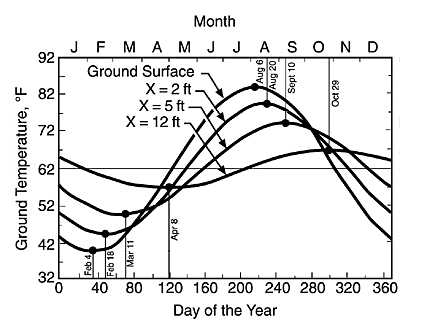
I recall reading that temperatures 12 feet underground range between 55F and 65F (13-18C) year around. Found this chart [ https://www.builditsolar.com/Projects/Cooling/time-lag-vs-de... ] which suggests that's true with a ground-temp range of 42F to 82F (6-27C). And then there's Coober Pedy, which enjoys a 104F temp swing each year.

If/when things get dire, there's always underground (moving into new digs). Those cities in Turkey are getting easier to understand.

Re: Observation-based early-warning signals for a collapse of the Gulf Stream

#316
post #256

Earlier quoted context omitted.

I agree, humanity is just not equipped to deal with this crisis. We are not organized or disciplined enough. There are too many competing interests and whats worse, the problems are not human scale. (Meaning that people won't see the benefits of their sacrifices in their own lifetimes) If I were a wealthy silicon valley type guy I would be looking closely at the Biosphere 2 project from the 80s and other closed ecosy…

I'd be surprised if any 'secret ecosystem projects' don't suffer the same fate as the Biospheres. Namely, catastrophic systemic collapse within a relativity short timescale brought on by an unmitigated pathogen.

The main reason those projects failed was quite simple: they were too small. Make it large enough, limit occupancy and stand back and nature will figure out a way to make it work, it doesn't need engineering, it needs scale and patience. After all, a planet is exactly that: a closed cycle biosphere that somehow balances itself if we don't mess too much with it.

Re: Observation-based early-warning signals for a collapse of the Gulf Stream

#317

Earlier quoted context omitted.

> The global response to Covid-19 is much better than could reasonably have been expected before the event. We're going to have to disagree on that. I read a couple of books on the subject pre-pandemic and I thought we were in good shape because the science was well understood. I had not calculated in politics, my bad. > We don't have 10% of the world's population dead, collapsed major cities due to core services fai…

I think it's completely fair to say that the death toll from COVID could have been much lower up to this point, and it also could have been much higher. In spite of the political divides, there was a lot of collective action across the globe to mitigate the effects of the pandemic, and I wish people wouldn't dismiss that for the sake of cynicism.

Fair enough. I was - still am - in the act early and decisively camp, and got shouted down by the people who felt that that would affect their preferred lifestyle too much and it still grates. But you have a good point, it could have been much worse. At the same time: this isn't over yet and it may still get much worse, we are still at 2/3rds of the peak more and more nasty strains of the virus keep popping up.

When a virus jumps species there is a chance that it will evolve into more benign species over time, unfortunately COVID seems to be going in the other direction, it is getting better at infecting us and doing more damage to allow itself to spread better. And our slow-walking of counter measures has created an ideal environment with just enough selection pressure to evolve some even nastier strains.

On a global scale this is far from over, and there is a very good chance that the places that are now breathing a sigh of relief are going to be hit hard by later waves of more dangerous versions of this virus.

So 'mitigate' is a word that is best used retrospectively.

Re: Observation-based early-warning signals for a collapse of the Gulf Stream

#318
post #136

Earlier quoted context omitted.

Northern Europe doesn't have ownership of Southern Europe, so they may not be comparable in the sense that habitability is somewhat subjective in the age of modern logistics.

That’s the thing. Growing food may be tough up there, but otherwise you can still have thriving cities if you have the capital to build appropriate infrastructure.

And are willing to spend a very high amount of energy per person.

Re: Observation-based early-warning signals for a collapse of the Gulf Stream

#319

Since we can’t get global cooperation on this, I think geo-engineering for reduced solar absorption is something to seriously consider.

So, because we can't get global cooperation on this we will have to engage in a global program?

Re: Observation-based early-warning signals for a collapse of the Gulf Stream

#320

Solutions to climate change are not behavioral as some suggest here. It’s about incentives. Transitioning to carbon neutral energy is possible at the expense of businesses’ cost structure, ie. less competitive. Same applies to building retrofitting, agriculture and other major carbon emitters. There is no serious conversation about climate change without looking at nuclear energy; it is base load generation (24/7), c…

"Bipartisan federal mandates to scale nuclear energy is the only real solution to this problem"

Where to start? Bipartisan implies 'America', which is not 'the world'.

Scaling up nuclear energy implies even more energy consumption rather than to do the obvious: shut down coal and gas fired plants and cap the per capita energy budget to something reasonable.

Finally, nuclear instead of solar/wind is going to push yet another problem down to future generations.

Post reply on HN