Live data from Hacker News

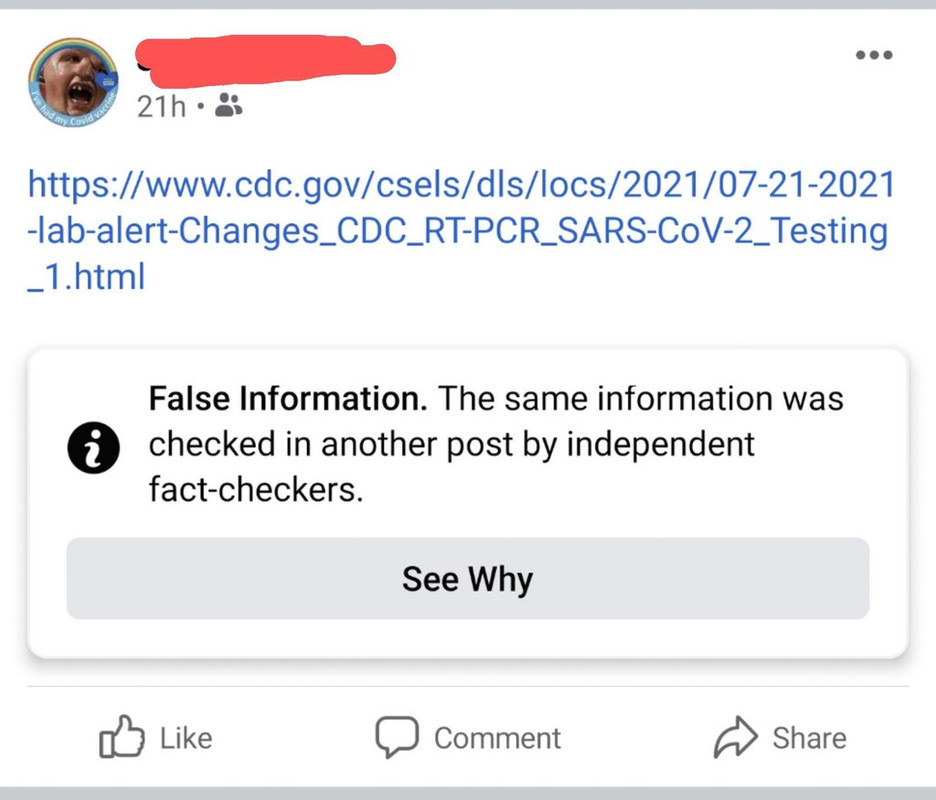
Facebook is now claiming official CDC.gov links are “False Information”

i.postimg.cc

621–630 of 654 posts

Re: Facebook is now claiming official CDC.gov links are “False Information”

#621

Earlier quoted context omitted.

I don’t find it very persuasive for people to baldly post “that’s different” when my whole idea is that the line between these things is not so bright as we like to imagine.

>the line between these things is not so bright as we like to imagine In practice, the line exists, whether or not it's clear to you, it is clear to Facebook, because they already (and always will) act differently depending on their judgment of which side something falls on. There are things that are totally outside the pale, and then there is the practice of curating peoples' feeds amongst the stuff that is allowed.…

So we're not disputing the principle at all but merely arguing over the degrees to which it should be applied. QED.

Re: Facebook is now claiming official CDC.gov links are “False Information”

#622

Earlier quoted context omitted.

A lot of people do say that but I frankly don’t believe them when they say it. It’s well known inside and outside of technology that customer descriptions of their own behavior are often far out of step with reality and I think people would find Facebook less engaging and fun to use if it didn’t tune what it showed them based on their perceived interests and their activity. I would guess most people are friends with…

> It’s well known inside and outside of technology that customer descriptions of their own behavior are often far out of step with reality How do you get from "people may not be reliable witnesses of their own preferences" to "I know their preferences better"? The first doesn't sound that improbable, but the second is a non sequitur, even if a popular one. If it's easy to lie to yourself, doesn't that suggest it's ev…

The rational argument is pretty simple. They have data about what things you click on, comment on, react to, etc., and use these to show you more similar things and show you fewer things you just scroll past. I'm not sure how you argue against what seems like pretty objective data.

Re: Facebook is now claiming official CDC.gov links are “False Information”

#623

Earlier quoted context omitted.

Do you never use features like groups and pages?

I mostly don't, but there is still a disconnect here. Who wants to not know the sort of group they belong to? Censoring things that are not acceptable at all is different from censoring (or reordering) things that are determined to be sub-optimal for a particular person to see, that come from members of the group who are not going to be banned. Which is really the topic here?

So if you go to a listing of groups, without some active curation, how do you prevent it from being that kind of content, or hate groups, or other undesirable content? The standard gets real blurry real fast.

Re: Facebook is now claiming official CDC.gov links are “False Information”

#624
post #567

Earlier quoted context omitted.

You can generally trace it back to someone they know on Facebook or Tucker Carlson. I’d say the side effects are real and they should be given adequate rest to recover.

You can generally trace it back to someone they know on Facebook or Tucker Carlson. Dems would serve themselves better by not trying to point fingers on where to aim the ban cannon. This is only going to cause more mistrust. Actually visit the areas with hesitancy, then come back and see if you say the same. I know some 100 people that are hesitant. Not a one of them are on FB, nor listen to anything FOX puts out. It…

I’ve done 15 12 hour shifts at vaccine clinics, designed clinics around the country, and regularly talk with unvaccinated individuals but thanks for the advice.

Re: Facebook is now claiming official CDC.gov links are “False Information”

#625
post #568

Earlier quoted context omitted.

It's a much bigger problem than than merely content promotion and aggregation. There are countries where Facebook is the entire internet. Maybe they tried to make it happen and maybe they didn't - but however it happened, they are effectively the Ministry of Information now for that country. They probably shouldn't be. Everyone agrees on this, even them. But like the child-kings of history, it is still the situation.…

Regarding the Ministry of Information concept, I recently realized that one potential motivation for the large-scale end-to-end encryption agenda is to move the "keys to the kingdom" for the world's trillions of chat messages (and attached media) to end-user devices, *and* loudly signal that this shift has taken place by taking advantage of the very loud minority of security-conscious folks that implicitly trust and…

I don't think Facebook literally thinks they're a web site -- I think they know something extraordinary is going on. Probably much better than I do. But I do know that what they set out to do, and what they found themselves doing, are very different, and the head shift has been difficult. This is why, when people come to them with questions and requests and complaints that seem a little more appropriate to ask a judge or monarch or a legislature, they make expedient and historically and politically short-sighted decisions. They don't recognize them as questions of political philosophy, opportunities to think about the right way to architect a global community. They don't even draw on the considerable existing wisdom we have about how governments should work. They fumblingly reinvent ideas from ancient Babylon so they can get back to doing what they think they do and what they want to do.

It's hard to blame them. The head shift is difficult. They didn't ask for this responsibility, and finding themselves at the wheel of something enormous they aren't qualified to pilot, shrink from the task. Any sane person would. I only write about it here in the hopes that we all can start taking these problems seriously. How should a global information community work?

It's not literally true that Facebook is a branch of government, either. It's just the closest analogy I have, and it's closer to the truth than where we started. Really, they are something new. Something nobody knows how to manage correctly yet. I am not the only one to understand that the stakes are high, which is why people keep passing the buck. Facebook wants the government to tell them what's expected and allowed, and the government refuses -- or acts in small-minded expedient ways, too. They don't know either.

This disinformation and censorship question is one of a hundred with deep philosophical and legal elements. What Facebook thinks about the value of free speech, how they decide disputes should be adjudicated, what they do in small cases of deception and fraud and political manipulation, actually matters a lot more to us practically than what our own laws say. This is a shame, because our legal thinkers actually have a lot more experience with being wise and just when it comes to such matters. Facebook has the power to set policy in a way no one ever has before, and they do not seem to be thinking in terms of implications for humanity. They seem to be thinking in terms of how to get people off their back because this sort of thing isn't what they do. Or perhaps more charitably, because the people coming to them with problems are so terrifyingly powerful and the problems are so terrifyingly high stakes. There have been complaints about minor changes in advertising policy throwing elections in far-flung countries. Would you want that responsibility?

This is why I say we need a Thomas Jefferson. What I really mean is, we need a political philosopher who sees the moment and its dangers and opportunities clearly, and can try to help us do things fairly and right. I don't know where you'd find one, though.

You're right that it isn't as easy as that -- people's expectations play into it. Governments', yes, and people's too. While I say Twitter should be creating a legislature and courts and a constitution, we'd all think they were insanely arrogant to do so. Even though now that I say it, you can probably see that it probably is getting to the point where that's needed. But they aren't ready for it and we aren't either -- inertia and expectations. A Thomas Paine could fix that. I don't know where you'd find one of those, either.

We are at a time of great change in history. The information revolution is in full swing. The internet had been a tool for research, then a toy for nerds, then a novel technology full of opportunity. Now it is changing the way society organizes itself. Some people think these digital communities will supplant nations, or exist alongside as something equally important. I don't know. I suspect the change is as profound as the one that ended the middle ages, when we transitioned from the church as a primary social organization to nations. But living in the middle of history, who's to say?

It took us a while to figure out how to run nations, too. We really shouldn't expect too much for a generation or two at least.

My main hope in writing this is to encourage people to take the problem seriously, and think of it as belonging to the space of political philosophy -- which it does. If you work for one of these organizations, learn something about the history and philosophy of government -- why we have laws, why we have courts, why we have elections, why we have bills of rights. You are running a community bigger and more diverse than any nation, with totally novel powers and limitations, totally novel ways to be unfair and evil that you need to avoid, and you do not have the resources to do it right, nor can anyone even tell you what doing it right even looks like. It has to be invented. Get help -- from history, from scholars, from anywhere you find it. If you find Thomas Jefferson living under a rock, hire him immediately.

The rest of us are living under the feet of a giant struggling while trying to carry far too many boulders. We yelp when he steps on us -- and we should -- but we should also be trying to figure out if we can build something that will help carry that load. The boulders are there regardless and the guy is hardly up to the task. Running massive communities fairly is hard and complicated. We need widsom and principled understanding. Attacking the overwhelmed monarch is not how you get peace and justice -- you get that by finding him advisors and engineers that can help him build it.

The situation as it stands is untenable. We need a better way. But until we have one, the situation is what it is and we should help the poor guy stuck managing it.
Re: Facebook is now claiming official CDC.gov links are “False Information”

#626

Earlier quoted context omitted.

>the line between these things is not so bright as we like to imagine In practice, the line exists, whether or not it's clear to you, it is clear to Facebook, because they already (and always will) act differently depending on their judgment of which side something falls on. There are things that are totally outside the pale, and then there is the practice of curating peoples' feeds amongst the stuff that is allowed.…

So we're not disputing the principle at all but merely arguing over the degrees to which it should be applied. QED.

What principle? Are you saying you weren't disputing the principle that there are two different kinds of things that people call "censorship", in practice and in theory?

It is a difference in kind, not degree.

You can have an arbitrary number of rules, enforced by human and machine, for acceptable behavior in a forum. I think that's basically the case on HN or reddit.

But if you have an optimizer that filters and reorders things on top of that, then any particular item that is moved or removed is not against any rule. And nobody can really say why, even if they are informed of what happened.

The latter thing is what many people, including me, think is terrible, and the distinction is not fuzzy even if you can call it all "censorship" or "curation".

Re: Facebook is now claiming official CDC.gov links are “False Information”

#627

Earlier quoted context omitted.

> It’s well known inside and outside of technology that customer descriptions of their own behavior are often far out of step with reality How do you get from "people may not be reliable witnesses of their own preferences" to "I know their preferences better"? The first doesn't sound that improbable, but the second is a non sequitur, even if a popular one. If it's easy to lie to yourself, doesn't that suggest it's ev…

The rational argument is pretty simple. They have data about what things you click on, comment on, react to, etc., and use these to show you more similar things and show you fewer things you just scroll past. I'm not sure how you argue against what seems like pretty objective data.

>I'm not sure how you argue against what seems like pretty objective data.

I commend you for crystallizing the argument which I think is indeed representative of what the industry believes about itself and many others reject.

Virtually everything in computing, or the real world, for that matter, is solving some sort of optimization problem, explicitly or implicitly.

I'd paraphrase your comments as, Facebook solves an optimization problem, they make billions of dollars doing it, so it is objectively the optimum.

There are two objections I think that capture most of the opposition.

  - Real optimizers can't promise a true optimum every time; they sometimes converge on a local optimum. This local optimum may not be within any particular distance from the global optimum either.

  - "Fewer things you just scroll past" is not necessarily what the *user* wants to optimize. It is not in fact what I want to optimize. I'm not sure if I made it clear, but the *existence* of things that I don't actually read is important contextual information. So is the relative order, the timing, the source...
These points are really abstract and general - virtually anything can have these two issues - they're not optimizing the right thing, and they're not finding the global optimum.

I think non technical people sometimes get angry because they intuitively feel that people claim objectivity without justification, but I think it's possible to provide a bloodless, abstract, logical, and specific critique more suitable for a software engineer's mentality, and that's what I tried to do above.

[One other general issue I thought of - optimizers can have the wrong constraints; everything in life normally has rules and limits on how you can pursue a goal. The ends don't necessarily justify the means. So this is another thing that is not covered by simply saying the optimizer produces the optimum]

[This topic makes me think of: https://en.wikipedia.org/wiki/With_Folded_Hands]

Re: Facebook is now claiming official CDC.gov links are “False Information”

#628

Earlier quoted context omitted.

I mostly don't, but there is still a disconnect here. Who wants to not know the sort of group they belong to? Censoring things that are not acceptable at all is different from censoring (or reordering) things that are determined to be sub-optimal for a particular person to see, that come from members of the group who are not going to be banned. Which is really the topic here?

So if you go to a listing of groups, without some active curation, how do you prevent it from being that kind of content, or hate groups, or other undesirable content? The standard gets real blurry real fast.

>active curation

As I contemplate the subject, I think I draw the line between a set of human-understandable rules, enforced by some combination of human and machine partners, versus a set of goals that drive a ruthless optimization process that is opaque.

So no, it's not that all "curation" is bad.

Re: Facebook is now claiming official CDC.gov links are “False Information”

#629

Earlier quoted context omitted.

We're already past the testing period. The phase 3 trials of multiple vaccines are concluded and analyzed. The issue isn't people that didn't want early untested vaccines, it's people that ignore the test results to continue to not want them. Hopefully full FDA approval helps, as the process gets through the bureaucracy.

> We're already past the testing period. The phase 3 trials of multiple vaccines are concluded and analyzed. From the FAQ on the Pfizer vax: "The Pfizer-BioNTech COVID-19 Vaccine is an unapproved vaccine..." "The Pfizer-BioNTech COVID-19 Vaccine has not undergone the same type of review as an FDA-approved or cleared product. FDA may issue an EUA when certain criteria are met, which includes that there are no adequate…

Correct, the approval is not complete yet. I said that in my last comment.

But the testing is done on some. You can go read the results, or have an expert read them for you. For example: https://www.nejm.org/doi/full/10.1056/NEJMoa2034577

Isn't that the better option anyway, if you don't trust the government?

Re: Facebook is now claiming official CDC.gov links are “False Information”

#630
post #465

Earlier quoted context omitted.

While there is disinformation out there, it is rare to see completely fabricated primary sources. For example, when a bunch of news sources are saying things like the election was rigged, you can go to the published court cases and the handwritten affidavits. You can then see that 87 judges of all types totally rejected the ridiculous arguments. You can then read through about 250 pages of affidavits and see that the…

>You can then see that 87 judges of all types totally rejected the ridiculous arguments. Not one election fraud case was rejected on merit and claims. None were heard. All were denied via process. This isn't a surprise. All lower courts are going to boot them, they aren't the place to hear this, I watched the hearings where the judges rejected and immediately facilitate getting the time sensitive paperwork ready for…

> Not one election fraud case was rejected on merit and claims. None were heard. All were denied via process.

Do you mind expanding on what you mean by "[not] rejected on merit and claims", "none were heard", and "all were denied via process"? There are multiple arguments that these are incorrect:

- In the US court systems, dismissal due to failure to state a claim is a decision on the merits (Federated Dep't Stores v. Moitie)

- At least one court did hear claims (barring you and me using different definitions of "hear claims"), and specifically addressed them in their decisions (e.g., Law v. Whitmer included depositions and explicitly ruled on the merits)

- Multiple decisions included an analysis of the claims in addition to analysis of the procedural failings (e.g., the decision in King v. Whitmer addresses 11th Amendment immunity, mootness, laches, abstention, and standing, and also goes on to describe why even if the complaint did not suffer from the previous issues the plaintiffs would not be granted their requested relief).

> The higher courts rejected even the idea of hearing them for various reasons including the establishment right wanted Trump to remain in office as much as the establishment left.

Can you cite anything that would support the latter half of that sentence being a reason appeals courts tended to rule the way they did?

> Including the Supreme Court that ruled that potential federal election fraud or process violations in states wouldn't effect another state.

This is an incorrect reading of the Supreme Court's decision. They said Texas lacked Article III standing, which is not the same thing as what you said. For example, the Supreme Court could agree that potential election fraud or process violations could affect another state, while still ruling that Texas lacks Article III standing due to failing the injury-in-fact requirement (injury is not a) concrete and particularized and b) actual or imminent).

> So in this case despite Texas correctly pointing out that other states unquestionably and admittedly violated Article2 by approving election protocols without the consent of their legislatures

This is almost certainly not as unquestionable as you make it sound; for example, Texas claimed that Pennsylvania's Secretary of State "unilaterally abrogated several Pennsylvania statutes requiring signature verification for absentee or mail-in ballots" without the approval of the legislature, but the Pennsylvania Supreme Court pointed out that the Pennsylvania Election Code does not permit the rejection of mail-in ballots based on signature, so if anything the SoS's guidance is aligning with state law more than before.

Post reply on HN