Live data from Hacker News

“Computer science is not about computers”

quoteinvestigator.com

231–240 of 293 posts

Re: “Computer science is not about computers”

#231
post #73

My view is quite unconventional, but I believe, computer science is a branch of mathematics that deals with large but finite structures (so they need an algorithmic description). Compare with most of "legacy" mathematics, which studies countable structures (so the description can use arbitrary series). Of course, there are larger sets, but they mostly serve as a theater (just like countable infinity is just a theater…

Please explain how Dijkstra's _Go To Statement Considered Harmful_ (see https://homepages.cwi.nl/~storm/teaching/reader/Dijkstra68.p... for the text) is part of mathematics. Then Knuth's famous reply _Structured Programming with Go To_ (available at http://citeseerx.ist.psu.edu/viewdoc/download?doi=10.1.1.103...) and then the much later follow-up at https://cis.temple.edu/~ingargio/cis71/software/roberts/docu..., _Loop Exits and Structured Programming: Reopening the Debate_.

When you've disposed of those, read the less well-known paper _Programming as Theory Building_ by Peter Naur (see https://pages.cs.wisc.edu/~remzi/Naur.pdf for a link).

Are there computer science papers that could fit within mathematics? Yes. Are there important computer science papers that clearly don't? Also yes.
Re: “Computer science is not about computers”

#232
post #83

Earlier quoted context omitted.

Biology is consistent with science in the sense that there exists people called scientists in biology that do experiments utilizing the scientific method. In math everything is purely theoretical conjecture. No hypothesizes, no testing, no observation, just derivations of theorems from axioms. Same with "Computer Science" it's all logic games. That's why mathematicians are not known as scientists. For computing, I be…

> Same with "Computer Science" it's all logic games. Unlike math, it's domain related applications though. What are databases, codecs, regexes or neural nets - abstractions or concrete tools for specific uses? It's not all platonic.

Domain related applications aren't what's studied by "Computer Scientists." You will note that most people who do "domain related" applications call them selves Software developers, Software engineers, etc. etc.

If someone finds themselves calling themselves "Computer scientist" they are indeed usually exclusively studying the logic game.

Re: “Computer science is not about computers”

#233

CS is a way of thinking about how to solve things, with regards to efficiency of solution. Example: my wife likes to put gym shorts and shirts in different drawers. To my CS mind that doubles the seek time of a retrieval. The little bowl by the door is a cache of my most recently used stuff. People who nearly file their papers (eg bills) nearly are optimizing for retrieval efficiency - of an operation that is actuall…

> People who nearly file their papers (eg bills) nearly are optimizing for retrieval efficiency - of an operation that is actually very rare. It maybe rare but that fact doesn't capture the probability that the importance of retrieval could be disproportionately high - when you really need that bill, you definitely want it and want it quick.

> when you really need that bill, you definitely want it and want it quick.

Seems very unlikely & it's a very improbable event and if it does happen, say you have "all your bills for the last 3 years" jumbled up together it'll take a minute or two to find it anyway. Vs filing each one carefully..

Re: “Computer science is not about computers”

#234
post #178

Earlier quoted context omitted.

Did you just group Logic and aesthetics together into one thing? Beauty and ethics are subjective. Logic is not. Either way following this definition of "normative science" neither logic nor computer science nor math goes under it: https://en.wikipedia.org/wiki/Normative_science The reason is because this definition mentions the notion of preferred outcome. Logic and Math and computer science do not deal with "prefer…

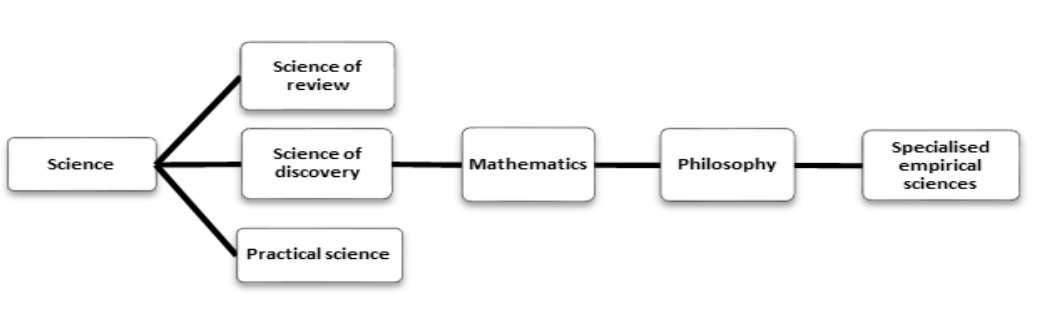
I’m using Peirce’s definition of the normative sciences[1]. As is not uncommon in English, the same words or phrases can denote different concepts and the wiki link you shared is a case in point. [1] https://www.isko.org/cyclo/peirce

Feels arbitrary. You don't group oil painting with mechanical engineering why group Math with Beauty?

This isko organization... if they do indeed follow pierce is incredibly strange. Case in point: https://www.isko.org/cyclo/peirce1.jpg

Philosophy is under mathematics which is not under logic? Philosophy is like literature it is entirely a separate category and logic isn't even mentioned in his arbitrary grouping.

Re: “Computer science is not about computers”

#235

I hate this quotation and find it not only false but sad. It feels as if a physicist would say "physics is not about mass, energy and matter, it is about ODE and PDE." And yes, astronomy is pretty much about looking at the shadows of sticks under the sun; and this includes more complex "sticks" like telescopes.

I also disagree with the quote. I think it's fair to say that the goal of Computer Science is to generally improve computing, but the purpose of astronomy is not to generally improve telescopes, nor biology microscopes, etc.

Re: “Computer science is not about computers”

#236
post #146

Earlier quoted context omitted.

> Maybe we should call it Turing Machine Science Nope. Turing machines are arbitrary and rather unmathematical. The lambda calculus is a much better computational formalism, more mathematically grounded and oriented, with far more direct practical applications.

This reads like total nonsense to me. Why would Turing machines be 'arbitrary and unmathematical'? What's 'unmathematical' about them? They can be formally and precisely described and I don't know of any mathematician who wouldn't accept TMs as a sound definition.

Turing machines are arbitrary in that they don't derive from some mathematical basis. You could easily reformulate the abstraction in many different ways, replacing "tape" or a "read/write head" with some other quasi-physical concept that don't normally appear in mathematics. Those concepts are spurious, just provided for their analogy to real-world machines.

You can provide formal descriptions for many things - the Perl programming language, for example. I would also call that language unmathematical. You can study such objects mathematically, but they are essentially external objects of study which one is using mathematics to make more tractable.

In contrast, Curry and Howard discovered direct correspondences between logic and lambda calculus. For example, intuitionistic natural deduction is isomorphic to typed lambda calculus. The internal languages of Cartesian closed categories are lambda calculi.

If Church hadn't discovered lambda calculi, they would have eventually been discovered via one of these correspondences.

Wikipedia provides a partial list of these correspondences at https://en.wikipedia.org/wiki/Curry%E2%80%93Howard_correspon... :

* Girard-Reynolds System F as a common language for both second-order propositional logic and polymorphic lambda calculus

* higher-order logic and Girard's System Fω

* inductive types as algebraic data type

* necessity in modal logic and staged computation

* possibility in modal logic and monadic types for effects

* The λI calculus corresponds to relevant logic.

* The local truth (∇) modality in Grothendieck topology or the equivalent "lax" modality (◯) of Benton, Bierman, and de Paiva (1998) correspond to CL-logic describing "computation types".

As such, lambda calculi are inextricably embedded in mathematics and logic, and their core features (ignoring superficial choices such as syntax) are a discovery, rather than an invention. We can't change the equivalences described above, they are facts that arise from the formalisms developed to address subjects like logic and categorical analysis. The same is not true of Turing machines.

Re: “Computer science is not about computers”

#237
What should it be called then? I saw suggestions for computing science, but applications often don’t ‘compute’ anything rather make API calls. Data science doesn’t seem to fit.

The best I can come up with is ‘instruction science’ the study of how to structure, execute and store sequences of instructions. The computer is a tool to do it faster, but you can also use pen and paper, it would just take longer.

Re: “Computer science is not about computers”

#238
post #109

Earlier quoted context omitted.

> Maybe we should call it Turing Machine Science Nope. Turing machines are arbitrary and rather unmathematical. The lambda calculus is a much better computational formalism, more mathematically grounded and oriented, with far more direct practical applications.

Why would you think that? I believe I’ve read that even Church himself said that Turing machines are a more elegant basis for computations, since they are much easier to mathematically reason about. I’m sure one can prove everything proved for Turing machines for lambda calculus, but I disagree with your statement that it is more mathematically grounded. It may be true in a syntactic form, but definitely not in a mat…

> I believe I’ve read that even Church himself said that Turing machines are a more elegant basis for computations, since they are much easier to mathematically reason about.

I'd be interested in a source for this.

Lambda calculi are used as the basis for several functional programming languages, which seems to argue against the idea that they're less easy to reason about.

They're also used as the basis for proof assistants such as Coq. Coq is based on the calculus of constructions, which is a typed lambda calculus. Again, this would be a mystifying choice if lambda calculi are difficult to reason about.

> I disagree with your statement that it is more mathematically grounded.

I've provided more support for my position here: https://news.ycombinator.com/item?id=27334163

Re: “Computer science is not about computers”

#239
post #231
post #73

My view is quite unconventional, but I believe, computer science is a branch of mathematics that deals with large but finite structures (so they need an algorithmic description). Compare with most of "legacy" mathematics, which studies countable structures (so the description can use arbitrary series). Of course, there are larger sets, but they mostly serve as a theater (just like countable infinity is just a theater…

Please explain how Dijkstra's _Go To Statement Considered Harmful_ (see https://homepages.cwi.nl/~storm/teaching/reader/Dijkstra68.p... for the text) is part of mathematics. Then Knuth's famous reply _Structured Programming with Go To_ (available at http://citeseerx.ist.psu.edu/viewdoc/download?doi=10.1.1.103... ) and then the much later follow-up at https://cis.temple.edu/~ingargio/cis71/software/roberts/docu... , _…

I don't think there's necessarily a disagreement here. You're talking about "how" to approach problems and he's talking about "what" the problem space is.

Re: “Computer science is not about computers”

#240
post #52
post #14

Earlier quoted context omitted.

There's this old picture from a 1986 MIT lecture: https://miro.medium.com/max/4448/1*-yaqXNO1tUwVkUpyOqTT7Q@2x... .

https://www.youtube.com/watch?v=2Op3QLzMgSY&t=15s

Good find. My post is voted down, but this authoritative source is literally saying the same exact thing.
Post reply on HN