Earlier quoted context omitted.
How many people would be ready to drive a hydrogen bomb?
Do you ride on a CNG city bus?
Otherwise methane is insanely safe, safer in all regards except pressurization than gasoline.
251–260 of 426 posts
Earlier quoted context omitted.
How many people would be ready to drive a hydrogen bomb?
Do you ride on a CNG city bus?
Otherwise methane is insanely safe, safer in all regards except pressurization than gasoline.
Earlier quoted context omitted.
The Nexo is much less aerodynamic than the Model 3. One is an SUV/CUV, the other is a low sedan which looks like wet poop. The Nexo has more frontal area and a higher CD. And the Tesla is known for rigging its EPA tests for higher, but illusory, numbers.
> And the Tesla is known for rigging its EPA tests for higher, but illusory, numbers. By that you must mean Tesla bothers to do the full suite of EPA tests instead of accepting a somewhat penalizing multiplier, like how other manufacturers do? There's no rigging whatsoever and the same option is available for other manufacturers as well. If they bother to do the longer and more demanding test cycle, that is.
Earlier quoted context omitted.
It generally breaks down to don’t brake unless you have to, and know & use the performance characteristics of whatever you’re driving. This might mean slowing down while anticipating stoplight changes, curves or congestion behavior so you can just keep rolling, not accelerating over the top of a hill or entering a decline with excess speed, leaving a good distance to the car in front and so on. Also knowing the effic…
When you go in neutral downhill your engine idles, vs if you leave it in gear the ECU cuts fuel supply completely. It's generally better to stay in gear except when you're at a standstill. (This assumes a modern vehicle with fuel-injectors)
Earlier quoted context omitted.
An electric charger costs less than the fuel cell does, so it makes very little sence unless this is being used in industrial equipment
Sure. News from 15 years ago: diesel powered car is 10 times cheaper than an electric car.
Much smarter to compare total cost of ownership, and then the ociture is very different
Earlier quoted context omitted.
I shouldn’t think it’s much more dangerous than other pressurized flammable gases. Those pressure vessels are designed for safety contrary to what you see in movies. I’d be about as concerned as I am driving around with a tank of highly flammable gasoline.
Hydrogen forms explosive mixtures with air at a much wider range of concentrations than typical hydrocarbons and has a nasty tendency to permeate straight through a lot of materials.
Earlier quoted context omitted.
Beyond the missing expensive infrastructure, the big problem is energy efficiency. Moving forward, we have to switch every energy production to renewables. But for the same amount of electric energy produced, an electric car gets about 3x the mileage than producing "green" hydrogen and powering fuel cell cars with it. Hydrogen means at least 3x the electricity cost and for many years to come, we are going to struggle…
The bottleneck is not kwh of electricity produced, but storage. Hydrogen cards do well on that bottleneck.
If I wanted to do this with my hydrogen car, I would need to get some expensive electrolysis station next to my house and I would get maybe 50% of stored energy back after electrolysis. I would also need to get the compressor etc maintained regularly.
Also, if you mean storage for actual driving, as in possible range, there's hardly a need for more range than a Tesla can already deliver... For most people. The biggest change to make it more feasible for pretty much all people is charging speed and that keeps improving too.
This is at 66.9 km/h (40 mph) in order to greatly increase its range due to lower drag compared to normal highway speeds. As a comparison a Tesla Model 3 got 975km (606 miles) at 40 km/h (25 mph) [1]. I can't seem to find any range tests at a similar speed as the Nexo. I found an EPA dyno test for the Model 3 at 77 km/h (48mph) for 708 km (440 miles). The Nexo and Model 3 have similar dimension and weight and price,…
The Nexo is much less aerodynamic than the Model 3. One is an SUV/CUV, the other is a low sedan which looks like wet poop. The Nexo has more frontal area and a higher CD. And the Tesla is known for rigging its EPA tests for higher, but illusory, numbers.
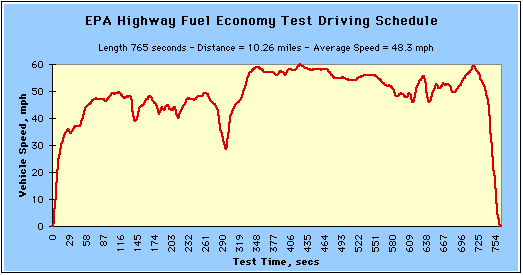
The Tesla numbers are correct and verifiable, actually. The problem is that the EPA "highway" test is designed to capture the "average highway mile" driven by a US vehicle (which makes sense, it was designed to inform purchasers of aggregate fuel use). Here's the driving schedule:
https://www.epa.gov/sites/production/files/2015-10/hwfetdds....
Note that it never goes above 60mph, and spends most of its time between 40 and 50. This isn't wrong, but it corresponds to an urban highway commute (again, which is pretty much the "average highway mile").
The problem is that this does NOT match what typical consumers think of as "highway driving", meaning blasting 75mph+ down an open road. So people get in their Model 3's and measure their consumption at those speeds and it doesn't match.
And it's true that other EV manufacturers (Ford, especially -- the Mach E actually does somewhat better than sticker consumption on the highway) chose not to run the full test and used other methods that put a higher number on their stickers. And in context that's probably more informative.
But nothing was "rigged". In fact Teslas in stop-and-go urban commute traffic really do get close to their sticker mileage. It's just that no one cares because one's battery doesn't run out on an urban commute before you get home to charge it. Ironically, EV owners in this case care LESS about efficiency than gas owners.
It also ties the consumer to that fuel system with no other options. You can’t, in other words, fill up at home in your parking spot.
The potential for auto parts profits is high because hydrogen, being the smallest molecule, is notoriously corrosive as it is able to leak through almost any material. And able to bond with many molecules, causing corrosion. So I would expect a lot of degradation over time.
So I guess that’s why Toyota loves this: ongoing parts sales. As a former Toyota owner, I loved the reliability at first, but it was not absolute, and the parts cost for repairs started approaching the cost of car payments as the car got older.
This is at 66.9 km/h (40 mph) in order to greatly increase its range due to lower drag compared to normal highway speeds. As a comparison a Tesla Model 3 got 975km (606 miles) at 40 km/h (25 mph) [1]. I can't seem to find any range tests at a similar speed as the Nexo. I found an EPA dyno test for the Model 3 at 77 km/h (48mph) for 708 km (440 miles). The Nexo and Model 3 have similar dimension and weight and price,…
>It doesn't seem like current fuels cell have much of a energy density / range advantage even though hydrogen itself is much more energy dense, the fuel cell weight and efficiency and high pressure liquid hydrogen tanks must be accounted for. Hydrogen has a better gravimetric scaling than batteries - as stored energy increases, the fixed weight of the fuel cell is amortised over more energy and the weight of high pre…
Nope, tank mass scales with volume because bigger tanks need thicker walls: https://en.wikipedia.org/wiki/Pressure_vessel#Scaling
Earlier quoted context omitted.
It scales better than green production of hydrogen does
Do you know what is even less green? Building tens of thousands of charging ports that are not being utilized because they are used for day parking.
This is 'batteries pollute the environment too" FUD all over again.