Live data from Hacker News

We are desensitized to Christianity’s influence on Western thought

perell.com

51–60 of 85 posts

Re: We are desensitized to Christianity’s influence on Western thought

#51
post #10

Earlier quoted context omitted.

Historically correct but do we need to tell that part of the story going forward? Can we not set the idea of “human rights” on its own pedestal and decide what those are and carry them forward in tradition and song? Why do we have a literal obligation to the asinine part of a dead philosophers opinions on their origin, along with an actual useful concept? Let’s dispense with the all-father bits and see it as we claim…

> Historically correct but do we need to tell that part of the story going forward? Yes. Hiding the truth is almost always wrong.

I don't think the point is to suppress history. But that ideas about human rights can have a firmer foundation than a particular religion.

I.e. moral principles such as equality and some basic rights result in a safer and more productive society for the vast majority of people, vs. alternate principles.

They are less arbitrary principles than saying this group of people is better than another group, and results in a society with greater productivity and resiliancy than one where the strong continually put down the weak.

The history is still meaningful, but is not the rationale.
Re: We are desensitized to Christianity’s influence on Western thought

#52
post #5

Yeah, this is a load of nonsense. The worst part is this essays ahistorical line of thinking. Like highlighting the Romans bad behavior without examining things like the crusades and chattel slavery which used Christianity as a defense. And it’s Christian supremacist since he leaves out the Jews, Muslims, Hindus, Buddhists, and any other religion that believes in human rights.

To flatly reject the author’s argument just proves his point. Specifically that folks don’t consider the origin of American values and law (he used the Constitution as an example if you recall) as being Christian. This is also why he didn’t mention the other belief systems you stated because they weren’t considered when America was created. Secondly, just because someone claims to be a Christian doesn’t mean they are…

> just because someone claims to be a Christian doesn’t mean they are.

Externally it pretty much does. Unless you have some specific concrete evidence there's not really ever value or reason to claim someone isn't part of the religion they say they are.

If you are _also_ part of the religion they claim then you might have some interest in whether or not they adhere to your doctrines but to outsiders it's all opaque and irrelevant.

Re: We are desensitized to Christianity’s influence on Western thought

#53

> The same people who tout the virtues of being well-read skip right past the Bible, the most popular book in human history. Who's doing that? You wouldn't be able to understand half of what you read. Did the author just make up someone to score points on?

At least in my (I think typical?) big city tech worker circle the bible as literature has been received with disdain the couple times I've seen it come up.

I also had a (atheist) friend once tell me he bought copies of the bhagavad gita and quran to put next to his bible so he would look well read instead of christian if anyone looked at his book shelf.

Re: We are desensitized to Christianity’s influence on Western thought

#54
post #13

I was reading this essay nodding, until the revelation: the author isn't Christian at all. He's raised in Judaism. My knowledge of religion (despite being born and raised in a Catholic country) is entirely intuitive, but Judaism and Christianity seem pretty different religions, and the Old and New Testament contain different teachings and a different worldview. At the very least it could be lexical sloppiness (Christ…

Yeah there's a thing for a while now in the US where we like to talk about "judeo-christian" values or roots or whatever. I've never really understood it except as a way to exclude islam which I really believe is all it is.

Parts of the white evangelicals going hard into it is weird but not completely out of nowhere I guess.

BUT! Anyway the "judeo-christian" thing is just a rhetorical move. I think overall Americans are very ignorant of judaism and think it's a lot more similar to christianity than it is but no one thinks they're the same religion. Uninformed but not likely to mix the two up like this.

Re: We are desensitized to Christianity’s influence on Western thought

#55
post #3

> But at the same time, they believe in human rights, which can be justified only by the very God they don’t believe in. Why?

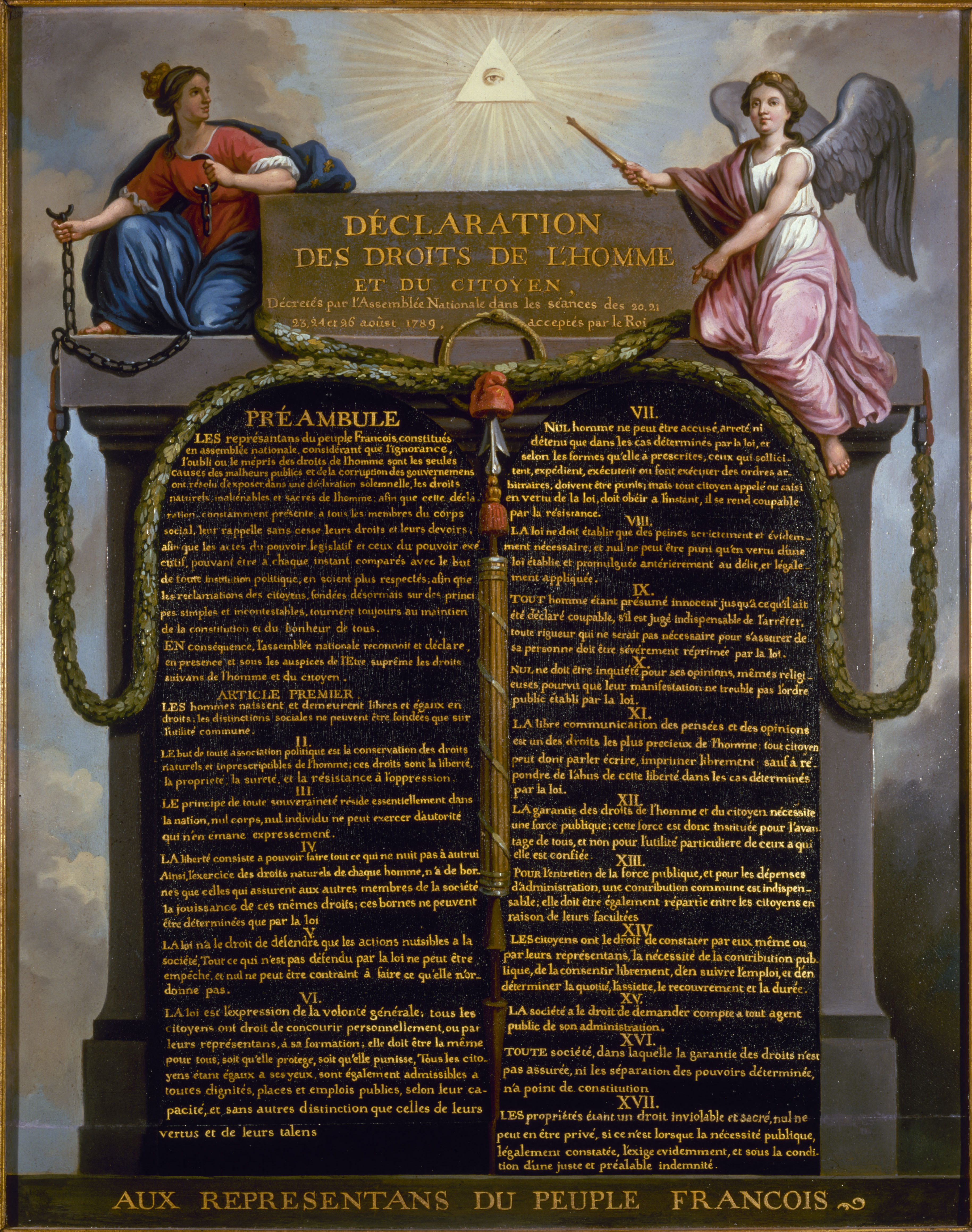
I don't believe in God, but this is historically correct. The Universal Declaration on Human Rights as conceived by the United Nations traces its roots to the 1789 Declaration of the Rights of Man and of the Citizen that was a product of the French revolution. https://en.m.wikipedia.org/wiki/Declaration_of_the_Rights_of... The preamble of this document directly references God: > In consequence, the National Assembly…

> The preamble of this document directly references God:

No it certainly does not reference "God".

The "Supreme Being" they were talking about was definitely not the God of Catholic Church that came under direct attack in the French Revolution.

The French revolutionaries did not hide their Masonic root. It's right on the tin.

https://upload.wikimedia.org/wikipedia/commons/6/6c/Declarat...

The "Supreme Being" is the Masonic "Great Architect", a metaphysical notion entirely distinct from the experiential spiritual God of religions with visionary prophets and scripture. You can have a 'born again Christian' who experiences a divine encounter, but you don't have epiphanies with "the Supreme Being".

https://en.wikipedia.org/wiki/Cult_of_the_Supreme_Being

https://en.wikipedia.org/wiki/Dechristianisation_of_France_d...

Re: We are desensitized to Christianity’s influence on Western thought

#56

Earlier quoted context omitted.

I think you may be missing the point of the essay. I don’t think it meant to say that Christianity is perfect nor that Christianity is the supreme religion. Of course Christianity has been used to justify hateful conduct (just like most other religions at some point) but regardless it more than anything else is responsible for how “Western Civilization” developed, and by extension our understanding of human rights. Y…

Greece and Rome's civic and philosophical development was the source of how Western Civilization developed. Christianity was then transplanted on top of Western Civilization; it wasn't the source. The author is either mistaken or arguing in bad faith, and makes numerous factually incorrect statements. He argues the Locke "assumed" God given rights, and states that there are no other legitimate sources, despite there…

At least in the context of this essay this point seems moot to me. Whether the author argues that only Christianity provided such theories or not, the vast majority of the US founders cite the Christian God as the source of a lot of things, human rights among them. They don’t cite some Greek philosopher because that’s not what they pulled that aspect of their argument from.

Maybe this is just more cut snd dry for me because I’ve studied US history for years and I’m imposing a lot of that into the essay, but I don’t think the author is being disingenuous at all for rightly pointing out the reaching effect of Christianity on our modern understanding of human rights (see Locke’s “Reasonableness of Christianity” for some fun reading).

Re: We are desensitized to Christianity’s influence on Western thought

#57
post #7

Earlier quoted context omitted.

That's a declaration. Which apart from mentioning a supreme being (not the Christian god) has its roots in other concepts. However, the article is typical Christian propaganda insinuating that atheists are amoral and you need the benevolent guidance of a supernatural being (and its church) to behave like a decent human being.

The stronger form of this argument is made by Nietzsche, not by Christian propagandists. Without God, there is no objective moral foundation. Obviously, people remain 'moral' regardless of their religious orientation, because morality is a social phenomenon, it's the 'herd instinct in the individual'. But this morality shifts and changes with times and cultures. You have no perch from which to stand and declare yours…

Which Nietzscheian piece is this from?

Re: We are desensitized to Christianity’s influence on Western thought

#58

Earlier quoted context omitted.

The stronger form of this argument is made by Nietzsche, not by Christian propagandists. Without God, there is no objective moral foundation. Obviously, people remain 'moral' regardless of their religious orientation, because morality is a social phenomenon, it's the 'herd instinct in the individual'. But this morality shifts and changes with times and cultures. You have no perch from which to stand and declare yours…

Which Nietzscheian piece is this from?

The Gay Science, which, in my humble opinion, is his greatest work! Page 279 of the Kaufmann edition, but Nietzsche repeats similar thoughts on a few other occasions in this book and elsewhere.

Re: We are desensitized to Christianity’s influence on Western thought

#59

Earlier quoted context omitted.

> Historically correct but do we need to tell that part of the story going forward? Yes. Hiding the truth is almost always wrong.

I don't think the point is to suppress history. But that ideas about human rights can have a firmer foundation than a particular religion. I.e. moral principles such as equality and some basic rights result in a safer and more productive society for the vast majority of people, vs. alternate principles. They are less arbitrary principles than saying this group of people is better than another group, and results in a…

Sorry, that's absurd. The rationale for why something exists cannot be divorced from the history for why it exists. And there is no source for a principle of equality in nature.

Re: We are desensitized to Christianity’s influence on Western thought

#60

Earlier quoted context omitted.

Greece and Rome's civic and philosophical development was the source of how Western Civilization developed. Christianity was then transplanted on top of Western Civilization; it wasn't the source. The author is either mistaken or arguing in bad faith, and makes numerous factually incorrect statements. He argues the Locke "assumed" God given rights, and states that there are no other legitimate sources, despite there…

At least in the context of this essay this point seems moot to me. Whether the author argues that only Christianity provided such theories or not, the vast majority of the US founders cite the Christian God as the source of a lot of things, human rights among them. They don’t cite some Greek philosopher because that’s not what they pulled that aspect of their argument from. Maybe this is just more cut snd dry for me…

Many writings of the founders were absolutely rife with references to antiquity and classical authors, it was a common practice of the time to write under a Roman republic era pseudonym, and off the top of my head, Jefferson and Adams knew Latin, Madison knew Greek and Latin, and they all were definitely well versed in the classics.

Maybe we're talking past each other, but the essay seemed to be arguing that Christianity was both the source and only legitimate basis for modern human rights, and I don't think the historical record supports that argument at all.

Post reply on HN