Live data from Hacker News

The health benefits of better air

dynomight.net

251–260 of 471 posts

Re: The health benefits of better air

#251

This article seems to make fantastic jumps from the believable -- mortality from overall air pollution (e.g. in Delhi) to the frankly unbelievable -- your ultrasonic humidifier supposedly reducing your life by nearly an hour each night, or that a daily commute between Newark and NYC takes half a year off your life. According to this logic, anyone who works in the subway should be dying, what, 10 years earlier? Which…

Extinguish candles with a lid. If you are worrying about the method by which you extinguish a candle, worrying is what's going to shorten your life, not the candle.

My first thought on the candles was: If you're worried about paritculate emissions and air quality in your flat then maybe just don't burn anything in your flat.

I haven't researched that, but it always seemed entirely obvious to me that candles aren't exactly healthy in terms of air quality.
Re: The health benefits of better air

#252

Earlier quoted context omitted.

I don't think that really happens because breaks are used every time you stop. You can't regeratively break to 0.

Depends on how much your drive. Drive only now and then and brake only the bare minimum, you can get really rusty brakes. I ended up having to get towed with brakes being seized due to rust and lack of use.

I didn't notice any more rusting with a hybrid with regerative breaking than I did with normal car.

Rusting is for me more associated with the weather and lack of use of the whole car than with how much do you use breaks when you use the car.

Re: The health benefits of better air

#253

Earlier quoted context omitted.

I'm no way an expert on the matter but by pure logic it's still amazes me how we survived (and evolved!) as a species for thousand of years without almost no shelter from direct sunlight and yet now (too much) sunlight exposure is seen as a cause of death. I know we lost almost all the body hair we used to have but still, we usually wear clothes when under the sun.

According to my naive knowledge: 1. We have more ozone holes now. 2. We weren't constantly in direct contact with sunlight. If you move past very early stages, we had shelter in forests, caves, tents, igloos. 3. When we were in direct contact with sunlight, we had a darker skin, which is more resilient to that. Correct me if I'm wrong.

We have more ozone holes now.

The global ban on CFCs (https://en.wikipedia.org/wiki/Montreal_Protocol) is working, and although there are still big holes that open and close every year we're on the way to getting back to pre-1980 levels of holes by 2060. https://public.wmo.int/en/media/news/record-breaking-2020-oz...

Re: The health benefits of better air

#254
post #201

This article seems to make fantastic jumps from the believable -- mortality from overall air pollution (e.g. in Delhi) to the frankly unbelievable -- your ultrasonic humidifier supposedly reducing your life by nearly an hour each night, or that a daily commute between Newark and NYC takes half a year off your life. According to this logic, anyone who works in the subway should be dying, what, 10 years earlier? Which…

I put together a monster air quality monitor with just about every sensor I could cram into it. Dust sensors, geiger counters, the whole works. One of the biggest problems I found was indoor CO2 levels. High CO2 levels (much less than dangerous CO2 levels) make you groggy, sleepy, and can induce headaches. I now get notifications to open my windows when CO2 levels pass a certain threshold. https://dheera.net/projects…

Having good data is the first step towards making a change.

I like that the air quality monitor enables you to figure out how much the window has to be opened and also when.

That's far more useful than the blanket advice of opening windows daily.

Re: The health benefits of better air

#255
post #214

Earlier quoted context omitted.

Just to point out how why this is a fairly nuanced topic, a shepherd may be breathing clean air but they're also exposed to UV radiation all day. They may have a higher morbidity due to increased skin cancer rates.

I'm no way an expert on the matter but by pure logic it's still amazes me how we survived (and evolved!) as a species for thousand of years without almost no shelter from direct sunlight and yet now (too much) sunlight exposure is seen as a cause of death. I know we lost almost all the body hair we used to have but still, we usually wear clothes when under the sun.

Unless that skin cancer thing is also actually overblown… https://elemental.medium.com/what-if-avoiding-the-sun-is-bad...

As the parent said, plenty of nuance to go around.

Re: The health benefits of better air

#257
> Install a HEPA cabin air filter in your car.

If you drive a lot this should be #1 on your list. How come this is not an absolute standard in the automotive industry?

Last time I have tried to purchase a HEPA cabin filter for my Hyundai i40 I failed to find any.

Re: The health benefits of better air

#258

Earlier quoted context omitted.

Really prefer co2 levels lower than outside? What's your outside environment?

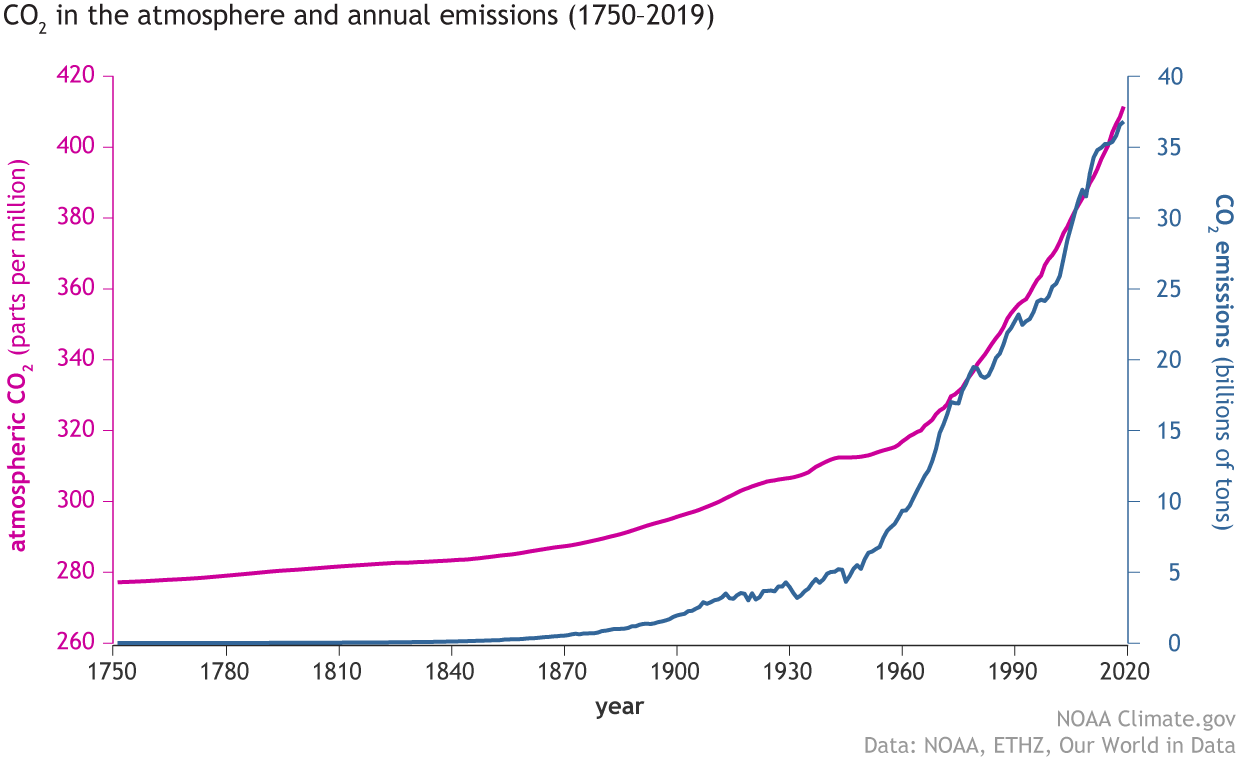
Before the industrial revolution the CO2 levels outside were around 250ppm or at least less than 300. Current levels outside as measured by my device just now are about 450ppm.

Here is a nice historical chart: https://www.climate.gov/sites/default/files/CO2_emissions_vs...

Re: The health benefits of better air

#259

Earlier quoted context omitted.

According to my naive knowledge: 1. We have more ozone holes now. 2. We weren't constantly in direct contact with sunlight. If you move past very early stages, we had shelter in forests, caves, tents, igloos. 3. When we were in direct contact with sunlight, we had a darker skin, which is more resilient to that. Correct me if I'm wrong.

We have more ozone holes now. The global ban on CFCs ( https://en.wikipedia.org/wiki/Montreal_Protocol ) is working, and although there are still big holes that open and close every year we're on the way to getting back to pre-1980 levels of holes by 2060. https://public.wmo.int/en/media/news/record-breaking-2020-oz...

Maybe, if China would curtail their CFC usage perhaps.

...A recently reported slowdown in the decline of the atmospheric concentration of CFC-11 after 2012, however, suggests that global emissions have increased...

We show that emissions from eastern mainland China are 7.0 ± 3.0 (±1 standard deviation) gigagrams per year higher in 2014–2017 than in 2008–2012, and that the increase in emissions arises primarily around the northeastern provinces of Shandong and Hebei. This increase accounts for a substantial fraction (at least 40 to 60 per cent) of the global rise in CFC-11 emissions.

https://www.nature.com/articles/s41586-019-1193-4

Still, the Montreal Protocol is a good example of what can be achieved when we finally reach an imminent crisis.

Re: The health benefits of better air

#260
post #9

Thank you for this extensive resource on air quality. Yes, it needs to get more attention as it is one of the main drivers of mortality of environmental risks. One thing one has to bear in mind is that often when you optmize your home for low PM (e.g. with air purifiers and fixing of air leackage) your CO2 will get very high causing headaches and reduce cognitive performance. So it always makes sense for indoor air q…

I have an AirVisual Pro, which is quite expensive, but my half finished air quality monitor project had been on the bench for much too long. I have windows open all the time, air conditioning on too often, and dehumidifiers and HEPA filters as well. It is not efficient or particularly environmentally friendly... but I want a CO2 level My next half baked idea is figuring out a way to have a sealed home and an applianc…

> and an appliance (or messy bench-top device) to remove CO2 from the room continuously and exhale outside

There are these things called "plants"...

https://en.wikipedia.org/wiki/NASA_Clean_Air_Study

Post reply on HN