Live data from Hacker News

Apple’s M1 Positioning Mocks the Entire x86 Business Model

extremetech.com

151–160 of 942 posts

Re: Apple’s M1 Positioning Mocks the Entire x86 Business Model

#151
While the M1 is great now, I'm very hopeful in what's to come. If Apple can maintain even a bit of their current improvements year over year, in 2-3 years it just won't make sense to use anything else; see this graph to know what I mean:

https://miro.medium.com/max/1356/1*_aVjpbyBkMq-KIY8kbbP_w.pn...
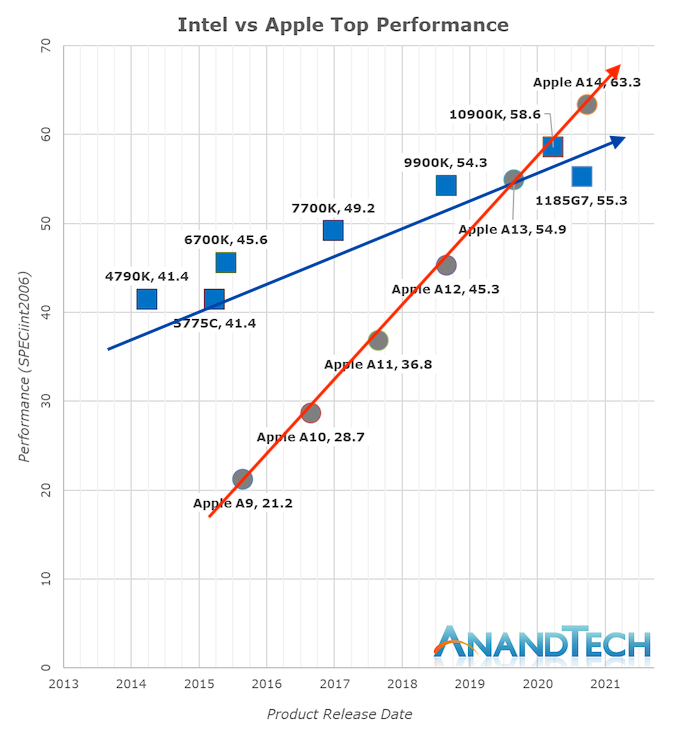
Even if Intel can catch up somehow, it'll take years to catch up to this, and by then it'd be too late. The only reason why Apple will not win is that they bundle software and hardware too strongly. This some times and for some markets is a big strength, but other times it's a weakness IMHO.

Re: Apple’s M1 Positioning Mocks the Entire x86 Business Model

#152

Earlier quoted context omitted.

It seems like they do binning. For example, the M1 with 7 gpu cores vs 8 gpu cores.

That struck me as an extremely odd metric to differentiate products by, given its low relevance to non-technical users who don't know what a GPU core even is (except gamers, but they are not buying iMacs). Additionally, most people are going to think adding one more core is hardly worth the price upgrade, and its quite strange to see an odd number of cores.

Apple dont bin them because of price / product differentiation as in Intel / AMD.

Apple bin them only because of yield.

I also think Apple doesn't want to use their M1 as differentiator. They use RAM and Storage instead which is an easier concept to grasp by consumers.

Re: Apple’s M1 Positioning Mocks the Entire x86 Business Model

#154
Can't wait for an iPhone Pro with an M1 processor that I can plug into a thunderbolt/usbc dock, run monitors, a keyboard, ethernet, and have it running MacOS when in desktop mode.

EDIT: A little context; when I am in the office, I use vscode over ssh to connect to my desktop PC at home. My desktop takes care of my language server, syntax highlighting, compilation and vscode forwards my ports and spins up terminals. All I will ever need is a low powered computer that can run my browser and tooling fast enough.

Re: Apple’s M1 Positioning Mocks the Entire x86 Business Model

#155

> Apple’s gamble, with the M1, is that its custom CPU performance is now so high, at such low power consumption, that the choice of chip inside the system has become irrelevant within a given product generation. This is clearly wrong as they are still selling Intel versions of the MacBook and MacMini. Apple makes a lot of money by offering a range of processor options. At the moment we are early in the transition but…

> This is clearly wrong as they are still selling Intel versions of the MacBook and MacMini

I can think of other reasons some customers may prefer or need to buy the Intel version. AFAIK, you cannot run virtualized x86 code (docker, parallels, vmware) on the M1 macs (yet?) or maybe you need a driver for HW that is not yet available for M1/ARM. You can't conclude that they sell Intel versions for performance reasons.

Re: Apple’s M1 Positioning Mocks the Entire x86 Business Model

#156

Earlier quoted context omitted.

Creative class is a lot more than programmers. Look at boutique system integrators like Puget Systems... do you see Apple/ARM Hardware? Heck no you don't! These guys sell hardware to a LOT of the companies that comprise the credits in movie production, game production, laboratories, university science departments, ML researchers, big energy, and soooooo much more. These guys are not rewriting their software stack for…

Raytheon etc don't buy them yet . But the M1 is already a huge hit in the music and design community, which is pro-performance oriented. If subsequent Mnx chips provide enough of a speed bump they're going to destroy the high end Xeon market.

You've named two industries where Apple have histrionically been really popular, mostly because of their software rather than for any particular performance reason. They'd all buy the latest, Apple product whatever was inside because that's the only one Apple is going to support going forward. The idea of real high-performance computing moving to ARM is entirely dependent on there being suitable good software support, which currently does not exist (at least in my industry there is nothing yet and the vendors move very slowly). This "destruction" might eventually come but it won't be any time soon and Intel will of course react in the meantime.

Re: Apple’s M1 Positioning Mocks the Entire x86 Business Model

#158

Make it as fabulous as much as you want, $1700 for an 8 core, 8 gigs of ram machine is just one plain fabulous joke. This in the time when 16 gigs ram is the baseline if you plan to do anything more than facebook and instagram.

Yup, I have 16Gb of RAM on macbook 2011.

Re: Apple’s M1 Positioning Mocks the Entire x86 Business Model

#159
post #145

You get an M1 with the new iPad Pro as well! I hadn't thought of the situation as the article presents. When shown in that light, it made me pause to reflect. The M1 doesn't make sense when its in every darn product. The only differentiator is screen size, RAM, and OS? I will admit that I switched to Thinkpad and Win10 about two years ago when I had to return my butterfly for the 5th time. I am not looking back eithe…

>The M1 doesn't make sense when its in every darn product. Would you feel better if they called it A14X? It is basically the same thing as what Intel is doing. Same Die, different binning, different naming. Same with Core count on AMD, same die, different binning on Cores and Clock Speed. Apple doesn't bother do any of that because well it is complicated for consumers. I call it TDP Computing. You are limited by the…

>I am waiting to see Apple absolutely max out their SoC approach for Mac Pro.

But they already maxed out their SoCs in the benchmarks because Geekbench doesn't care about TDP. The TDP makes a difference in real world performance but not in the benchmarks.

Re: Apple’s M1 Positioning Mocks the Entire x86 Business Model

#160

The M1 processor is a direct result of the death of Moore's law. It's an amazing processor, but a sad sign of things to come. The performance gains from Moore's law have typically come from shrinking die size. That has ended, you can't juice more performance from general purpose CPUs. If general purpose processors no longer advance quickly enough, the only way to get performance gains is to build custom chips for com…

Scaling will continue for at least another 10 years.
Post reply on HN