Live data from Hacker News

Draw an iceberg and see how it would float in water

joshdata.me

131–140 of 179 posts

Re: Draw an iceberg and see how it would float in water

#131
post #9

I get interesting results if I draw a figure 8 (or a figure ∞). I wonder if it's treating one of the lobes as having negative density.

I think this was patched just now. On my last visit a few minutes ago the bug still worked, now it removes any larger bits where the lines intersect. Also, the code has been amended right where this comment is: // People like to draw shapes with kinks, which results // in part of the polygon being treated as negative area. // turf.unkinkPolygon can be used to find the kinks and // separate the polygon into multiple p…

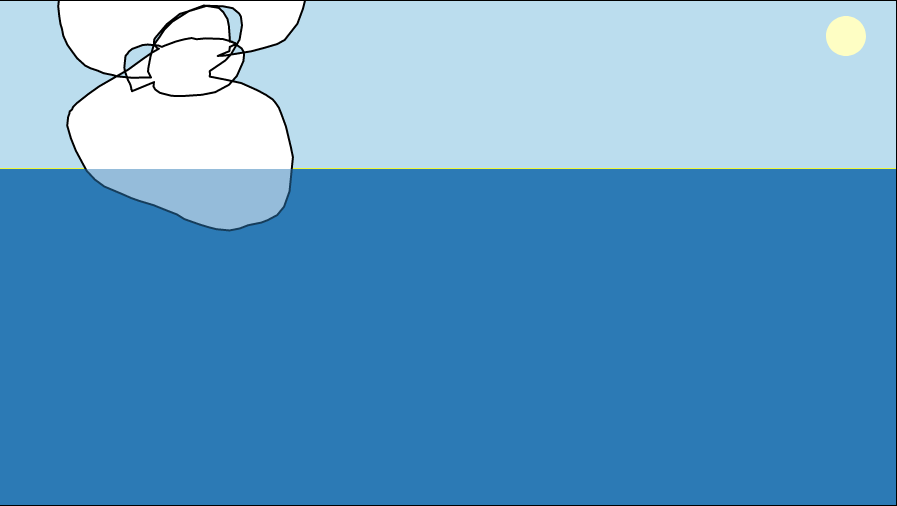
It still works, you just have to mess around with the lines a bit more: https://gliggy.github.io/broken.png
Re: Draw an iceberg and see how it would float in water

#133
post #9

I get interesting results if I draw a figure 8 (or a figure ∞). I wonder if it's treating one of the lobes as having negative density.

Symmetric and asymmetric behavior baffles me. Any progressive papers on the independent relationships between infinite limits, finite quantities, and asymmetric phenomenon would be much appreciated from the homestead.

Also, what is the dependent relationship between stable states and non-stable state systems? Is it more simple than thought before?

Re: Draw an iceberg and see how it would float in water

#136
post #126
post #71

Earlier quoted context omitted.

I spent... longer than I should have trying to take advantage of this bug to recreate a stable version of the stereotypical tall iceberg that the original tweet was complaining about. https://imgur.com/a/WG6D0RJ

I don't think there is a stable "vertical" configuration without the negative mass trick from crossing lines: https://en.wikipedia.org/wiki/Metacentric_height Any convex shape will tend to minimize the forces due to buoyancy and "horizontal" should always go less deep (or equal for a sphere) than "vertical"

https://imgur.com/a/OjuWEKK

It can be in a local minima of buoyancy without being a global minima. Similar to an un-sharpened pencil balanced on it's end.

Re: Draw an iceberg and see how it would float in water

#137

So without any further knowledge about how icebergs should orient and how scientists draw them: Icebergs in 3D will generally have different mass distributions than the corresponding 2D projections that we are drawing here. For example, there will generally be higher "2D mass density" in the center. Consequently, it is possible that the scientists "drawing icebergs wrong" are actually right and it just looks/"behaves…

One way to avoid this might be to create an internal 3D model by rotating the drawing about the y-axis.

Re: Draw an iceberg and see how it would float in water

#140
post #136
post #126

Earlier quoted context omitted.

I don't think there is a stable "vertical" configuration without the negative mass trick from crossing lines: https://en.wikipedia.org/wiki/Metacentric_height Any convex shape will tend to minimize the forces due to buoyancy and "horizontal" should always go less deep (or equal for a sphere) than "vertical"

https://imgur.com/a/OjuWEKK It can be in a local minima of buoyancy without being a global minima. Similar to an un-sharpened pencil balanced on it's end.

Cool, I stand corrected. I tried with a few triangles of my own but they never stayed upright, but maybe I just suck at drawing and they all started too far off-center to remain in the little "valley" of the stability diagram.
Post reply on HN