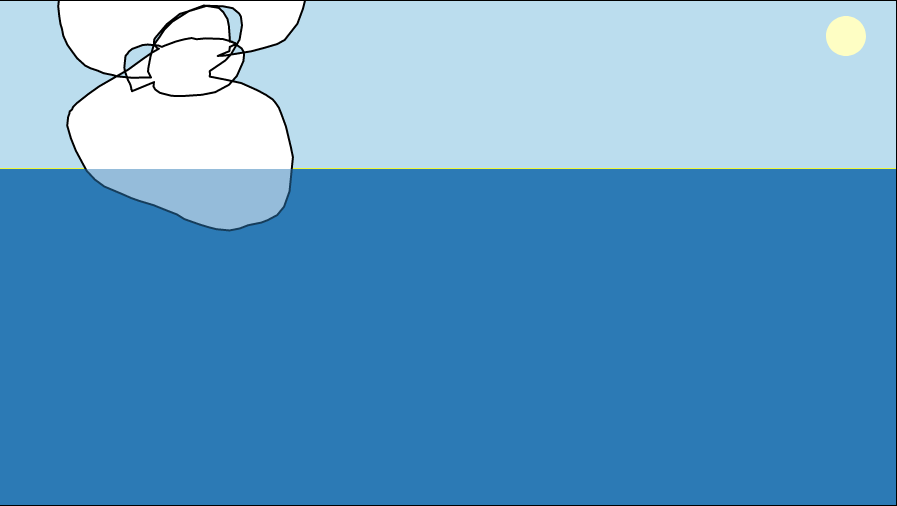
I get interesting results if I draw a figure 8 (or a figure ∞). I wonder if it's treating one of the lobes as having negative density.
I think this was patched just now. On my last visit a few minutes ago the bug still worked, now it removes any larger bits where the lines intersect. Also, the code has been amended right where this comment is: // People like to draw shapes with kinks, which results // in part of the polygon being treated as negative area. // turf.unkinkPolygon can be used to find the kinks and // separate the polygon into multiple p…
Draw an iceberg and see how it would float in water
131–140 of 179 posts
Re: Draw an iceberg and see how it would float in water
#132Re: Draw an iceberg and see how it would float in water
#133I get interesting results if I draw a figure 8 (or a figure ∞). I wonder if it's treating one of the lobes as having negative density.
Also, what is the dependent relationship between stable states and non-stable state systems? Is it more simple than thought before?
Re: Draw an iceberg and see how it would float in water
#134Re: Draw an iceberg and see how it would float in water
#135Re: Draw an iceberg and see how it would float in water
#136Earlier quoted context omitted.
I spent... longer than I should have trying to take advantage of this bug to recreate a stable version of the stereotypical tall iceberg that the original tweet was complaining about. https://imgur.com/a/WG6D0RJ
I don't think there is a stable "vertical" configuration without the negative mass trick from crossing lines: https://en.wikipedia.org/wiki/Metacentric_height Any convex shape will tend to minimize the forces due to buoyancy and "horizontal" should always go less deep (or equal for a sphere) than "vertical"
It can be in a local minima of buoyancy without being a global minima. Similar to an un-sharpened pencil balanced on it's end.
Re: Draw an iceberg and see how it would float in water
#137So without any further knowledge about how icebergs should orient and how scientists draw them: Icebergs in 3D will generally have different mass distributions than the corresponding 2D projections that we are drawing here. For example, there will generally be higher "2D mass density" in the center. Consequently, it is possible that the scientists "drawing icebergs wrong" are actually right and it just looks/"behaves…
Re: Draw an iceberg and see how it would float in water
#138Re: Draw an iceberg and see how it would float in water
#139Re: Draw an iceberg and see how it would float in water
#140Earlier quoted context omitted.
I don't think there is a stable "vertical" configuration without the negative mass trick from crossing lines: https://en.wikipedia.org/wiki/Metacentric_height Any convex shape will tend to minimize the forces due to buoyancy and "horizontal" should always go less deep (or equal for a sphere) than "vertical"
https://imgur.com/a/OjuWEKK It can be in a local minima of buoyancy without being a global minima. Similar to an un-sharpened pencil balanced on it's end.