Live data from Hacker News

Ford Makes $29B Commitment to Electric and Self-Driving Cars

caranddriver.com

171–180 of 183 posts

Re: Ford Makes $29B Commitment to Electric and Self-Driving Cars

#171

Electric cars - I get it... but who would in their right mind let their Ford drive itself?! Why is the self-driving a thing mostly in America? Don't people here enjoy driving? If they don't, why not focus on the more economical and environmentally-friendly mass transit instead? In Europe, people get a car and get behind the wheel, because they enjoy the experience, not because it gets them in the most efficient way f…

Average trip length is about ~12km[1] (we are talking about Europe so no weird units, sorry not sorry) and 22mn. That's about 33kmh, less than most speed limits within the cities. What it means is that most car trips are short and slow. I consider myself as someone who likes to drive. But I don't own a car because most of my trips (done on my bicycle) are done in the city where I know I'm more efficient on my bike th…

I'm sure hiring a taxi will have the same benefits and it will end up being cheaper and even more convenient when you consider all the costs and hassles, which including parking in these short trip situations, insurance, rapid depreciation, maintenance, etc. The issue with mass transit is always the last mile, but foldable lightweight e-scooters and mini e-bikes can solve it.
Re: Ford Makes $29B Commitment to Electric and Self-Driving Cars

#172
post #128

Earlier quoted context omitted.

I think you are completely wrong, let me make the argument. As a whole, H2 cars are also quite heavy. You literally require everything that is in an EV plus multiple extra subsystems that are incredibly complex and not light by any means. The manufacturing and materials are very both complex and expensive. You need the fuel cell itself, and that is not just some thin layer, but a whole complex subsystem that requires…

I think Hydrogen fuel cell tech doesn't belong in passenger vehicles; there batteries can do a fine enough job. I believe the future of H2 is in intermodal transport, that is, trucking and (previously diesel) trains. Why? Do the math on weight, and you'll quickly see that you can't fit enough batteries in a Semi to give them the range that they need for long haul, while still being able to carry any appreciable amoun…

The waste majority of trucking is not actually super long range. So the waste majority trucking can be done perfectly fine even with current generation EV that are starting to come out this year.

There is a small amount of very long range trucking where there 'might' be a competition. However, I believe even that will quickly go electric.

So, even current generation trucks could do 80% of trucking. From there year by year they will be able to do more of the jobs. Hydrogen will lose against Diesel until BEV trucks will be good enough. In 5 years nobody will question if BEV trucks can do everything.

A properly engineered electric Semi is not actually that much heavier then a Diesel truck.

Re: Ford Makes $29B Commitment to Electric and Self-Driving Cars

#173
post #128

Earlier quoted context omitted.

I think you are completely wrong, let me make the argument. As a whole, H2 cars are also quite heavy. You literally require everything that is in an EV plus multiple extra subsystems that are incredibly complex and not light by any means. The manufacturing and materials are very both complex and expensive. You need the fuel cell itself, and that is not just some thin layer, but a whole complex subsystem that requires…

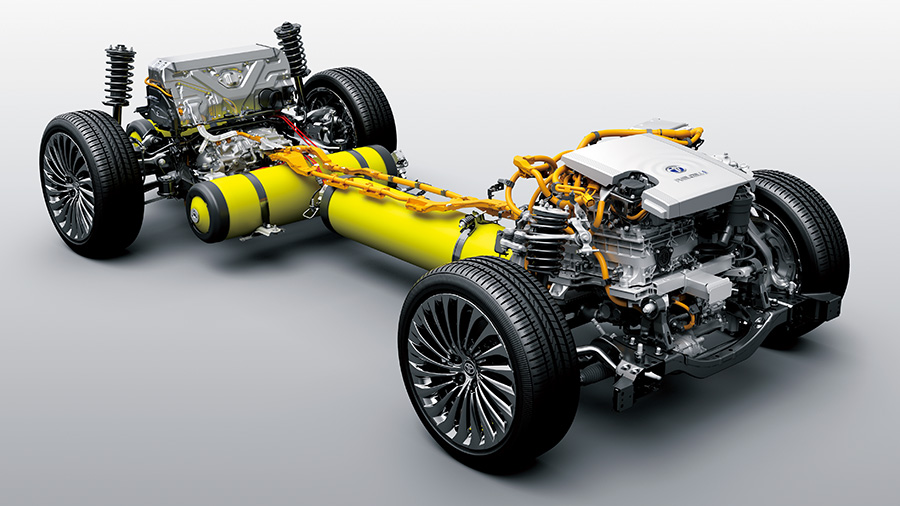
> As a whole, H2 cars are also quite heavy. You literally require everything that is in an EV plus multiple extra subsystems that are incredibly complex and not light by any means. Toyota Mirai 2 curb weight 1925 kg vs Tesla P100 curb weight 2241 kg. Both have the range of 500 to 507 km. But with a Mirai, given that the infra for filling up would exist, I’d spend 5 minutes filling up instead of 40 at a charging stati…

Look at how amazing and simply the Mirai 2 is:

https://global.toyota/pages/news/images/2020/12/09/1200/005....

compared to:

https://468y981o84o43v2wo2600a0gcj-wpengine.netdna-ssl.com/w...

And one of these cars is incredibly fast, the other is a not a performance car. I can't find good data on Mirai 2 but I think the S is a considerably bigger car.

At least in comparison between the Mirai and the Model 3, the Model 3 is lighter.

Of course, the reality is that batteries are getting lighter fast.

> Yeah, I have dozens of those around. But you know what, more battery cars also need those so it’s not like we will be removing these soon.

Again, the simply fact is fuel cells are considerably less efficient. Therefore you need more of them.

https://img.drivemag.net/media/default/0001/96/Battery-elect...

Re: Ford Makes $29B Commitment to Electric and Self-Driving Cars

#174
post #168

Earlier quoted context omitted.

> Eventually, you want the ownership experience of the gasoline car without the emissions No I don't. I abhor getting into the car and realizing I need to stop at the gas station before I can drive to the trail head and ride with my friends. The idea of having a car that is ready to perform at maximum every time I step out the front door has a tremendous appeal. I hate gas stations, they stink, they are a waste of my…

Unless you need to drive beyond the limits of your battery, at which point a gasoline powered vehicle makes more sense. I get the feeling your belief system is a post hoc rationalization since you’re just ignoring a major use case. If it really bothers you, then you probably be able to refuel your fuel cell car at home at some point in the future. So you can avoid the refueling station altogether with fuel cell cars…

> Unless you need to drive beyond the limits of your battery, at which point a gasoline powered vehicle makes more sense. I get the feeling your belief system is a post hoc rationalization since you’re just ignoring a major use case.

I have a pretty good handle on my driving. Its been over a year since I've driven more than 300 miles in a day. Even when I was driving 500 miles 20 times a year, that's still only 20 Supercharger stops versus easily twice as many stops for gas that I've made during those same years.

> If it really bothers you, then you probably be able to refuel your fuel cell car at home at some point in the future.

I won't have to bother, by the time those are affordable and efficient enough to make sense, batteries will be a fraction of their current weight. So there will still be no point in some arbitrary extra steps cutting into efficiency.

Re: Ford Makes $29B Commitment to Electric and Self-Driving Cars

#175
post #167

Earlier quoted context omitted.

> You can probably refuel a hydrogen car at home eventually too. The problem with electric cars is that there's not a single thing that fuel cell cars can't replicate. First. No, we're not going to have home electrolysis. It would be expensive and inefficient. And that inefficiency is what will make hydro cars also ran. While EVs are heavier, they are less expensive to operate because there is energy loss in every ph…

Why not? A company called Lavo is selling such a thing right now. You should realize that weight steals from your efficiency. A fuel cell can be less efficiency, but still gets you a similar distance on the same amount of energy. If you can accept that a fuel cell car can match a battery powered one on efficiency, then it’s conceivable that it can be as cheap to drive too.

> A company called Lavo is selling such a thing right now.

A link would be nice. The only thing I could find is a home battery from Lavo which costs $26,000 and doesn't say anything about being able to compress and deliver hydrogen safely to a car.

> If you can accept that a fuel cell car can match a battery powered one on efficiency,

This is laughable. Here's some numbers direct from your Lavo home hydrogen battery:

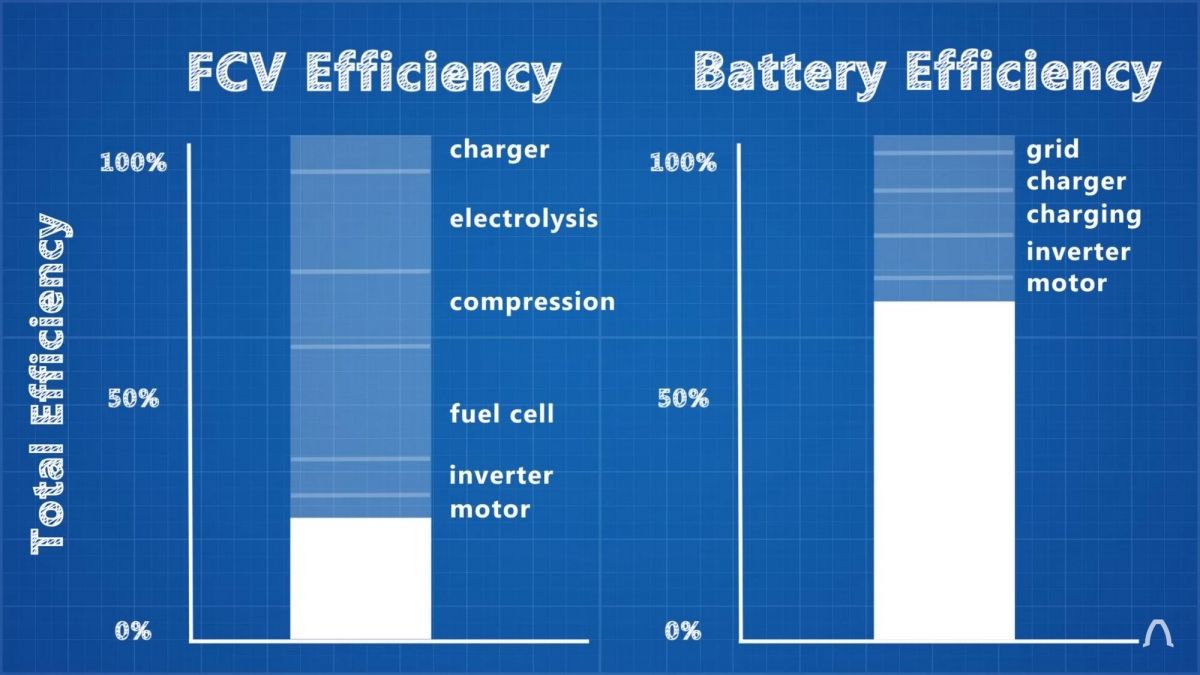
> "But the process of generating hydrogen by electrolysis using a proton exchange membrane is only about 80 percent efficient, so you lose 20 percent straight away. And at the other end, you'll lose somewhere around half of what you've got stored in the process of converting the hydrogen back into energy through a fuel cell."

So ever watt of power you put into it you get 40% of the power back in the for of go-juice. That's not even accounting for carting all of the hydrogen around the country to keep fuel stations supplied. Nor does it account for any drain from compressing it to deliver it to a car at home.

By comparison, you lose about 15% efficiency pushing the extra 500 pounds of Tesla around.

> If you can accept that a fuel cell car can match a battery powered one on efficiency

Efficiency isn't even close. Why would I accept what is clearly something which only exists in the imaginary future in your head? It's not even in the ballpark.

There are a lot of potential future applications for this technology, but large scale adoption of hydrogen in personal vehicles is not going to happen.

Re: Ford Makes $29B Commitment to Electric and Self-Driving Cars

#176
post #4

EVs make sense but at this point self driving cars are fantasy vaporware. Executives should be tired of embarrassing themselves in public with grand pronouncements of “just 6 more months!” by this point.

Fantasy vaporware that I still routinely see driving past my house.

Everyone quickly move the goalposts.

Re: Ford Makes $29B Commitment to Electric and Self-Driving Cars

#177
post #170
post #161

Earlier quoted context omitted.

That's just a big pile of misinformation. A fuel cell is pretty simple device. It's literally a type of battery not much different than a li-ion battery. The "complexity " you speak of is just a series of pumps and filters. Those cost nearly nothing and weigh very little. A fuel cell cad is likely to eventually cost the same as a Toyota Corolla while also allowing for gasoline-like refueling time and range. Finally,…

Its a a series of pumps, filter and tubes, and that is if we don't consider the tank. All of that is IN ADDITION to everything a normal EV also has. Look at this simple design, I'm sure they can't wait until they can finally mass produce it, so easy: https://global.toyota/pages/news/images/2020/12/09/1200/005.... And every car maker disagrees with you that it doesn't cost much. Maybe in some future it can be built as…

> Its a a series of pumps, filter and tubes, and that is if we don't consider the tank. All of that is IN ADDITION to everything a normal EV also has.

As if battery powered cars have no pumps, filters and tubes... And a tank is literally just a tank, with no complexity inside it. It allows you reduce the amount of batteries you need to carry by nearly 2 orders of magnitude. This is a significant reduction in cost and complexity.

> Look at this simple design, I'm sure they can't wait until they can finally mass produce it, so easy: https://global.toyota/pages/news/images/2020/12/09/1200/005....

You see a battery in the back, 3 hydrogen tanks, and the fuel cell stack in front. This is in fact quite simple.

> And every car maker disagrees with you that it doesn't cost much.

Most car makers have never even bothered to look seriously at fuel cell cars. The only companies that did think they can make one for the same cost as a Corolla. That should tell you something.

> Maybe in some future it can be built as cheap as you say, but not now. So you would really have to compare it to some future EV as well.

> Fuel cell have been studied for 60 years, and their efficiency is still not good. Li-Ion has made far more progress in far less time and is still improving significantly year over year. Nobody has announced anything close to that in terms of improvement for fuel cells.

> And even if there were such announcements, there is still a long way to go for fuel cells to catch up to current battery tech.

The problem is that you're just stuck in the past. Fuel cells have advanced to the point where they are a disruptive threat to battery electric cars. The notion that batteries have some massive lead is a claim completely at odds with reality. You're going to see cheap, long-ranged fuel cell cars in the coming few years. Due to advances in hydrogen related technology, batteries will lose every single advantage they enjoy, including the ability to refuel at home and cost per mile of driving. That is a big problem that battery powered cars will face.

Re: Ford Makes $29B Commitment to Electric and Self-Driving Cars

#178
post #167

Earlier quoted context omitted.

Why not? A company called Lavo is selling such a thing right now. You should realize that weight steals from your efficiency. A fuel cell can be less efficiency, but still gets you a similar distance on the same amount of energy. If you can accept that a fuel cell car can match a battery powered one on efficiency, then it’s conceivable that it can be as cheap to drive too.

> A company called Lavo is selling such a thing right now. A link would be nice. The only thing I could find is a home battery from Lavo which costs $26,000 and doesn't say anything about being able to compress and deliver hydrogen safely to a car. > If you can accept that a fuel cell car can match a battery powered one on efficiency, This is laughable. Here's some numbers direct from your Lavo home hydrogen battery:…

If you can electrolyze water at home, the compression step is not a hard problem anymore. This is more trolling than a serious counterargument. Alternatively, you can have hydrogen piped to the house instead of home electrolysis.

You should understand that fuel cells will continue to improve in efficiency. 40% today will mean 50% tomorrow, and likely 60% at some point in the future. Losses for transport and compression of hydrogen is a surprisingly small amount. In fact, its more efficient to pipe hydrogen over long distances than to transmit electricity. In additional, you can always reuse the heat in either CHP or thermal energy recapture.

It's also important to realize that the electric grid is not perfectly efficient, nor is charging a battery. You're likely to lose around 30% to these types of losses. This figure is going to get worse once grid energy storage and long-distance power transfer become necessary. Combined with your 15% loss pushing the extra battery weight and it really does start to add up. Worse if you look at cold weather performance. The notion that fuel cells can never match batteries on efficiency is a very short-term worldview.

Re: Ford Makes $29B Commitment to Electric and Self-Driving Cars

#179
post #168

Earlier quoted context omitted.

Unless you need to drive beyond the limits of your battery, at which point a gasoline powered vehicle makes more sense. I get the feeling your belief system is a post hoc rationalization since you’re just ignoring a major use case. If it really bothers you, then you probably be able to refuel your fuel cell car at home at some point in the future. So you can avoid the refueling station altogether with fuel cell cars…

> Unless you need to drive beyond the limits of your battery, at which point a gasoline powered vehicle makes more sense. I get the feeling your belief system is a post hoc rationalization since you’re just ignoring a major use case. I have a pretty good handle on my driving. Its been over a year since I've driven more than 300 miles in a day. Even when I was driving 500 miles 20 times a year, that's still only 20 Su…

Your own driving needs are not everyone else's drivers needs. 20 supercharger uses per year means you wasted more time than refueling a gasoline car 40 times a year. Fuel cell cars that can do both would be more convenient than either.

Fuel cells of the future will also be superior to fuel cells of today. That likely includes a dramatic increase in efficiency that will great reduce or eliminate this issue.

Re: Ford Makes $29B Commitment to Electric and Self-Driving Cars

#180
post #178

Earlier quoted context omitted.

> A company called Lavo is selling such a thing right now. A link would be nice. The only thing I could find is a home battery from Lavo which costs $26,000 and doesn't say anything about being able to compress and deliver hydrogen safely to a car. > If you can accept that a fuel cell car can match a battery powered one on efficiency, This is laughable. Here's some numbers direct from your Lavo home hydrogen battery:…

If you can electrolyze water at home, the compression step is not a hard problem anymore. This is more trolling than a serious counterargument. Alternatively, you can have hydrogen piped to the house instead of home electrolysis. You should understand that fuel cells will continue to improve in efficiency. 40% today will mean 50% tomorrow, and likely 60% at some point in the future. Losses for transport and compressi…

Yes, compression is a solved problem... one which adds additional inefficiency to an already terribly inefficient technology.

And of course your reply here we is more nonsense that hydrogen is going to continue progressing at miraculous rates while the rest of the world stands still.

Your quasi-religion about this is getting bad.

EVs are real. They are here now and don’t need future-magic to be viable and interesting. Hydrogen is essentially magic beans at this point being sold on promises and hot air.

Post reply on HN