In other news, the entire Universe is a nature park according to the town council of Nowhere, Wyoming. Just kidding. But what's the point of legislating things beyond our control?
Neil Armstrong's bootprint on the moon is now protected by U.S. law
41–50 of 58 posts
Re: Neil Armstrong's bootprint on the moon is now protected by U.S. law
#42So what would be the penalty if someone does something happens to it? Not flippant question as I am genuinely interested.
how utterly arrogant and entitled this headline sounds. A case of "US superiority" which makes me want the Russians or the Chinese to nuke the ruddy thing just so they have some additional thing to whine about.
This is a treasure of humanity’s achievement; and since there is no global governance body, it makes sense to start here.
Re: Neil Armstrong's bootprint on the moon is now protected by U.S. law
#43Re: Neil Armstrong's bootprint on the moon is now protected by U.S. law
#44Earlier quoted context omitted.
> The USA is more likely on a steady course of becoming increasingly less relevant to anyone but themselves. While it is certainly true that the USA is loosing it's status as the world's only superpower, it is still very much the most powerfull country and will probably stay, if not number 1, at least in the top 3 for at least the rest of our lifetime. I wouldn't call that irrelevant.
However, the US has about entirely lost their status as a model. As-is, following US legislation would require some amount of apologetic discourse anywhere outside of North America. (That the US have left the international community for the most, or, at least, have proposed to do so – especially, when it comes to treaties and jurisdiction – doesn't especially help either.)
Especially post Vietnam, it should never have been regarded as the model, humanity needs competing systems to better allocate risk.
Re: Neil Armstrong's bootprint on the moon is now protected by U.S. law
#45US taking their we have jurisdiction over everything to a whole new level
Re: Neil Armstrong's bootprint on the moon is now protected by U.S. law
#46Re: Neil Armstrong's bootprint on the moon is now protected by U.S. law
#47Earlier quoted context omitted.
That wouldn't be cricket https://www.youtube.com/watch?v=Nj-7SPf8_Qk Cricket on the moon would sure be interesting.
What about a moonlap? 3.5 hour drive in a Cybertruck?
Re: Neil Armstrong's bootprint on the moon is now protected by U.S. law
#48Earlier quoted context omitted.
> Who cares about a U.S. law outside of US jurisdiction? Alas, Julian Assange for one, as an Australian citizen, indicted for breaking a US law while not in the US. The recent UK court decision not to extradite him to the US nevertheless in no way disputes US standing nor jurisdiction, and he remains in custody while the US appeals. So, we're all living in America.
There's nothing unusual about this. Obviously you don't have to physically be in a country to commit a crime in that country. If I'm a German citizen residing in France hacking UK hospitals, the UK very obviously would want brought to justice, which both France and Germany would happily agree to in this case, I'd imagine.
> As things stand at the time of writing, following the UK’s departure from the EU [...], the UK will no longer be part of the European Arrest Warrant (EAW) system. This means that, unless and until other arrangements are agreed, future extradition requests with European states will be governed, as with many countries outside the EU, by the 1957 Convention on Extradition, leading to increased costs, delay and complexity in extradition proceedings. Certain EU states already do not extradite their citizens to countries outside the EU. Three EU states – Germany, Austria and Slovenia – have already announced that they may even refuse to surrender their respective nationals to the UK pursuant to an EAW during the transition period.
Re: Neil Armstrong's bootprint on the moon is now protected by U.S. law
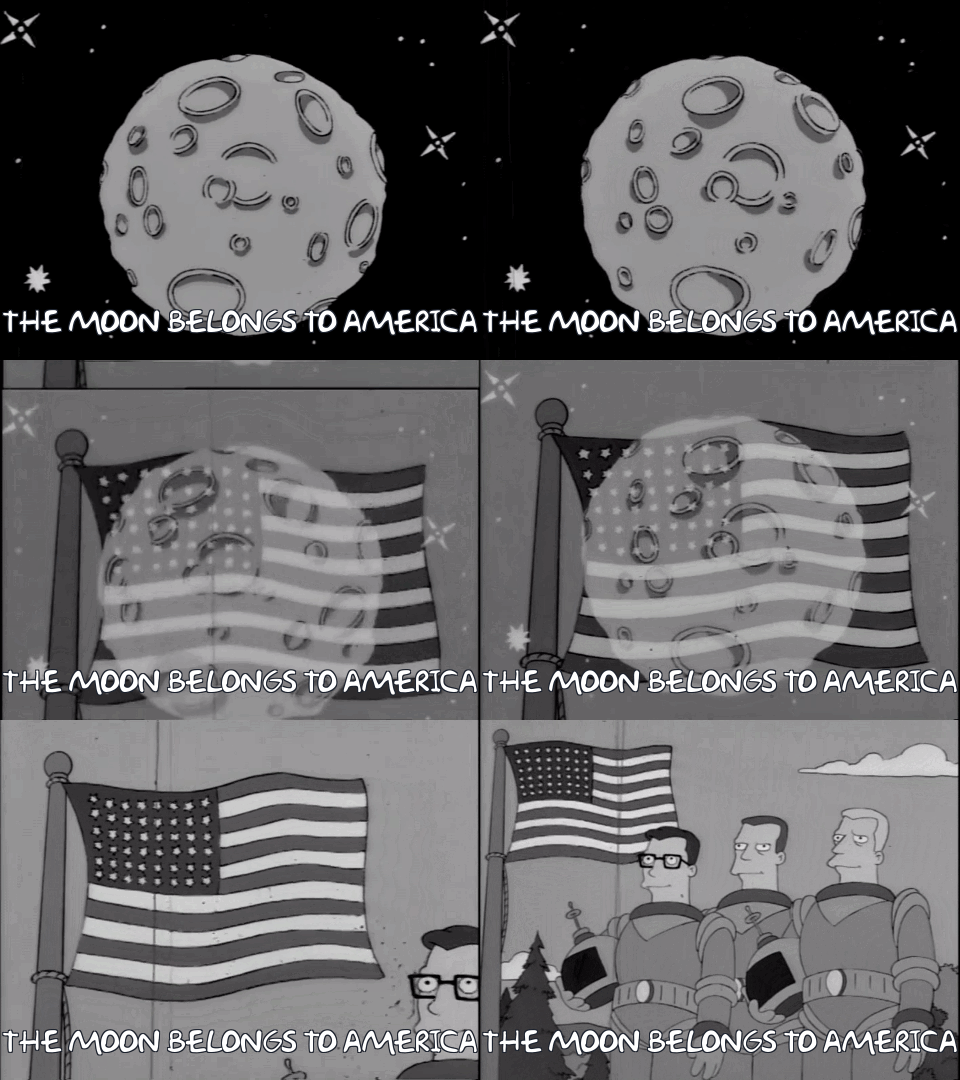
#49Just reading the headline leads me to the immediate reaction: Who cares about a U.S. law outside of US jurisdiction? If the U.S. wants other countries to follow the same rules they need to make international treaties like the outer space treaty from 1967. That requires actual diplomacy of course.
> Who cares about a U.S. law outside of US jurisdiction? Alas, Julian Assange for one, as an Australian citizen, indicted for breaking a US law while not in the US. The recent UK court decision not to extradite him to the US nevertheless in no way disputes US standing nor jurisdiction, and he remains in custody while the US appeals. So, we're all living in America.