Earlier quoted context omitted.
> I believe using such escalating fees would just favor the big companies who can stay ahead of the curve. But that’s fine. If a company can rake in so much money off of one product it’s still providing an obscene amount of value.
No it's not. It just entrenches the position of those who have money, to the disadvantage of everyone else.
E Ink has developed a 2nd generation Advanced Color E-Paper
141–150 of 194 posts
Re: E Ink has developed a 2nd generation Advanced Color E-Paper
#142I've heard people argue that e-ink displays would be in much wider use if the patent-holding company weren't so protective of the technology. So the news I'm waiting to hear is when E-Ink the company decides to loosen up its business practices.
not going to happen it s the only thing they have and they know its a cash cow if it gets wide adoption unfortunately they have gotten greedy and no one will pay it. They also seem to think their market is digital signage and aren't that interested in licensing for other mass market consumer products despite the fact the market it has been adopted most in is e-readers
I believe this was because of the limitations of the previous generations. I saw some color e-paper that was super slow to refresh and had terrible ghosting. No one would buy a color e-reader if it takes 15 seconds to turn a page, especially if it costs more than grayscale ereaders due to the 'new technology'.
OTOH, store signage is a use case where refresh and ghosting is relatively unimportant.
Re: E Ink has developed a 2nd generation Advanced Color E-Paper
#143Earlier quoted context omitted.
Between 2007-2009, 80+ Stratasys patents expired. Think about this - a single company holding back the world in advancing forward in 3D printing. Orthogonally, ever wondered why memory on your PC is so expensive? Thanks to Micron, Hynix and Samsung triopoly.
But isn’t it those same companies that are the reason that memory isn’t $1000/megabyte?
Re: E Ink has developed a 2nd generation Advanced Color E-Paper
#144> ACEP achieves a full color gamut, including all eight primary colors Last I checked there are three primary colors, and what is a full color gamut? There are several standard choices of gamut. What confuses me about color e-ink products is that it is a reflective display, yet none of them use a reflective color model (CMY) - all of them talk about RGB pigmented subpixels. Either what I learned about color reproduct…
In a subtractive colour model you typically have a fourth channel (CMYK) because simply mixing all three primary colours together still reflects too much light to get good contrast. For E-ink the colours don't actually mix with each other, so some basic maths shows that you would have even worse contrast with only three colours in a subtractive model: Each ink colour absorbs only a single RGB channel, eg. cyan absorb…
Re: E Ink has developed a 2nd generation Advanced Color E-Paper
#145I've heard people argue that e-ink displays would be in much wider use if the patent-holding company weren't so protective of the technology. So the news I'm waiting to hear is when E-Ink the company decides to loosen up its business practices.
not going to happen it s the only thing they have and they know its a cash cow if it gets wide adoption unfortunately they have gotten greedy and no one will pay it. They also seem to think their market is digital signage and aren't that interested in licensing for other mass market consumer products despite the fact the market it has been adopted most in is e-readers
Re: E Ink has developed a 2nd generation Advanced Color E-Paper
#146Why does every article on e-paper omit the most interesting bit of information? I.e. the refresh time.
Because it’s bad compared to every other digital display. They’re always on the order of seconds , and get even worse the more colors there are. Tri-color displays (red, white, and black) are sometimes up to a dozen seconds or worse. For example, [0] has a refresh time of fifteen seconds ! I’d be surprised if this isn’t an order of magnitude worse than that. [0]: https://www.good-display.com/product/223.html
https://goodereader.com/blog/e-paper/e-ink-waveforms-are-a-c...
Re: E Ink has developed a 2nd generation Advanced Color E-Paper
#147Re: E Ink has developed a 2nd generation Advanced Color E-Paper
#148I really want an e-ink (I mean an e-ink-only, not a dual-screen Lenovo ThinkBook) laptop. And I want it monochrome, low-refresh, no-clutter lo-fi. Rich colour, high refresh rates? No, thank you, I appreciate the mental silence classic e-ink devices provide. Just give me a reMarkable with a keyboard, capable to run a terminal and something like Emacs with org-roam.
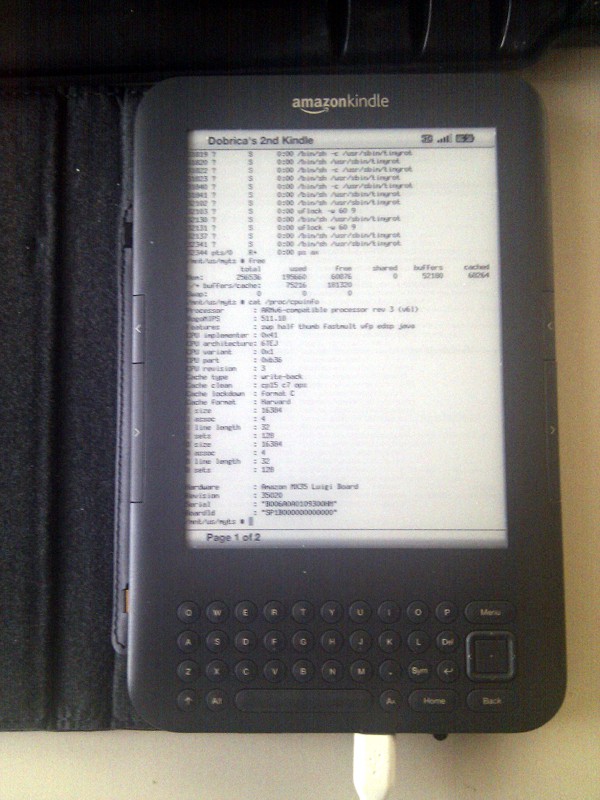
https://blog.rot13.org/2011/12/liberate-your-kindle-3-and-ge...
Re: E Ink has developed a 2nd generation Advanced Color E-Paper
#149Earlier quoted context omitted.
> That ties the duration of a patent directly to how much value it provides to the company over time Actually I think that idea causes the opposite of what is wanted. A high value monopoly patent will stay locked up for a long time, well after the development costs and risk have been paid off. The consumer is paying high economic rent and the product has less supply. A low value product is where a longer patent makes…
> A high value monopoly patent will stay locked up for a long time Yes, but this rewards you for inventing something high-value, which is the whole point of patents. Patents on low-value products largely exist to generate lawsuits against productive entities.
> In accordance with the original definition of the term "patent", patents are intended to facilitate and encourage disclosure of innovations into the public domain for the common good
The idea is that to avoid companies keeping the details of inventions hidden indefinitely using trade secrets, the embargo period is set up as an incentive to disclose the idea. This is an incredibly important part of the entire social contract of patents. Maintaining a complicated legal apparatus (courts, patent offices, etc.) to defend and enforce these legal monopolies is expensive and is paid through public funds. Thus a public good is expected in return. A system that allows the most important inventions to stay locked up forever seems to go against the spirit of this entirely. Perhaps you think that this has its own merit, but it is certainly not the intended purpose of the patent system.
Re: E Ink has developed a 2nd generation Advanced Color E-Paper
#150Earlier quoted context omitted.
Just to play devil's advocate, that's the whole purpose of patents, to prevent progress by others. On the other hand, the gain is that E Ink Corporation decided it was worth investing in developing and commercializing the technology knowing they'd have exclusive rights for 20 years, and quite possible only because of that. If they didn't have that guarantee, it might not have been worth any company developing it in t…
It’s important to remember every laws has trade offs, including patent laws. Perhaps patents stiffened e-ink but OP seems to have issue with patents in general which it would be hard to argue universally prevent innovation.
The main problem is "temporary", as patents have a flat duration but fields innovate and turn over at different speeds - compare web software to aeronautics/NASA software. The former could potentially he outdated within months, the latter likely won't be used until it's been tested for decades.
So obviously a 30-year patent is potentially paralyzing in webdev, yet might even be too short in space tech!
The problem is there simply isn't any duration that can satisfy both fields.
Meanwhile, often patents don't benefit anyone because they're 1) more trouble than they're worth to actually enforce, and only serve to reinforce the incumbents who don't need them, and 2) are in some cases deliberately written to be meaningless and uncommunicative, which defeats the purpose of open publishing in the first place.
Every law might have upsides, but that doesn't change the fact that patents are fundamentally flawed.