Live data from Hacker News

Anti-Pasta: When Italian Futurists Tried to Ban Pasta in Italy

mentalfloss.com

101–110 of 112 posts

Re: Anti-Pasta: When Italian Futurists Tried to Ban Pasta in Italy

#101

Earlier quoted context omitted.

> I noticed that after eating pasta, my blood sugar stayed elevated for 4-5 hours. But how long your blood sugar stayed high after eating "fast carbs"?

My meals without slow carbs usually had a "rounded" elevation that last for about 1 hour and converges do my baseline after about 3 hours. I never tried only carbs/fruits in a meal. I always add fat and some protein. I should try it for my next experiment. The glucose response also appears to be affected by physical activity before or after a meal. You can "walk-off" a heavy meal.

Thanks!
Re: Anti-Pasta: When Italian Futurists Tried to Ban Pasta in Italy

#102

I recently used the Libre Sense continuous glucose sensor as an experiment (I don't have diabetes). I noticed that after eating pasta, my blood sugar stayed elevated for 4-5 hours. It looks like calling pasta and bread "slow carbs" is appropriate. One of my conclusions from the experiment is that I will probably never buy wheat again (but I'll eat it if I get it served).

I have diabetes. For me, pasta is in the "normal" range.

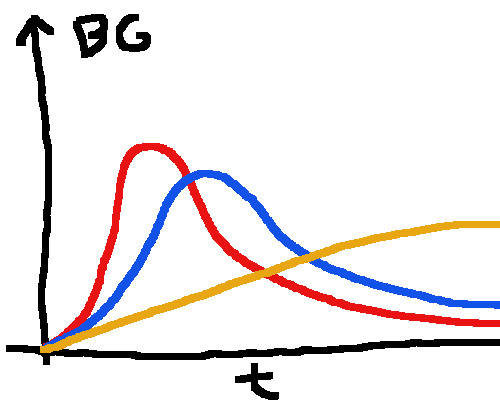
"Fast" -- candy, soda, etc. Hits in 20 mins and is gone in 2.5 hrs.

"Normal" -- pasta, a sandwich, rice, etc. Hits in 30-45 mins and is gone in 4/5 hrs

"Slow" -- high fat foods, peanut butter, meats, etc. hits in ~2h and is gone in 7-9

Made a little chart (†). The area under those curves is the same for the same g of carbohydrate but the shape is different.

The thing is, pasta is heavy. Compared to most meals it's dense and almost pure carbohydrate. So if you have even a little bit of insulin resistance you will definitely feel it.

Then there's alcohol, that lives in the complete opposite corner: a shot of vodka hits in the "fast" category but then actually lowers the BG later on.

https://i.postimg.cc/5tqc24zn/fast-slow.png

Re: Anti-Pasta: When Italian Futurists Tried to Ban Pasta in Italy

#103
post #13

Earlier quoted context omitted.

Your mention of guanciale reminded me of this delicious video: https://www.youtube.com/watch?v=3AAdKl1UYZs The serving seems gigantic though.

Big mistake: no olive oil should go in the pan where you cook the guanciale. Otherwise, everything else is legit.

Yes, even more that at some point he removes some of the oil/fat mix. What was the point of the oil, then?

Re: Anti-Pasta: When Italian Futurists Tried to Ban Pasta in Italy

#104
post #6

> the popular 21st-century view that heavy pasta meals leave diners feeling equally heavy and lethargic. Pasta gets a bad rap unfairly, I think. A few years ago over the course of ~18 months, I lost 100 lbs. I ate pasta almost every day when I did this. One problem, particularly in the US, is that portion sizes are so large. This affects much more than just pasta. But in the American mind, a serving of pasta is often…

That reminds me of this meme: https://mk0dietvsdiseascuno2.kinstacdn.com/wp-content/upload...

Yes, it is true that they have the same qualitative goal of creating a caloric deficit. However, some diet patterns slow down the metabolism more than others, which heavily impacts the likelihood of success in creating a significant (quantitative) caloric deficit

Re: Anti-Pasta: When Italian Futurists Tried to Ban Pasta in Italy

#105
post #74

Earlier quoted context omitted.

Uncooked. depends on the pasta type though. Spaghetti can be easily 180g. Penne, Fusilli or Rigatoni, let's say 150g. My sauces are generally quite light. I'm vegetarian, so they never involve calorie-dense ingredients such as guanciale or pancetta. (I know, I know, what am I missing and so on... :D) For me pasta means less ingredients as possible, at the highest possible quality. Examples: Fresh Tomato-Basil Spaghet…

Why should it depend on the pasta type? 100g penne is same as any other type.

Curlier pastas carry more sauce into your mouth so when you eat 100g of fusilli you're eating more total food than 100g of spaghetti.

Re: Anti-Pasta: When Italian Futurists Tried to Ban Pasta in Italy

#106

Earlier quoted context omitted.

As an Italian, my experience is that I can’t have any satisfaction with less than 180g of pasta. Therefore I only eat it like once a week and make it a little event. Growing up I had similar portions almost on a daily basis and I was never overweight. Trick: do sports. A lot.

As an Italian, that's really a lot of pasta. I eat 80gr of pasta, a bit more at the restaurant (they make larger portions), I hate big bowls of pasta and have it no more than 2/3 times a week, usually less. Pasta is a kind of food you have to eat and then wait that gastric acids kick in to take the hunger away If you're trying to eat pasta until it makes you feel full, you're having too much of it. Pasta releases wat…

> Pasta releases water over time and too much of it will also make you very sleepy, especially after lunch.

No way

Re: Anti-Pasta: When Italian Futurists Tried to Ban Pasta in Italy

#107
post #32

Earlier quoted context omitted.

Do you mean that in a negative way? A food with carbs that release over 4-5 hours seems ideal for lunch.

Practitioners of intermittent fasting and keto diet claim we have more mental clarity when we are in ketosis. During the experiment I made a homemade pizza with about 300 g of flour. After eating it I experienced brain-fog and I was not able to focus on reading a book that evening.

That likely very much depends on the individual. Personally I'm probably mildly hypoglycemic; I get brain-fog if I haven't eaten in a while - eating some fast carbs lifts the brain-fog.

Re: Anti-Pasta: When Italian Futurists Tried to Ban Pasta in Italy

#108

If buying (hard) pasta in the US make sure to look at the ingredients on the package and only buy pasta that lists only two ingredients: semolina and water. Not sure why so many other ingredients are added here. The pasta with only semolina and water tastes much better. Also make sure to cook it al dente, not al mush: https://www.simongriffee.com/pastaclock/

You probably know that salt is often fortified with iodine. Quite a lot of other basic foodstuffs, including bread, rice, and pasta, are fortified with folic acid, iron, niacin, etc. It's a largely forgotten program of the USDA that has been wildly popular in reducing the incidence of nutritional diseases. I presume that's what you're referring to, because I just looked at the ingredients on the spaghetti boxes of the two most popular brands of pasta in the U.S., Barilla and Mueller's, and they only list wheat--semolina & durham, and durham, respectively. But they're both also fortified, with Mueller including that in the list of ingredients, and Barilla listing them separately as vitamins/minerals.

I understand it's de rigour to eat "pure" foods, but it's actually led to reduced intake of important nutrients in the wider population. For example, until very recently iodine wasn't included in prenatal vitamins because for much of the past century most people used fortified salt. But with the increased use of kosher salt in home kitchens, medical advice not to add too much salt when cooking, and the fact that prepackaged foods don't contain iodized salt, iodine intake began to drop in the United States and UK.

Re: Anti-Pasta: When Italian Futurists Tried to Ban Pasta in Italy

#109

I love these events that makes food, cuisine and gastronomy political. In France, cuisine critics Gault et Millau attacked the fat, slow cooked, sauce heavy French cuisine for the same reason, opening the way for the new French cuisine "chefs". Pleasures of the senses over satiety. Earlier, Etienne Auguste Parmentier used elaborate tactics to have the potato accepted by the population, from fake guards around the fie…

> from fake guards around the fields Is there any actual proof of this? The same story has been told about Frederick the Great, and I always assumed it was an urban legend.

It could be a myth, and still contribute to the "legend".

Re: Anti-Pasta: When Italian Futurists Tried to Ban Pasta in Italy

#110
post #74

Earlier quoted context omitted.

Uncooked. depends on the pasta type though. Spaghetti can be easily 180g. Penne, Fusilli or Rigatoni, let's say 150g. My sauces are generally quite light. I'm vegetarian, so they never involve calorie-dense ingredients such as guanciale or pancetta. (I know, I know, what am I missing and so on... :D) For me pasta means less ingredients as possible, at the highest possible quality. Examples: Fresh Tomato-Basil Spaghet…

Why should it depend on the pasta type? 100g penne is same as any other type.

To be honest? I don’t know. My take is that they carry more sauce, as said above, but also penne and similar pasta suck in more water than spaghetti.
Post reply on HN