Live data from Hacker News

The Death of Tony Hsieh: A Spiral of Alcohol, Drugs and Extreme Behavior

wsj.com

301–310 of 314 posts

Re: The Death of Tony Hsieh: A Spiral of Alcohol, Drugs and Extreme Behavior

#301

Earlier quoted context omitted.

>>Tony Hsieh had a surprisingly large collection of half-empty liquor bottles at his desk. Not just Tony. My best friend used to work at Zappos. He used to brag to me that every employee/team gets their own mini-fridge, which is stocked with booze and liquor. He said that a common "bonding" experience for different teams in the company is to exchange different types of liquor. This was in early 2010s. He said drinkin…

Wait what are you kidding!? Drinking DURING the day was encouraged? So the famed company culture is to let everyone get drunk as long as they're all hitting targets? Recipe for disaster for anyone who stays a significant amount of time. It seems cool when you're young then after 10 years people start getting serious problems like alcoholic neuropathy. Very sad situation all round.

Studies have shown that light drinking has a positive effect on work performance, especially in creative areas. I had no idea that this was frowned upon and I'm from Texas, but that's probably just because I've lived my entire life in tech. Lots of startups provide copious access to booze and some even have full bars onsite. IIRC, oil executives drank liquor back in the day as well.

The situation with Tsieh is really sad and probably not a result of him being an alcoholic or drinking at work or anything else. Depression rates have tripled during the pandemic, and deaths are way up from overdose caused by people coping with isolation.
Re: The Death of Tony Hsieh: A Spiral of Alcohol, Drugs and Extreme Behavior

#302

Earlier quoted context omitted.

> There have been 1.5 million confirmed Covid deaths It'd really be halpful to frame with some kind of context. TB kills that many annually. To make matters worse, it's a curable disease, so these deaths are entirely unnecessary, but when was the last time you heard a peep about that? It's been raging for decades, and WHO is targeting 2030 as the end of it.

The best current estimate of the IFR of Covid is something like 0.5% with good medical care, or much higher without. If populations take no action whatsoever to curb spread, somewhere between 1/3 and 2/3 of people will likely be infected. If we multiply that by the population of the world, we get something on the order of 15–50 million people dead. Not as bad as the 1918 flu, but worse than any pandemic since, roughl…

Truly, where do you keep pulling the most alarmist numbers you think you can plausibly get away with from? COVID IFR at 0.5% with exceptional treatment? No, none of the wider more recent data backs this up, and please, don't just take my word for it. The CDC's more recent overview results don't at all back up your claim even though they do state that IFR can vary by region due to demographic and other factors. https://www.cdc.gov/library/covid19/112420_covidupdate.html

Re: The Death of Tony Hsieh: A Spiral of Alcohol, Drugs and Extreme Behavior

#303

Earlier quoted context omitted.

The best current estimate of the IFR of Covid is something like 0.5% with good medical care, or much higher without. If populations take no action whatsoever to curb spread, somewhere between 1/3 and 2/3 of people will likely be infected. If we multiply that by the population of the world, we get something on the order of 15–50 million people dead. Not as bad as the 1918 flu, but worse than any pandemic since, roughl…

Truly, where do you keep pulling the most alarmist numbers you think you can plausibly get away with from? COVID IFR at 0.5% with exceptional treatment? No, none of the wider more recent data backs this up, and please, don't just take my word for it. The CDC's more recent overview results don't at all back up your claim even though they do state that IFR can vary by region due to demographic and other factors. https:…

First, off the bat: why are you so aggressively hostile and abusive?

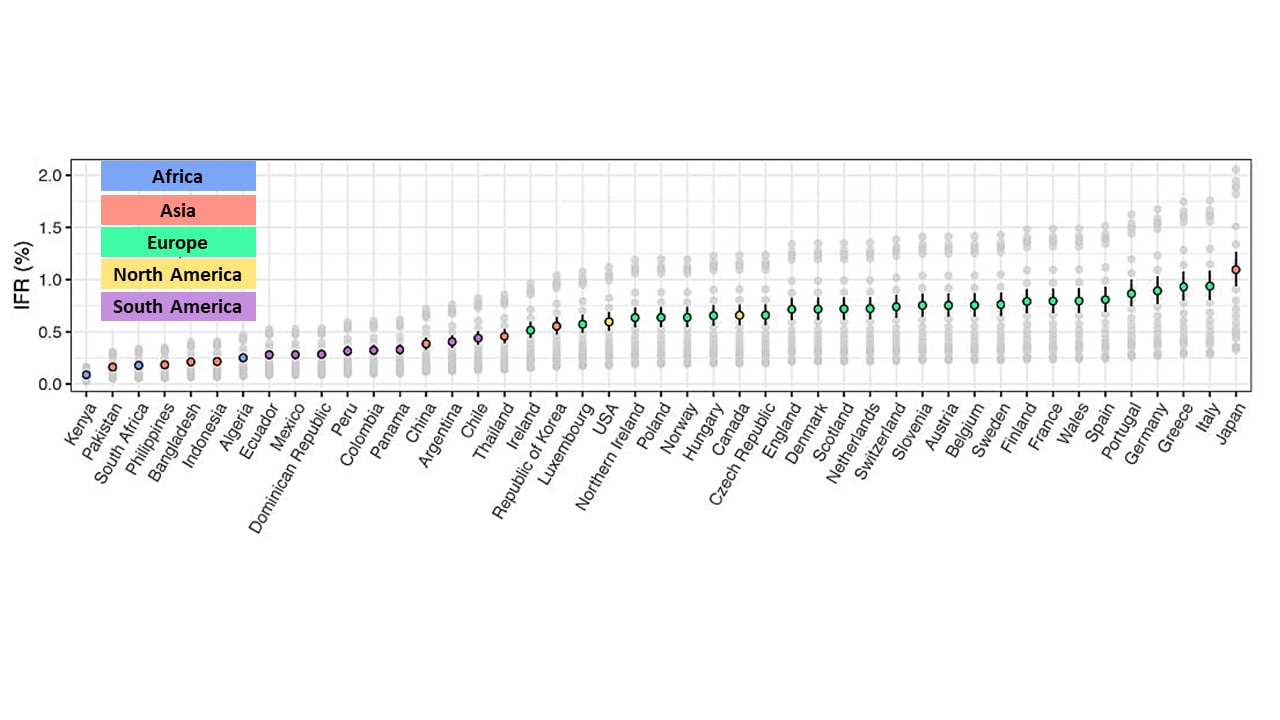
Your link estimates the Covid IFR in the USA to be about 0.6%, compared to e.g. 0.4% for China where the population skews younger or 0.8–1.1% for several European countries and Japan where the population skews older.

https://www.cdc.gov/library/covid19/images/november2020/1124...

I’m somewhat suspicious about the numbers for lower-income countries though. In Mexico for example Covid deaths have been grossly undercounted. These kind of high-level estimates are hard to do reliably when they are built on poor-quality low-level data.

I don’t know why you are pretending that “good medical care” (by which I mean, the average in a typical developed country with a well funded medical system that has not yet been completely overwhelmed; as compared to the “poor” level of care available in many developing countries or in places where hospitals are collapsing) is equivalent to “exceptional treatment”. I don’t know what you mean by “exceptional treatment”, but your link says nothing about it.

There have been a large number of estimates of IFR, and they consistently range from about 0.4% to about 1.5%, mostly toward the middle of that range. Judging by the best current science, the 0.5% number I used is probably a slight underestimate, but it is at at any rate in the right ballpark.

If you e.g. guess the actual number of deaths in absence of any countermeasures would be more like 10–20 million instead of the range I gave of 15–50 million, that seems plausible enough (though I stand by my estimate). It’s a counterfactual in any case, since in practice extreme countermeasures were adopted in many parts of the world.

Re: The Death of Tony Hsieh: A Spiral of Alcohol, Drugs and Extreme Behavior

#304

Earlier quoted context omitted.

If you want to play number games like that, then you should also acknowledge that many who died were on the brink of dead already without Covid. You should only count excess deaths, not who was tested or not. Show me the 3 million excess deaths, before you continue with the alarmism.

Eh, you probably should count what actually killed them, though you can make some arguments. If you have let’s say two years left to life and COVID ends up finishing you off, that’s a death due to COVID.

Just show me the excess deaths.

And what if somebody has only one month to live, and dies with Covid, also a death from Covid? Maybe yes, but really worthy of hyperbole then?

My grandmother died from the flu, at 99 years old. I never felt I should blame her death on the flu pandemic, though.

Re: The Death of Tony Hsieh: A Spiral of Alcohol, Drugs and Extreme Behavior

#305

Earlier quoted context omitted.

Children don't generally die from Covid19. Your numbers are exaggerated, Covid is not the only cause of death around the world. The load of sick people is also not exceptionally high, at least not in the intensive wards (don't have data for normal hospitalizations). Here in Germany we have daily updates on the number of ICUs in use. It shows Covid is only a fraction of the patients, even now only 10% despite of soari…

Of course there is an exceptional number of ICU patients. Many hospitals in Germany already are running at capacity and can't admit any more ICU patients. And that's despite every postponable operation being postponed.

I have posted the official chart of ICU occupation in Germany. How can you argue with that? Covid patients are only a small fraction of the occupied beds.

In general it makes sense to use existing ICU beds at capacity (or slightly below), to, you know, make use of them.

Surely you could also still adjust by delaying surgical procedures that are not urgent, if things would get worse.

Re: The Death of Tony Hsieh: A Spiral of Alcohol, Drugs and Extreme Behavior

#306
post #252
post #245

Earlier quoted context omitted.

The offical numbers say that German's hoslitals are not running at their limits. In average roughly 20% of intensive care beds are not occupied. https://www.intensivregister.de/#/aktuelle-lage/kartenansich...

You never run ICUs at 100% because where would you put the people who have car crashes etc? Optimal rate depends on the country, but about 75% is typical.

Sure, but that is exactly the case in Germany, only 80% are in use, as would be expected in normal times. Presumably they can adjust by delaying surgical procedures that are not urgent.

Re: The Death of Tony Hsieh: A Spiral of Alcohol, Drugs and Extreme Behavior

#307
post #245

Earlier quoted context omitted.

The offical numbers say that German's hoslitals are not running at their limits. In average roughly 20% of intensive care beds are not occupied. https://www.intensivregister.de/#/aktuelle-lage/kartenansich...

The regional differences are pretty high, and beds are in many cases not the limiting factor. It's ICU nurses. If you can read German here is a source for Berlin: https://www.tagesspiegel.de/berlin/zu-viele-corona-patienten... TLDR is only 85% of the beds are full, but there aren't enough nurses, so the emergency room will be closed. Several other hospitals in Berlin already stopped admitting new ICU patients.

As other said, it is not that unusual that individual units are full. As for staff, if things would become dire, surely more capacity could be mustered (people working overtime and so on).

And if it is really such a limiting factor, the statistics should be adjusted accordingly.

I think it is just a wildcard argument without any specific numbers. You can imagine whatever you like. How many nurses are available? How many are sick, specifically?

Also, sick nurses tend to be well again after two weeks (if they have Covid).

Re: The Death of Tony Hsieh: A Spiral of Alcohol, Drugs and Extreme Behavior

#308
post #219

Earlier quoted context omitted.

> put way too much focus (imho) on various nights and parties which don't really relate to entrepreneurship or business. “Work hard, party hard” is an extremely common aspect of startup culture. I personally suspect that startups tend to draw in risk takers, which explains the prevalence of over-drinking in many (but not all) startups.

How is drinking risk taking? I was in groups that where drinking was super normalized and never ever perceived it to be dangerous. Plus, anxious fearful people do drink too, it makes them feel better. I mean, I avoided drinking near to some specific individuals (I am woman), but I perceived those individuals to be unsafe. Drinking itself did not constituted risk taking for me.

Over-drinking is risk taking, OP explicitly mentioned that, not just "drinking".

It's risk taking because over-drinking is by definition going over your limits with alcohol and I assume we all know the behaviours that this can bring with.

Re: The Death of Tony Hsieh: A Spiral of Alcohol, Drugs and Extreme Behavior

#309

Earlier quoted context omitted.

No. Intoxication is generally considered to be mental impairment or a change of mental state, like mood, inhibition, etc. The warming feeling you get from alcohol is due to alcohol dilating blood vessels, moving more warm blood to your extremities and skin. It is a real physical reaction, not a mental perception. So while you might also be intoxicated, the warm feeling is not intoxication per se.

If it’s giving you a physical reaction then it’s also going to give you a mental one. They go hand in hand

Well, no. It is a drug and drugs do different things to different systems at different levels. You can't just assert that a drug must be doing B because it is doing A at the exact same dosage.

Re: The Death of Tony Hsieh: A Spiral of Alcohol, Drugs and Extreme Behavior

#310

Earlier quoted context omitted.

Of course there is an exceptional number of ICU patients. Many hospitals in Germany already are running at capacity and can't admit any more ICU patients. And that's despite every postponable operation being postponed.

I have posted the official chart of ICU occupation in Germany. How can you argue with that? Covid patients are only a small fraction of the occupied beds. In general it makes sense to use existing ICU beds at capacity (or slightly below), to, you know, make use of them. Surely you could also still adjust by delaying surgical procedures that are not urgent, if things would get worse.

You said it yourself, you want to run ICUs close to capacity, so you can't just add another 10% (or 27% like in Berlin right now) for COVID patients without calling it exceptional load. Procedures are already being delayed to free up extra capacity, and nurses are working overtime. The system is fairly close to collapse and we're lucky that the current measures stopped the growth of new infections, albeit at a very high level. We couldn't handle another doubling.
Post reply on HN