Earlier quoted context omitted.
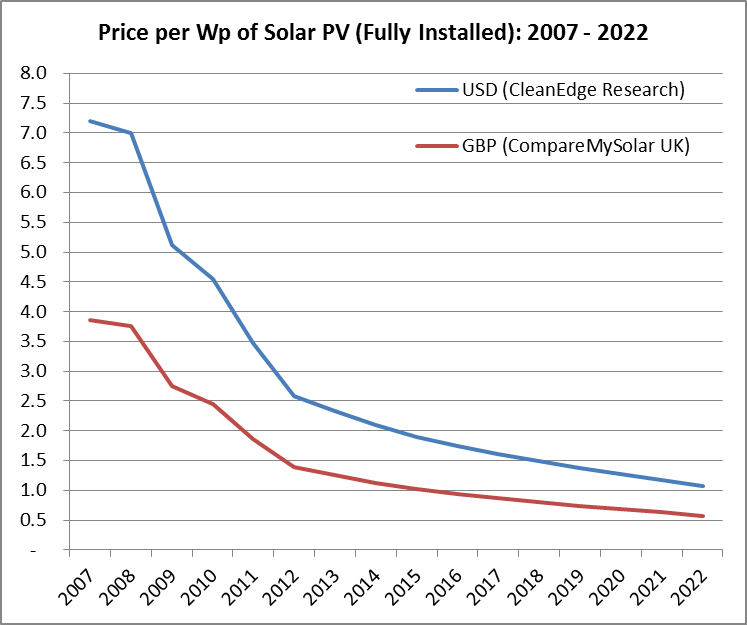
Great question! Here's what Germany did: They invested a vast amount in local renewables, at above market prices, that had the effect of dramatically driving down the global price of wind and solar. Because they radically expanded production capacity. Effectively, Germany gave the world a 'gift'! This had the long-term affect of dramatically increasing global solar + wind deployments (b/c prices fell) and transferrin…
Looking at the data on rolled out photovoltaics from here: https://en.wikipedia.org/wiki/Growth_of_photovoltaics It looks like Europe as a whole is only a fraction of global spending from 2012 onwards. Germany is only a part of that. How do you discount the counterfactual that Solar power costs were going down anyway as there was global demand anyway for solar panels at reasonable scale? Also, do you have any referen…
When I look at the "Worldwide growth of photovoltaics" plot at the top of the page you linked, I see the "Green" (European) color dominate from 2008-2013 (maybe 80%+ of installs). Germany purchases, peaking in 2011, where in the heart of when solar price declines occurred. By the same chart, deployments in the rest of the world explode post 2014, after the big price declines.
Here's an article from 2011 (concurrent with German deployments) showing the immense price falls at that time: https://rameznaam.com/2011/03/17/expis-moores-law-really-a-f...
Yes, there's a huge 'chicken' v 'egg' question here: deployment vs. price declines from tech learning rates. Someone had to kick-start this process by for huge deployments when it was uneconomical, to then drive scaling in production. Germany footed the bill. Global deployments then soured after those purchases and price declines.
Perhaps someone else would have done this later, but I don't really care about the historical counterfactual, I care about who's balance sheet the uneconomic debt, to kickstart the virtuous cycle, sits on. So I credit Germany.
Yes, I am attributing a success to the Energiewende that was not part of the initial plan. But I do think it's an important success. Here's reference: https://xenetwork.org/ets/episodes/episode-4-energiewende/
My understanding of the Energiewende, is that it was never focused on climate. Rather is was a plan to create economic energy independence at a time of very high and rising oil prices (e.g. 2008-2014).
So from 2020, the plan looks like a failure b/c 1) the twin tech. breakthroughs of low priced renewables and fracking have "slayed" the monster of rising high hydrocarbon prices 2) we now view climate change as a far bigger issue. If energy prices had stayed high, I think we'd view the Energiewende as achieving it's stated goals. The situation has changed.
Though, I'll be the first person to say the CO2 goals of the energy transition are more important than what the Energiewende focused on.