Live data from Hacker News

WTF Happened in 1971? (2019)

wtfhappenedin1971.com

451–460 of 477 posts

Re: WTF Happened in 1971? (2019)

#451
Under FDR and the conditions of the great depression, labor was able to get a seat at the table. 1940s onward the ruling class (corporate executives and corporate-aligned members of the political class) worked to dismantle the great society projects, the red scare was also used to this end.

By the 1970s labor had lost its seat at the table, unions had been demonized by the corporate class and their wholly-owned media organizations. Capital demands ever-increasing profits, those profits would be achieved by workers finding ways to increase productivity, and workers receiving an ever-decreasing percentage of the benefits.

This accelerated in the 80s under Reagan, Clinton being elected in 92 represented the democratic party fully abandoning labor.

Capitalism has a ways to go in China but is exhausted in the United States and Europe. Seeking increasing profit where none exists, it's now eating away at the base infrastructure like a starving body eating away its own muscle.

Historian podcaster Matt Christman has talked about this subject a bit in recent months on twitch streams, for example in this clip: https://youtu.be/DwH9i1yZR6E?t=1549

Re: WTF Happened in 1971? (2019)

#452
Ok i see not many people get this but let me explain how bad things truly are.

Ever since the reinaissance nations used gold was the reserve currency in one way or another(the romans also used gold and all other civilizations in fact one of the reasons the byzantine empire survived was because they were forced to adopt gold as a currency since hordes arriving at constantinople were better deal with by bribing them than fighting them and the barbarians demanded gold as payment so they adopted gold as a currency once again).

The western roman empire went on hyperinflation and was never able to regain it's stability.

https://www.youtube.com/watch?v=5YeEGcrinSM

Now you may be asking what the hell does rome has to do with the renaissance or gold. Well gold is a natural currency due to it's high stock to flow ratio(the mined stock per year is too small relative to the existing stock) this gives gold a yearly inflation of around 1.50%.

The problem with gold is that as a currency it's horrible and hard to transport and protect , in fact the byzantines adopted gold as the official currency due to what i mentioned above but the public still had a fiat currency for everything except paying taxes. So to pay taxes people needed to exchange fiat for gold and then pay the taxes in gold , this gave the government in the eastern roman empire the ability to balance budgets on a currency with 1.50% yearly inflation.

So europe ends up getting out of the dark ages and gold is once again a currency, then spain discovers the americas and brings lot's of gold to europe destroying it's economy since this sudden intro of gold caused massive inflation ironically

https://en.wikipedia.org/wiki/Spanish_treasure_fleet

But it also gave the whole of europe a golden age as a stable and abundant currency was introduced.

Eventually in the 19th 20th century gold was used as the reserve of fiat currencies.

This meant that governments WERE FORCED to balance budgets since they could not print more gold.

So from 19th century to 1939 the world prospered in some way constantly even if with massive wars. But at the end of the war the powers united at bretton woods to create a new world trade system but there were a few problems.

1_The soviets did not attend. 2_They had insane ammount of armies relative to western powers in europe. 3_All western powers minus the usa were destroyed.

The idea was to avoid the problems that gold had by creating a global currency called the bancor so central banks could trade with each other and devaluate against that currency if needed. But the usa smartly opposed this since in the case of the soviets marching west they were the only ones capable of financing the defense of europe. So at the end on bretton woods instead of the bancor something differnet happened the us dollar was adopted as the reserve currency backed in gold and all other currencies were going to be backed in us dollars.

So in the case of a war with the soviets the usa could inflate the usd and break the parity to finance the defense of europe. But that did not happened directly what happened was that after the korean war and eventually the vietnam war and LBJ programs i may add the usa broke the parity with gold.

This was all fine to a certain point until one understand that the usd was convertible to gold and countries like france demanded the gold in exchange of the usd.

The game theory behind the bretton woods was simple nations WERE FORCED to balance budgets since they could not print usds and the usa WAS FORCED to balance budgets since it could not print gold.

But in 1971 this unbalance was so great that nixon broke the gold standard and the world entered into something that never happened since the dark ages.

A system based on nothing and no game theory , the usa could print whatever the hell it wanted and other countries could also print what they wanted since now all currencies were floating against each other.

This is all fine if there is demand for those inflated currencies thus globalism and opening china , if the velocity of money goes up it's irrelevant to some level how much you print since the demand for said currency also goes up.

https://fred.stlouisfed.org/series/M2V

The problem is that disconnecting currency from gold which had a natural low inflation of 1.50% caused massive damage from a game theory because

1_Politicians could inflate without problem 2_Balancing budgets became irrelevant 3_They could change the definition of inflation to hidde the inflation.

So first they removed real estate from inflation indexes we went from

1_One worker being able to buy a house with two years of minimum wage in 1971 2_One worker needing a good job to buy a house in a 15 years mortgage in 1980 3_One worker needing a really good job to buy a house in a 15 year mortgage in 1990 4_One husband & wife needing to work on good jobs to buy a house in a 30 year mortgage in the 2000s

This is happening because currency was disconnected from a real good with low inflation , gold was not used because muh shinny , it was used due to it's low inflation.

When the dxy index that meassures the value of the us dollar relative to other fiat currencies(that constantly devaluate against the us dollar to keep their parity) shows exactly what i mean. Every time the dxy goes down bitcoin & ethereum or other cryptocurrencies which now has a low inflation goes up(and so does housing which also has low supply).

Basically it's a road to hell because every currency is devaluating against each other , the usd / euro rate can be the same for 10 years but relative to real estate both have lost their value. This was not the case before 1971 we are living in an insane experiment and the worse thing is that asset owners benefit from this shit which is leading society into feudalism.

As for how do we get out of this , who the hell knows as it seems the elites will introduce ubi to keep capital going up while purchasing power goes down. Maybe if we are lucky bitcoin takes over and forces politicians to reform this system but otherwise it's in their interest to keep it so it's hard to say what's going to happen.
Re: WTF Happened in 1971? (2019)

#453
post #270

Earlier quoted context omitted.

Moving to a different geography for a substantially higher compensation. The same phenomenon depresses compensation everywhere, so chances are most people won't be able to find compensation that's enough to keep the family going.

> As this would depress salaries everywhere, that's very unlikely. This part of your comment was super confusing. So much so it seems better in reverse: >As that's very unlikely, this would depress salaries everywhere.

The unlikely is that they'd find employment that's good enough to provide for the whole household elsewhere, because all geographies would be experiencing the same pressure.

Re: WTF Happened in 1971? (2019)

#454

Earlier quoted context omitted.

According to Thomas Piketty [1], it's mainly a result of a bifurcation in education, and dramatically rising managerial compensation helped with tax cuts. I personally also think this is the main answer. In other words, all our massive productivity increases have come from people with a ton of education, and they reap all the rewards, helped with lower taxes. The median worker isn't any more educated and hasn't reape…

LOL, as if people actually learn productive skills in college.

They sure do at Harvard or MIT. That’s the point.

Re: WTF Happened in 1971? (2019)

#455

Earlier quoted context omitted.

Social welfare spending, as a percentage of GDP, has massively increased since 1972. On the regulatoey side, major regulatory agencies, including the OSHA and EPA, were also created in the 1970s. Every broad-based measure of regatory burden shows increasing since 1971. So if anything, post 1971 United States has demonstrated the failure of abandoning economic liberalism in favor of central economic planning.

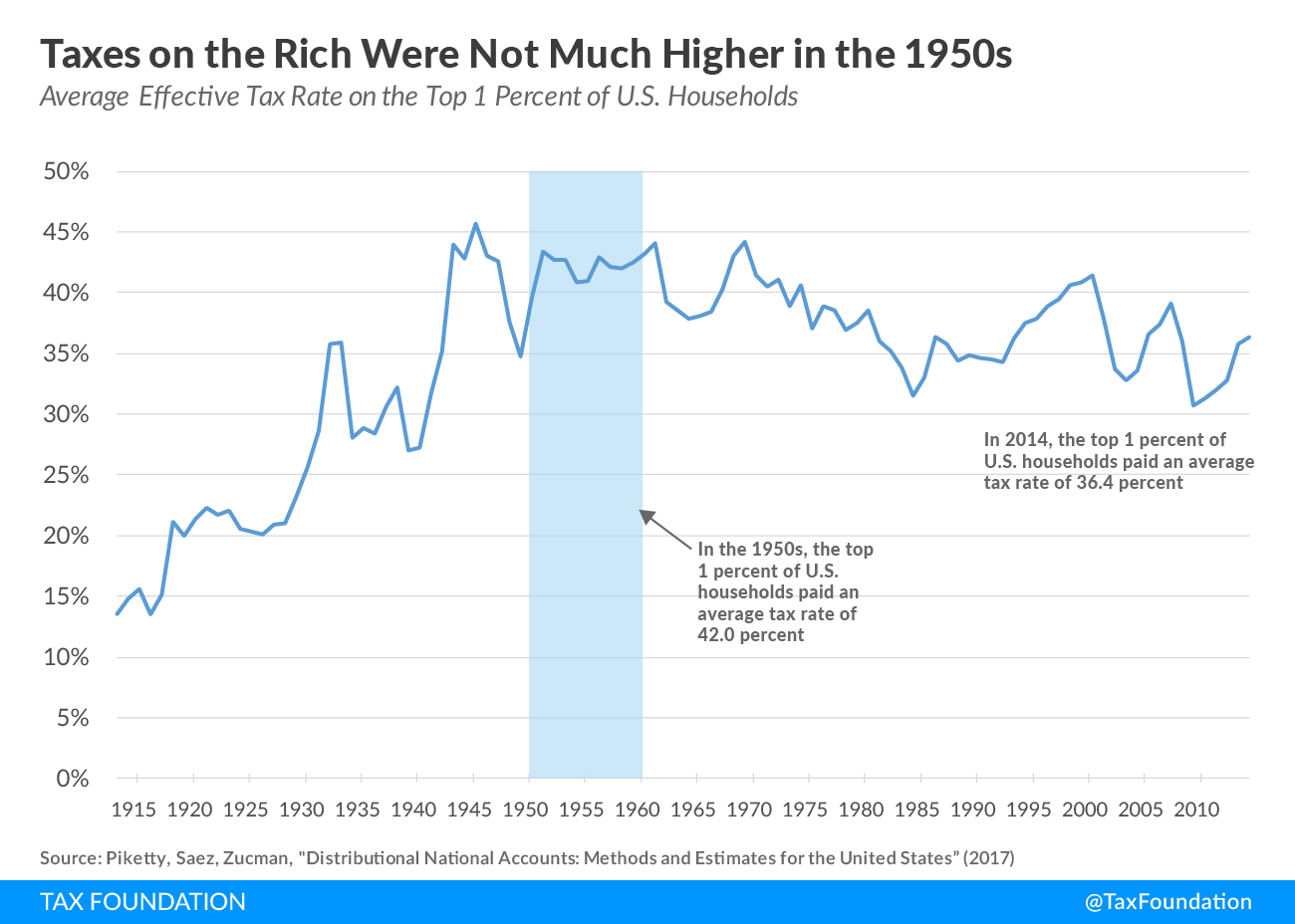
Taxes on the wealthy have decreased substantially in the US since the 50's. Even if social welfare spending is increasing, the wealthy are paying for less of it then they did before the 70's.

No they haven't. The top income tax rate has decreased, but other trends have counter-acted the effect of that decrease, like:

* all brackets creeping down due to inflation

* all brackets creeping down as a share of average income through the average income increase without a proportional raising of the bracket thresholds

* the closing of tax loopholes.

The result is that the effective tax rate for the wealthiest has barely decreased from the 1950s: https://files.taxfoundation.org/20170804133536/Average-Effec...

And this only covers reportable income. The cash economy was much more significant in the 1950s, so a lot of income could escape the gaze of the state.

>>the wealthy are paying for less of it then they did before the 70's.

No, the wealthy contribute a larger share of it than ever before.

Anyway, you're only focusing on tax rates on the top 1%, while ignoring every other factor, including major structural properties of an economy like what percentage of GDP is mandatorily redistributed by the state for social welfare programs, that would determine whether an economy is classified as economically liberal or social democratic.

Re: WTF Happened in 1971? (2019)

#456
post #400
post #398

Earlier quoted context omitted.

Perhaps. Seems to me that if that was the principal reason for the change, then the transition would be smoothed over several years.

It is not. It just added a bit to the effect, I'd put it as secondary or less.

Thanks, it is nice to see different perspectives!

Re: WTF Happened in 1971? (2019)

#457
post #418

Earlier quoted context omitted.

We did? I mean salaries in finance from the 80s on were much higher than in the 60s. They went from being some kind of accountants to being masters of the universe. And incomes of people near the top, in all fields, increased relative to the median too.

The argument is about government spending "crowding out" commercial spending. I have a very hard time believing that any government spending programs are affecting the demand for financiers' labor.

Oh I see. Sorry I took "This free money" to mean the money flowing into finance, largely as a result of regulatory changes IIRC, rather than direct govt. spending. But it's possible I've lost the thread of what's being argued here.

Re: WTF Happened in 1971? (2019)

#458
post #386

Earlier quoted context omitted.

You can summarise this argument, and several of the other arguments in this thread as: It was large-scale government spending financed by seignorage/inflation instead of taxes that did this. "Free money" for politicians, hidden from the electorate. Not just in America, but as a global phenomenon. With GREAT emphasis on the fact that is was not the large-scale spending that did it in, but the hidden aspect of it. You…

> You can summarise this argument, and several of the other arguments in this thread as: It was large-scale government spending financed by seignorage/inflation instead of taxes that did this. That's the angle that a lot of people want to push, but is it actually correct? What about the trade deficit angle? Especially with regards to oil imports.

Everything is connected. Since the government, despite what people seem to think these days, still represents something between 30% (only government directly) and 60% (government + contractors + fully dependent on government + ...) of the economy in the US, it can easily explain a 3% trade deficit.

But again, the actual spending is NOT the problem. Nor is the trade deficit. Using sovereignty (ie. government spending inflation) to take away normal people's ability to negotiate with accurate information (and voting) what their fair share of the economic pie is. THAT is the problem.

We could double government expenditures without causing a real problem. But if we double them and only 1% of people go to their boss "I need a raise" because they just don't know, then it'll be really bad: they'll have to compete for goods and services with the other side having double as much money as it does now.

Re: WTF Happened in 1971? (2019)

#459

The author obviously wants you to believe that it was the abandonment of the gold standard, but there are several other theories that have more credence with mainstream economists. The early 70's was the start of a horrible period of stagflation: stagnation coupled with inflation. Some do blame the loss of the gold standard, but the leading theory is the OPEC oil crisis. Others blame market regulations, the EPA was p…

> we could see energy prices decline at a rate reminiscent of Moore's law. Please do not base your vision of the future on exponentially-growing energy consumption

Yes, sometime within the next decade, many environmentalists are going to start seeing solar as the enemy rather than as their friend. It'll provide cheap energy and it uses lots of land.

Cheap clean energy by itself isn't a problem, but many of the behaviors it enables certainly are. We should be attacking the problematic behaviors rather than blaming it on cheap energy. The alternatives to cheap clean energy are much worse for the environment.

Re: WTF Happened in 1971? (2019)

#460

The author obviously wants you to believe that it was the abandonment of the gold standard, but there are several other theories that have more credence with mainstream economists. The early 70's was the start of a horrible period of stagflation: stagnation coupled with inflation. Some do blame the loss of the gold standard, but the leading theory is the OPEC oil crisis. Others blame market regulations, the EPA was p…

> Some do blame the loss of the gold standard, but the leading theory is the OPEC oil crisis.

The latter is a consequence of the former. The US defaulting on its gold obligation is equivalent to trading oil in exchange for paper rather than gold. Of course the OPEC countries were reluctant to sell their oil for irredeemable pieces of paper rather than something redeemable in gold.

Talking about the “oil price” as one thing before and after 1971 doesn’t even make sense, as the US gold default constituted a change in the unit of measurement for USD-denominated prices (gold versus irredeemable paper notes).

Post reply on HN