Live data from Hacker News

Apple’s M1 silicon is all about platform control

androidauthority.com

191–200 of 364 posts

Re: Apple’s M1 silicon is all about platform control

#191
post #132

Earlier quoted context omitted.

Because the GPU there is okay-ish, but not amazing - not really suitable for gaming.

The power-sipping, integrated GPU has performance 30% better than a GTX 1050 Ti [1]. The GTX 1050 Ti is still a current, sold product [2], selling for $150 or so USD [3], and consumes about 75-100W in your PC. We can no true Scotsman this, but that GPU performance is a literal magnitude+ greater than what the majority of users have in their computers (and I am including full desktops in this discussion). The overwhel…

That was some Fake news using worthless benchmarks. It's not even near 1050 Ti in the real world, check any game, M1 gets destroyed by that 4 year old 1050 Ti GPU. For example, Shadow of the Tomb Raider 45 fps 1080p medium vs 26 fps on M1.

You might say it's because of Rosetta (not that it makes any difference because probably most games will never be ported anyway, so Rosetta is all you get when talking about current games), but there's another game which has Apple Sillicon support - World of Warcraft. That one measures high 30s to mid 40s fps on ultra 1080p vs 58.1 avg fps on 1050 Ti. Comparisons are from userbenchmark.com regarding 1050 Ti and youtuber tests regarding M1.

So all those claims "30 % better" were just a manipulative scam using benchmarks nobody cares about.

Re: Apple’s M1 silicon is all about platform control

#193

Earlier quoted context omitted.

> The writing has thus been on the wall for circa a decade, as I said. So do you say that there is writing on the wall for removing 32-bit support in Windows and Linux too? I certainly don't. If Apple deprecated 32-bit while introducing x64 then the writing would be on the wall but they kept supporting and updating 32-bit. > You figured 32-bit would be supported for what, 20 years? 30? At least one hardware generatio…

I saw someone post on a non work slack about their steam library, where they had a bunch of games that previously ran on mac, being decimated, and they meant decimated literally by catalina. 90% of their games were 32 bit.

Funnily enough that is the inverse of the historical meaning of decimated (to destroy 10% of something).

Re: Apple’s M1 silicon is all about platform control

#194
post #125

Earlier quoted context omitted.

That issue is actually quite interesting. It's because if the GPU is reverse engineered enough, you can simulate an Apple GPU on another machine _and_ run other OSes with a proper GPU stack on those macs.

The little I’ve heard about the M1 makes it sound radically different in one respect: the system RAM is unified with the video RAM and shared, rather than partitioned the way it usually is on integrated video. Now I don’t know anything about GPU stacks, but I could imagine that one change essentially requiring a rewrite of the entire stack if certain assumptions were baked into the old one. The new model would seem t…

That's present on basically every Arm SoC, with the CPU and GPU on the same die. (and Intel & AMD APUs too, the difference is that Apple is scaling UMA beyond what anyone did for sold systems in x86 land that aren't consoles)

Currently, Apple and NVIDIA have the beefiest UMA w/ the CPU GPUs available, and those are Arm solutions.

Re: Apple’s M1 silicon is all about platform control

#195
post #132

Earlier quoted context omitted.

Because the GPU there is okay-ish, but not amazing - not really suitable for gaming.

The power-sipping, integrated GPU has performance 30% better than a GTX 1050 Ti [1]. The GTX 1050 Ti is still a current, sold product [2], selling for $150 or so USD [3], and consumes about 75-100W in your PC. We can no true Scotsman this, but that GPU performance is a literal magnitude+ greater than what the majority of users have in their computers (and I am including full desktops in this discussion). The overwhel…

>The GTX 1050 Ti is still a current, sold product, selling for $250 or so USD

That's very misleading. The card was released more than 4 years ago and has a MSRP of $139[1]. It's neither a current or expensive product.

The $250 price is almost certainty because it's "rare", not because it's actually worth that much. See for instance, i7-6700k being sold for $279[2] when you can get a similar performing current gen i3 for $115[3]

[1] https://en.wikipedia.org/wiki/List_of_Nvidia_graphics_proces...

[2] https://www.newegg.com/intel-core-i7-6th-gen-core-i7-6700k/p...

[3] https://www.newegg.com/intel-core-i3-10100-core-i3-10th-gen/...

Re: Apple’s M1 silicon is all about platform control

#196

The truth is somewhere in the middle, so while this article has some good points it is too colored by a strong dislike for all things Apple and borderline conspiratorial thinking. I don’t think there is anything that suggests Apple is going to stop people from installing Apps outside their App Store. Rather it is about making sure it is easy for regular users to get Apps in a safe manner without malware and Trojan ho…

> We know for a fact that this is a much smaller problem on iOS than Android. I am happy that Android exists as a choice for users but let us not pretend there are no trade offs.

Android is not a choice for iOS users, it's not a seamless switch. The solution as I see it is that apple could still very well protect users from "trojans" but have an opt-in for 3p app installation. A button that says "I want to install apps from anywhere, I know the risks".

If I pay for the hardware, as a customer, I should be able to do whatever I want with it. With the iPhone, it feels like I'm renting rather than owning. I worry that's the direction apple is taking Macs in with the M1.

Re: Apple’s M1 silicon is all about platform control

#197
post #22

> However, that marginal improvement hardly seems worth upsetting the entire Mac OS developer and consumer software ecosystem. Really? This entire article is really dismissive, but this line especially struck me. I'm not convinced the M1 chip is some strange alien tech bypassing the laws of physics, but it seems clearly superior at its specific niche (single processes with an emphasis on low power usage, using fewer…

[deleted]

Re: Apple’s M1 silicon is all about platform control

#198

The truth is somewhere in the middle, so while this article has some good points it is too colored by a strong dislike for all things Apple and borderline conspiratorial thinking. I don’t think there is anything that suggests Apple is going to stop people from installing Apps outside their App Store. Rather it is about making sure it is easy for regular users to get Apps in a safe manner without malware and Trojan ho…

My wife was an apple fan until she bought an iPhone and got locked out when she forget the password. Apple support refused to cooperate despite repeated cries of help.

M1 feels like a stepping stone in the same direction on laptops.

Personally it feels wrong to pay for a device someone can lock you out of and then refuse to unlock. It's like paying ransom without getting kidnapped.

Re: Apple’s M1 silicon is all about platform control

#199
post #22

> However, that marginal improvement hardly seems worth upsetting the entire Mac OS developer and consumer software ecosystem. Really? This entire article is really dismissive, but this line especially struck me. I'm not convinced the M1 chip is some strange alien tech bypassing the laws of physics, but it seems clearly superior at its specific niche (single processes with an emphasis on low power usage, using fewer…

> Architecturally it looks like they're sacrificing expandability and raw multiprocessing power (like massively parallel database server multiprocessing) for a single minded focus on laptop chips. I don't see that there's any hard evidence they're doing that; there's no obvious reason that they can't just shove in more cores for an M1X or whatever (very much Intel's approach these days, say), and they're not (at leas…

Actually, they might not be able to.

Everything comes with a cost when you're working in silicon. You can add more cores, yes, but to do so, you either must make each core smaller, or increase the maximum distance between two cores.

This is important, because the longer the distance, the harder it is to maintain e.g. cache coherency between all cores. There's a physical limit to the speed electrons travel, and you have to account for that.

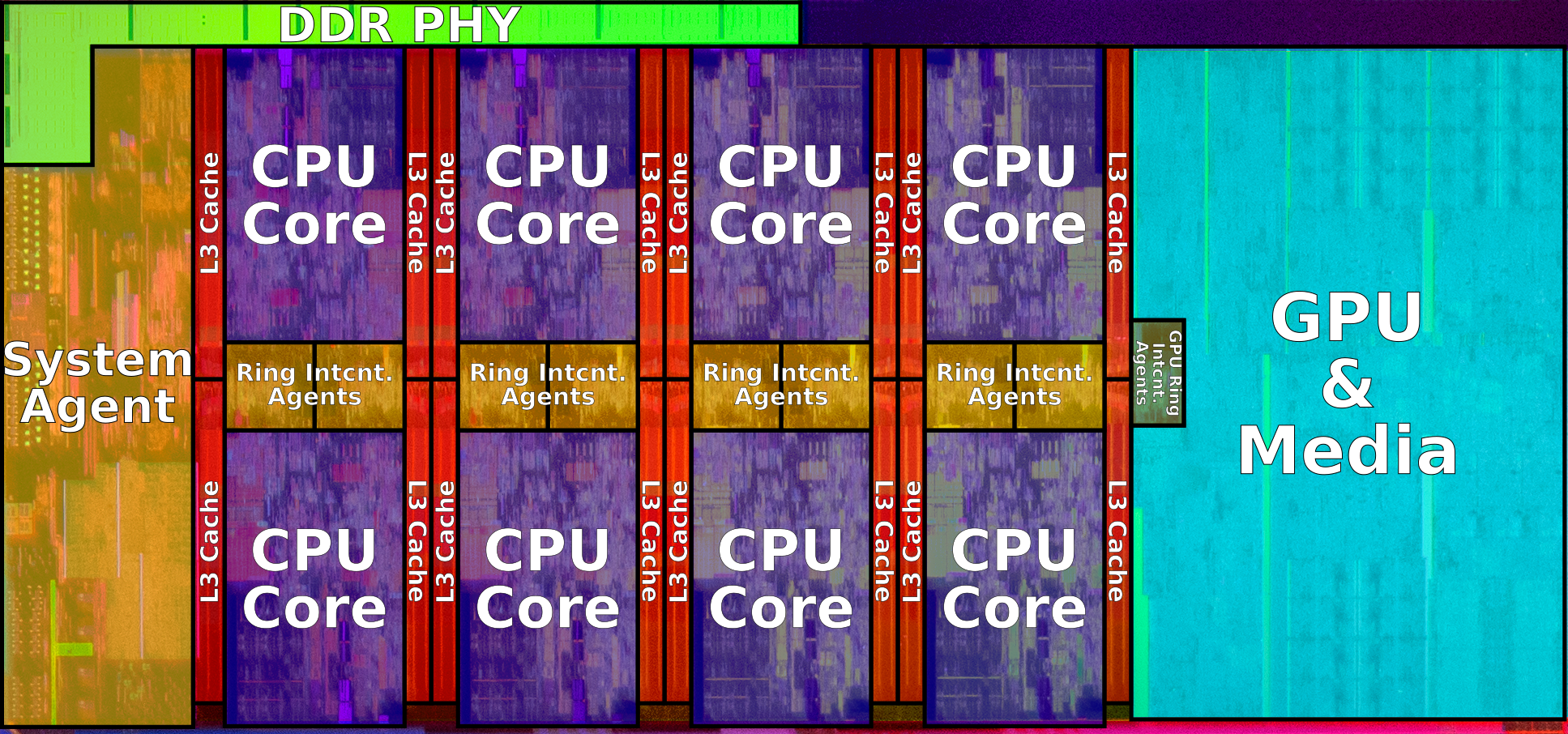
Intel's designs rely on pretty teeny cores with small L1{I,D} caches and small private L2 caches on a ring bus topology, with the iGPU on one polar end, and the system agent/memory controllers on the other ends. [0] [1]

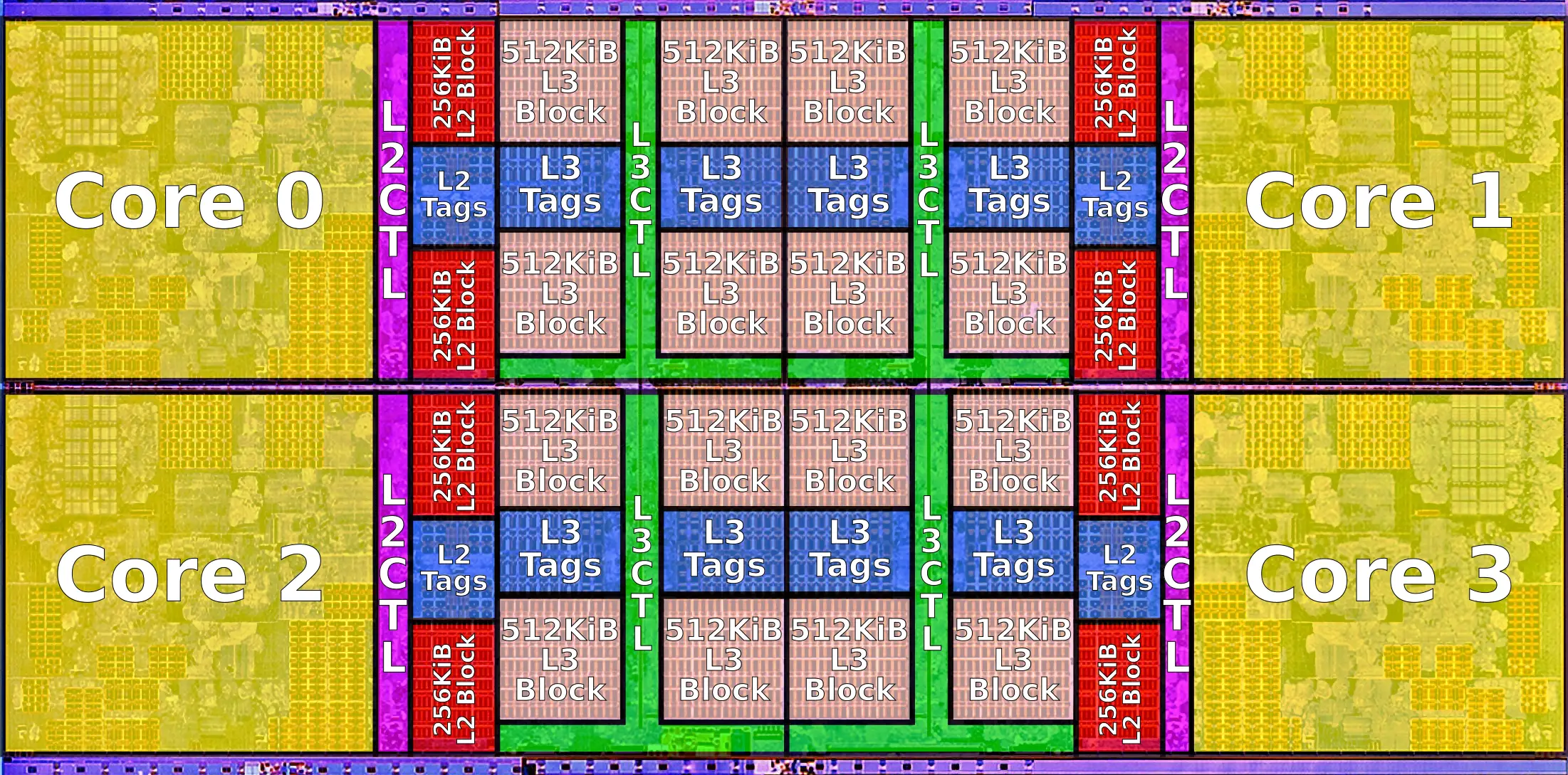
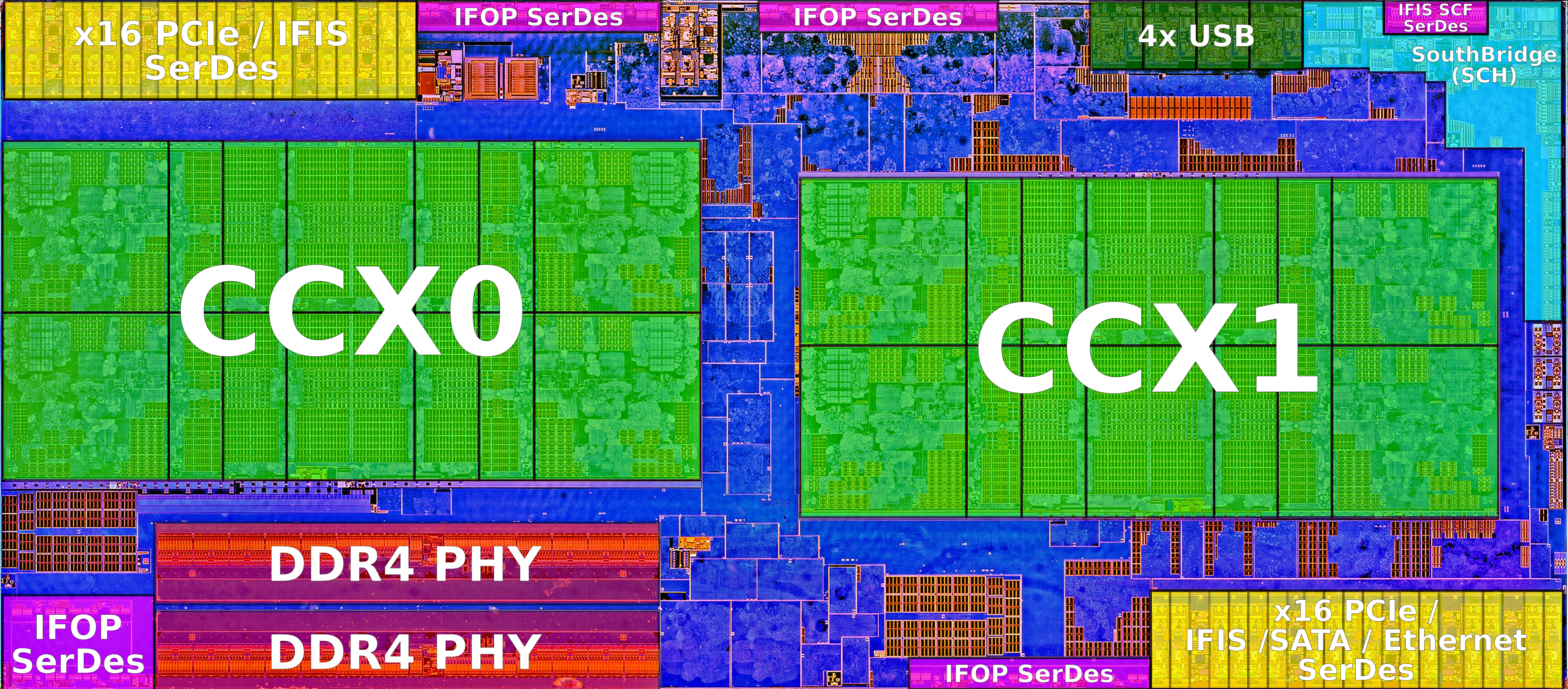
Zen takes a slightly different approach, using individual ICs with four cores on a single IC complex, sharing a single, relatively slow L3 cache, with small private L2 caches per core. The "chip complexes" are contained on a carrier chip which takes care of PCIe and the memory controller, similar to Intel's system agent, but farther from every core. [2] [3]

Apple has instead opted for all the cores to, instead, share a single large L2 cache, with enormous L1 caches. Both the GPU and CPU appear to have point-to-point connections to the memory controller and to the other peripherals.

Because they use 1) large caches and 2) squash everything together, they've managed to achieve ridiculously high memory bandwidth with teeny L1 latency.

For example, while Intel's latest uarch requires 5 CPU cycles to read L1D cache, M1 can do so in 3 cycles. Zen requires either 4 or 5 cycles.

There's no free lunch here, and I doubt they could maintain this same architecture while adding many more cores. They're missing the interconnects and necessary silicon to do so, and adding it would add latency and/or shrink existing caches. The design seems to be predicated on being small with minimal distance between components.

Caveat emptor, I'm not an engineer, this is all idle speculation.

[0] https://en.wikichip.org/w/images/thumb/c/cf/coffee_lake_over...

[1] https://en.wikichip.org/w/images/5/53/coffee_lake_die_%28oct...

[2] https://en.wikichip.org/w/images/a/a7/amd_zen_ccx_2_%28annot...

[3] https://en.wikichip.org/w/images/7/75/amd_zen_octa-core_die_...

Re: Apple’s M1 silicon is all about platform control

#200
post #88

Earlier quoted context omitted.

There is a cost to that though, the reality is Windows has become rather bloated because MS can't let anything go. It doesn't help that they have never been able to say no to anything and everything getting included.

> because MS can't let anything go. To be clear, this isn't really up to them. It's what market forces have dictated. Tons of old corp apps exist all over the place that necessitate this level of backwards compatibility.

> this isn't really up to them. It's what market forces have dictated.

This is a symmetric process. Microsoft chose its marker and set its customers’ expectations. That influences both who buys its products and how they structure their own dependencies.

Post reply on HN