Live data from Hacker News

16-inch MBP 2x slower than M1 MacBook Air in a real-world Rust compile

twitter.com

341–350 of 529 posts

Re: 16-inch MBP 2x slower than M1 MacBook Air in a real-world Rust compile

#341

Earlier quoted context omitted.

> I think the bigger question is what does this spell for x86-64? Not much? People are acting like M1 destroys x86, but as AnandTech showed in the recent benchmark, M1 is trading blows with Zen 3 in single thread performance while having much larger core and process advantage (5nm vs. 7nm) thus being actually more expensive to produce.

The only Zen 3 chips are desktop class, so Apple’s first generation ultra book oriented processor is trading blows with the best line of desktop processors. That’s a pretty big deal!

Zen 3 mobile chips are probably coming in the next months.

Single core performance does not differ much between mobile and desktop CPUs these days.
Re: 16-inch MBP 2x slower than M1 MacBook Air in a real-world Rust compile

#342

Earlier quoted context omitted.

Ray Tracing I'm not someone into the inner-working of chips much, but is "ray tracing" a new term used for something in microprocessors now? Or is this the same graphic "ray tracing" we were doing back in the 80's on Amigas and Atari STs?

We're crossing the threshold this year where real-time ray tracing in hardware isn't just some theoretical concept, it's actually useful and available in affordable consumer hardware (NVIDIA and AMD GPUs, as well as the PS5 and new Xbox all have it). Yes, the NVIDIA 2xxx RTX series had it two years ago, but this is the year where it's actually viable and not so gimmicky.

It's also shipping in consoles this generation, which is going to drive a lot more games to actually implement it. When it's only being used by 5% of the PC userbase, maybe you don't bother doing that work. If cheaper GPUs can push that up to say 20% of PCs next year, you still might not.

But when every PS5 and XSX has raytracing hardware, suddenly it makes sense. That's going to be helpful for getting it supported in PC titles sooner.

Re: 16-inch MBP 2x slower than M1 MacBook Air in a real-world Rust compile

#343
post #281

Earlier quoted context omitted.

Slack (probably the most popular Electron app) has confirmed they are going native on Apple Silicon: https://twitter.com/SlackEng/status/1326237727667314688?s=20

This is still Electron, no?

My guess is that it's an ARM build of Electron - unless they've been working to bring the iOS version over? That would be a huge win.

Even if this is Electron, I suspect this still great news for anyone that needs Slack. The Rosetta 2 performance of Electron would likely be a dog and Slack is a very high profile app with a lot of visibility.

Re: 16-inch MBP 2x slower than M1 MacBook Air in a real-world Rust compile

#344
post #308

Earlier quoted context omitted.

Laptop or desktop: likely, but even if the next Apple Watch will be faster, which I doubt, their smart speakers and headphones probably can do with a slower CPU for the next few years.

Is there a name for this trait of bringing unnecessary precision to a discussion, I wonder? I mean, contextually it’s obvious that the previous poster meant this is the slowest Apple Silicon that will ever exist in a relevant and comparable use case - i.e. a laptop or desktop. And the clarification that yes, slower Apple Silicon may exist for other use cases didn’t really add value to the discussion. And I’m not even…

Maybe "overparticular"

Re: 16-inch MBP 2x slower than M1 MacBook Air in a real-world Rust compile

#345
post #294

Earlier quoted context omitted.

Note that the comparison is also compiling to ARM vs compiling to Intel, so its partly to do with the simplicity of the compilation process between the two architectures. https://twitter.com/rikarends/status/1328762958118346753

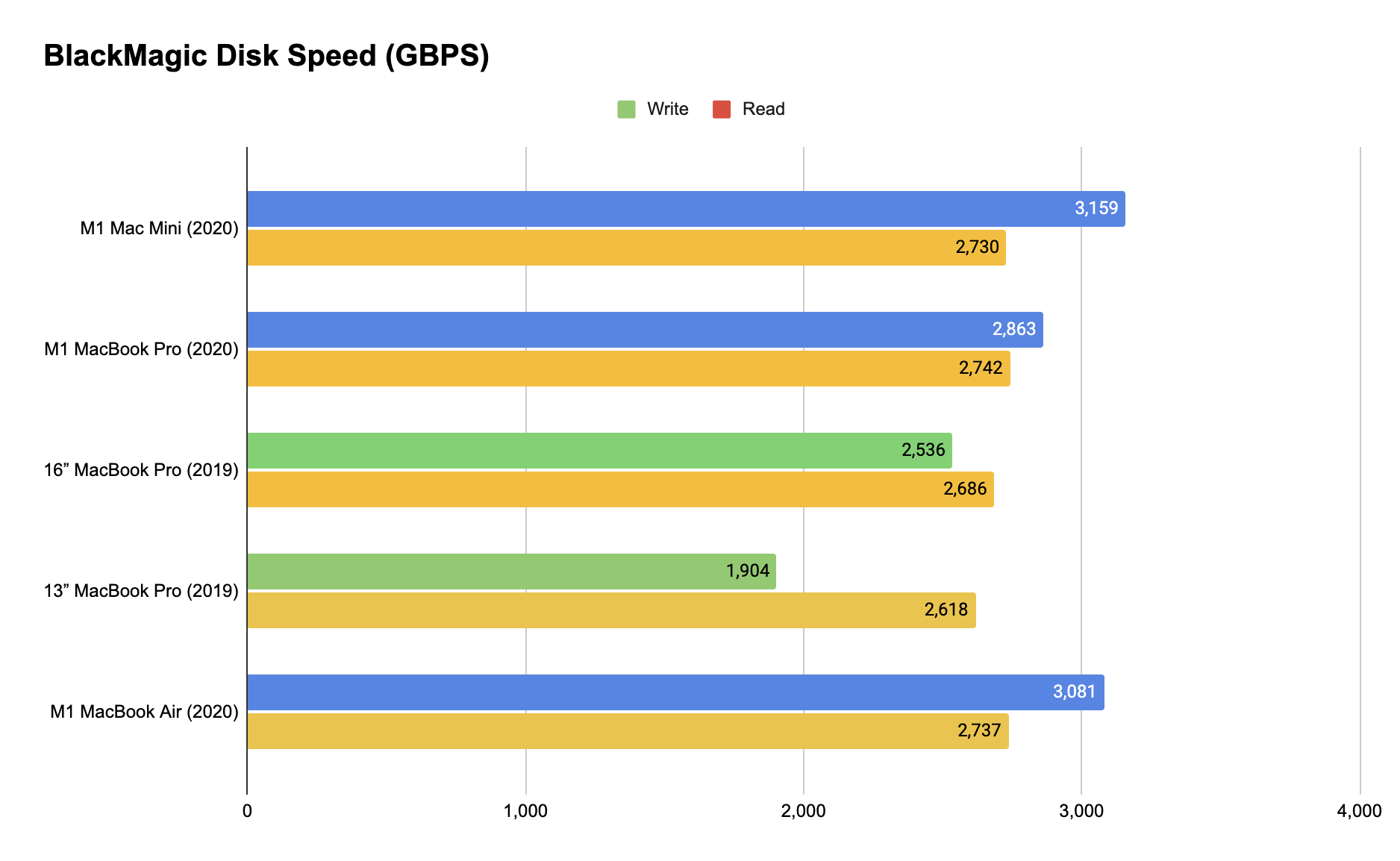
I'm also curious to learn where was the bottleneck in both tests. I've read stuff about how the M1-packing MacBook Air shipped with a SSD whose burst write speed was far higher than the one shipped in older MacBooks. The bottleneck on build jobs tends to lie on disk access, specially with projects comprised of a significant number of small files whose build also outputs a bunch of small files. This is one of the reas…

The SSDs are faster, but only by ~20%: https://techcrunch.com/wp-content/uploads/2020/11/BlackMagic...

From the TechCrunch review, which is pretty breathless but also contains a lot of good data: https://techcrunch.com/2020/11/17/yeah-apples-m1-macbook-pro...

Re: 16-inch MBP 2x slower than M1 MacBook Air in a real-world Rust compile

#346
post #236

Earlier quoted context omitted.

16GB is enough memory

What basis makes this comment apply to _everyone_ ?

I am a jerk. Trolling aside, I'm always a bit skeptical about the application, and roll my eyes (same as when people freak out about the processor on their smartphone). If you're sure it will make a difference though... you'd be like the one person out of ten that upgrades and sees a substantial improvement. Guess I can't help myself, and will accept my downvotes.

Re: 16-inch MBP 2x slower than M1 MacBook Air in a real-world Rust compile

#347
post #159

Earlier quoted context omitted.

Who knows, they might continue to offer an Intel MBP for years to come, or even add Windows ARM support if it commands enough demand. The other manufacturers have no mote here.

Windows arm is not real windows. It's not a substitute. Apple might command it's developers like a herd, moving them to whatever fancy new thing they make but windows is much more fragmented with 20+ years of backwards compatibility and tons of unmaintained software that won't be magically ported.

Current Windows on ARM seems promising with its x86 emulation so far, but still has a lot of room for improvement. Combined with the Windows 10 S sandboxing old windows apps I can see Microsoft catching up again in a few years once we have more widely available high power ARM processors.

In IT though, I don't expect any changes over to ARM hardware for another decade. I know where I work we have plenty of legacy cruft which would probably run into some weird edge cases if emulated on ARM.

Re: 16-inch MBP 2x slower than M1 MacBook Air in a real-world Rust compile

#348
post #4

I'm at the point where I need a new Macbook Pro and I can't help thinking I want the last generation of the x86_64 architecture, not the first generation of something new. Those have never paid off for me. At work, Intel would clearly be better. We do a growing amount of Docker work destined for Intel machines. But at home it's fuzzier, since I've been playing with k3s on a cluster of Pi clones. It's going to come do…

I'm unhappy with my MacBookPro16,1 I think it's slow, they keyboard is worse than that of my 2013 machine, the touchbar is useless and only produces heat. the fans are spinning 24/7 when an external monitor is connected. and a lot of the time the machine hangs.

my next machine won't be an macbook pro. 3000€ for a machine that can't handle my load is simply not worth it. especially since machines with more power and have linux/windows costing only around 2500€.

Re: 16-inch MBP 2x slower than M1 MacBook Air in a real-world Rust compile

#349
post #340

Earlier quoted context omitted.

According to anandtech the memory throughput is off the charts at 68.25GB/s [1]. That's twice as fast as high speed ddr4 memory (DDR4-4000 at 32GB/s). In other words: they totally trounced and took it to the next level with regards to memory, because they can. If anything, memory control is their biggest advantage. Scaling the amount of ram won't be an issue. Increasing the bandwidth perhaps, but it'll still be way q…

Isn't that just because all the memory is on the CPU?

Yes, but as other threads commented, this is not particularly new. It's similar to how games consoles have been designed.

It's a natural evolution, especially when MacBook Airs and the ilk are not really user upgradeable in the Intel form anyway. It's much harder for regular PCs to make this leap because one party doesn't have as much control.

Re: 16-inch MBP 2x slower than M1 MacBook Air in a real-world Rust compile

#350

Earlier quoted context omitted.

All CPUs throttle, all of the time. It's been years since anyone shipped a high-performance processor without a closed-loop dynamic thermal control system.

Having a throttling mechanism != the throttling mechanism is engaged With enough cooling, you can operate a CPU at full tilt and never engage the throttle.

If your CPU always runs at its steady-state temperature that means it sucks and it leaving performance on the table. A CPU that can run at a steady 3 GHz (or whatever) should be capable of 5+ GHz momentarily given the right initial conditions.
Post reply on HN