Live data from Hacker News

Banks, QE, and Money-Printing

lynalden.com

181–190 of 249 posts

Re: Banks, QE, and Money-Printing

#181

The fundamental issue with this article is that the inflation number is a lie. Housing costs are the key cost for every consumer but are excluded from CPI. Western countries have been running fiscal deficits consistently for decades, QE and low interest rates for 10 years. Yet for academics and central bankers the only answer to growth is more debt. Low interest rates benefit only the asset rich. They deprive everyon…

Housing prices are long term "bound" by CPI, not the other way around. More specifically they have always mean reverted to CPI if you look few hundred years back. Robert Shiller wrote a lot on this topic. Also, the current level of divergence between housing prices and CPI is nothing out of the ordinary. It will correct itself over time (either houses will become cheap or CPI will catch up). If you want a simple expl…

> “It will correct itself over time...”

by saying this, you’re implying that there is some underlying “truth” to cpi and housing prices, but it misses the underlying critique that these measures are not representing the truth on the ground at all, as experienced by americans.

cpi and housing prices may be correlated, but that says nothing about whether they each measure anything of societal relevance (similar to the critique of IQ, for example). we should expect housing prices to correlate to some combination of gdp (or some near equivalent, since that’s also a measure that’s gamed politically) attenuated by population and wages, as those would be underlying ingredients in the supply and demand functions. then when the correlation falters, we could potentially diagnose how the economy might be failing a core function of providing shelter to the populace.
Re: Banks, QE, and Money-Printing

#182

The fundamental issue with this article is that the inflation number is a lie. Housing costs are the key cost for every consumer but are excluded from CPI. Western countries have been running fiscal deficits consistently for decades, QE and low interest rates for 10 years. Yet for academics and central bankers the only answer to growth is more debt. Low interest rates benefit only the asset rich. They deprive everyon…

It definitely seems like BS to me. At 3% it's 258% over 32 years (1.03^32). Most people are barely getting 1% annual raises which means income increases by 138% over the same period. From 1984 to 2016 housing prices in the Greater Vancouver area have gone up 800% [1]. Assuming I got the math right, it doesn't take much to see current young people are getting screwed. In the last 4 decades wages have barely increased,…

You're perspective is skewed by living in one of the craziest housing markets in the world. Here in exurban Maryland (not to mention say Kansas City or Iowa) young people are buying homes and having kids.

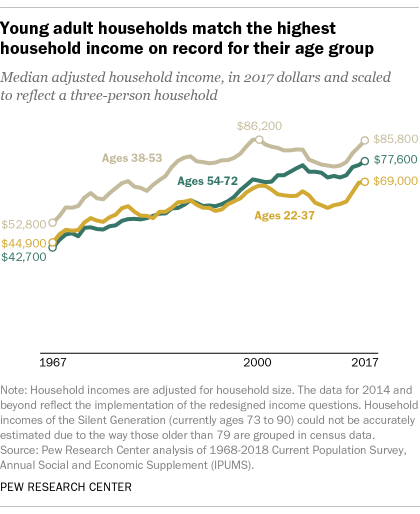
Millenials earn more than their parents did: https://www.pewresearch.org/wp-content/uploads/2018/12/FT_18...

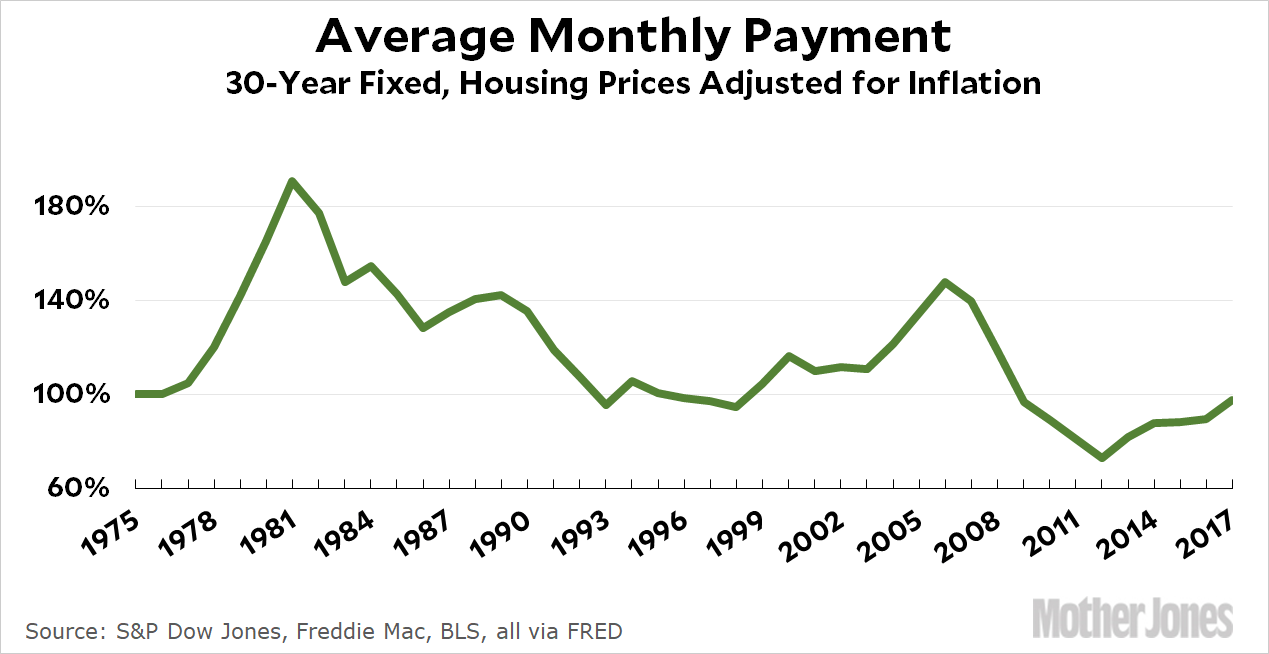
They pay less on a monthly mortgage payment than their parents did: https://www.motherjones.com/wp-content/uploads/2017/10/blog_...

Also, two-earner households were already the majority since the late 1960s: https://files.taxfoundation.org/legacy/docs/22.jpg. The percentage of households where only the husband works dropped a bit from 1980-1990, but has been basically unchanged in the last 3 decades.

The thing you're overlooking is that the median young person lives in Kansas City (or whatever the equivalent is for Canada), not Vancouver. Those young people living in Vancouver are getting screwed for sure. They should vote out the liberal governments causing housing prices to skyrocket through overregulation, causing credential inflation by throwing money at universities, etc. Or they can move to Kansas!

Re: Banks, QE, and Money-Printing

#183

The fundamental issue with this article is that the inflation number is a lie. Housing costs are the key cost for every consumer but are excluded from CPI. Western countries have been running fiscal deficits consistently for decades, QE and low interest rates for 10 years. Yet for academics and central bankers the only answer to growth is more debt. Low interest rates benefit only the asset rich. They deprive everyon…

The cpi is not a foundational premise of any argument in this article so I find this to be a strange critique.

Lyn Alden frequently makes the same arguments against CPI, in fact, most economists do. So this is a bit of a non statement.

Re: Banks, QE, and Money-Printing

#184
post #170

The fundamental issue with this article is that the inflation number is a lie. Housing costs are the key cost for every consumer but are excluded from CPI. Western countries have been running fiscal deficits consistently for decades, QE and low interest rates for 10 years. Yet for academics and central bankers the only answer to growth is more debt. Low interest rates benefit only the asset rich. They deprive everyon…

the free market will sort this out. oh wait. no it won't because you can't manufacture more land to build on.

Housing prices are going up regardless of land availability. In a smaller Midwestern city I visited this summer, there is essentially unlimited land in all directions from the city center - it is just farm fields. Regardless, the new construction they build is still priced 50% more than the exact same homes would have cost just 8 years ago, or about triple what they would cost in late 90's. You can verify this on sites like Zillow.

$8 / hour was the 'retail' wage back in the 90's in this area, and now maybe it has gone up to $14. I would imagine the professional salary has gone up even less - it has certainly not tripled from 1998.

Housing has far surpassed the rate of wage increases even in areas where land is not constrained. It has far more to do with interest rates and the monthly payment.

Re: Banks, QE, and Money-Printing

#185
post #118

Earlier quoted context omitted.

This is the definition of inflation that I was taught too. However it seems that people now days mean for inflation to be about price increases rather than money supply inflation (increases). The money supply inflates and deflates. Prices increase and decrease. I think it would be best if we all start being more clear and specific when talking about "inflation". Printing money DOES automatically lead to inflation. It…

When talking about inflation, there's no such thing as "money supply inflation". The term inflation IS clear, you're just choosing to try and redefine it to match your purposes. Inflation is a rise in the price of goods, full stop.

When using the word "inflation" without context is is referring to increased money supply. When using the word "inflation" with regard to prices it is in a different context. The assumed context is what has changed due to the fact that money supply no longer is directly correlated with price increases. When gold and silver were directly debased, prices of goods were directly inflated. If we still used gold/silver currency "inflation" by itself would be synonymous with price increases. We use fiat currencies and the money supply is increased in certain industries or assets and therefore "inflation" has to be defined more clearly. Debasing fiat is not as direct as debasing commodity backed dollars or gold/silver currency.

The article author does a decent job of defining these, but fails to be clear as the writing progresses.

Re: Banks, QE, and Money-Printing

#186

If you're interested in this stuff you might like: - MacroVoices Podcast[0] - The Market Huddle podcast[1] Lyn has been a guest on the Market Huddle (so you can hear her talk through this article) and Stephanie Kelton has been interviewed on MacroVoices. [0]: https://www.macrovoices.com/ [1]: https://www.youtube.com/channel/UCTNgTBKATr18Z7kR32rKOBw

The macro voices podcast is incredible especially their content with Lyn Alden and Jeffrey Snider.

Re: Banks, QE, and Money-Printing

#187
post #84

Earlier quoted context omitted.

Don't rent and housing purchase prices follow each other, roughly ?

Nope. They can go inverse when, say, an economy collapses and everyone is forced out of their homes as they go underwater on their mortgages and but they still need somewhere to live. Kind of like 2008/09

> an economy collapses and everyone is forced out of their homes as they go underwater on their mortgages

People are not forced out of their homes when their mortgages go underwater, they're forced out when they can't afford to pay the mortgage (underwater or not).

Re: Banks, QE, and Money-Printing

#188

Earlier quoted context omitted.

It definitely seems like BS to me. At 3% it's 258% over 32 years (1.03^32). Most people are barely getting 1% annual raises which means income increases by 138% over the same period. From 1984 to 2016 housing prices in the Greater Vancouver area have gone up 800% [1]. Assuming I got the math right, it doesn't take much to see current young people are getting screwed. In the last 4 decades wages have barely increased,…

You're perspective is skewed by living in one of the craziest housing markets in the world. Here in exurban Maryland (not to mention say Kansas City or Iowa) young people are buying homes and having kids. Millenials earn more than their parents did: https://www.pewresearch.org/wp-content/uploads/2018/12/FT_18... They pay less on a monthly mortgage payment than their parents did: https://www.motherjones.com/wp-content…

>>> They pay less on a monthly mortgage payment than their parents did

The reference you gave for "They pay less on a monthly mortgage payment" is itself adjusted for inflation as noted on the chart. So using the questionable inflation figure itself to refute inflation isn't persuasive.

Intuitively also, I'm not sure I buy the argument that the median young person lives in Kansas City. I grew up with dozens of family members who actually did live in middle america (most of them as engineers at car plants.) Many of those jobs are not as cushy as they once were. Some are gone. From my own experience as an engineer, the weighted centroids of the job market are in SF or NY or DC, not in Ohio.

Of course, that is an engineering viewpoint, what about overall across professions? I dont quite understand this and i'd love to be educated. From everything I read, the traditional jobs in middle america have left and these towns struggle. My own experience is only anecdotal (e.g., upstate NY, western pennsylvania)

Re: Banks, QE, and Money-Printing

#189
post #158

Earlier quoted context omitted.

Health-"care" costs are rising even faster - premiums are rising 13-15% EVERY year. And the only way you see it in full is when you are self-employed. If you have employer-sponsored health insurance, some part of the increase is covered by the company - at the expense of your salary increase or bonus, of course.

There needs to be outrage at the Physician cartel, the hospital cartel, the pharmacist cartel, the pharmacy cartel, the pharma manufacturer cartel, and insurance cartel. These government granted monopolies make unnaturally high incomes due to regulatory capture. My best solution is to legalize a science based healthcare. Although the cartels would never allow it, they have spent billions establishing Authority based…

Sadly the public outrage seems to be demanding more authoritarian based healthcare

Re: Banks, QE, and Money-Printing

#190

The fundamental issue with this article is that the inflation number is a lie. Housing costs are the key cost for every consumer but are excluded from CPI. Western countries have been running fiscal deficits consistently for decades, QE and low interest rates for 10 years. Yet for academics and central bankers the only answer to growth is more debt. Low interest rates benefit only the asset rich. They deprive everyon…

It definitely seems like BS to me. At 3% it's 258% over 32 years (1.03^32). Most people are barely getting 1% annual raises which means income increases by 138% over the same period. From 1984 to 2016 housing prices in the Greater Vancouver area have gone up 800% [1]. Assuming I got the math right, it doesn't take much to see current young people are getting screwed. In the last 4 decades wages have barely increased,…

How much has average home area increased from 1984 to 2016?
Post reply on HN