Live data from Hacker News

Pygame 2.0

github.com

41–50 of 63 posts

Re: Pygame 2.0

#41
post #28
post #8

As coincidences go, just the day before yesterday I looked into pygame and came across this Quora question: https://www.quora.com/Is-Pygame-fast-enough-for-modern-game-... The sentiment seems to be that it's not suitable for more than small toy games -- which in itself would still be interesting. I mean, it's clear that professional AAA studios are not the core target group. But has anyone here on HN additional hands…

I wanted to counter some of the child comments who say that it's a bit of a child engine with some real world results. After all, people are making great games today with Pico-8 or on a Game Boy, surely there must be some great indie Pygame games. Now, these aren't AAA developers, but it seems to have as much capability as something like Love2D does. Sure enough, there's quite a few = https://itch.io/games/made-with-…

Having used both Love2D and Pygame, Love2D is far and away more capable than Pygame used to be, because it can actually use GPU acceleration, and because Lua's features (like coroutines) make for a far more expressive way to write games.

Which isn't to say that people can't use Pygame to good effect, but that you're working uphill with it a lot more.

Looking at other comments here, though, it sounds like newer versions of pygame stepped up significantly in terms of what can be done. Kudos!
Re: Pygame 2.0

#42
Circa 2007 I started messing with pygame. Just this week I dug up some of my old code and typed `python main.py` thinking, no way this'll work. But it did.

The first feature on the Pygame 2 page is "Backward compatibility". Pygame's been way behind the times and I'm excited to see it getting some attention. But major kudos to the team for maintaining that priority.

Re: Pygame 2.0

#43

I self learned pygame in high school, 15 years later I’m still using it for mapping and rendering - I probably shouldn’t, but I find the library just so damn intuitive. Congrats To the pygame team, and thank you for being the core tool which truly taught my objective code, and many UI design concepts (:

That's cool, what kind of mapping and rendering are you doing with it?

Re: Pygame 2.0

#44
post #19

Has anyone tested the android support? It could be an interesting tool for prototypes.

I highly doubt it's possible to do Android stuff with toys, I'm still curious to learn otherwise.

Re: Pygame 2.0

#45
post #8

As coincidences go, just the day before yesterday I looked into pygame and came across this Quora question: https://www.quora.com/Is-Pygame-fast-enough-for-modern-game-... The sentiment seems to be that it's not suitable for more than small toy games -- which in itself would still be interesting. I mean, it's clear that professional AAA studios are not the core target group. But has anyone here on HN additional hands…

I am working at a company that is tracking vehicles using GNSS antennas. When designing the vehicle dynamics model for the Kalman Filters, I found it useful to have a graphical representation (including error ellipses, velocity vectors etc). Turns out that pygame was a great fit for that type of visualization.

Fast forward to two days ago, when I was idly watching George Hotz design a monocular visual SLAM prototype in 11h. Much to my surprise, one of the first things he fires up is pygame for visualization [1]!

[1] https://youtu.be/7Hlb8YX2-W8?t=701

Re: Pygame 2.0

#46

Circa 2007 I started messing with pygame. Just this week I dug up some of my old code and typed `python main.py` thinking, no way this'll work. But it did. The first feature on the Pygame 2 page is "Backward compatibility". Pygame's been way behind the times and I'm excited to see it getting some attention. But major kudos to the team for maintaining that priority.

[deleted]

Re: Pygame 2.0

#47
post #23

My wishlist: * Integration with numpy/scipy/matplotlib/etc. * Integration with Python Mode for Processing * Integration with either the Arduino or the Micro:bit ecosystem * Integration with Pygame Zero (so there are smooth, documented ways to transition -- low floor/high ceiling, rather than two modes of working) * Eventually, integration and wrapping of OpenCV In other words, Pygame would benefit from integrating wi…

A pygame volunteer here. Wish lists are fun. True, integration is important. We should do more. Luckily some of yours already came true! :) For image sharing, there's a surfarray, and sndarray modules for integration with numpy. pygame.image.frombuffer/tobuffer to going to and from buffers. PIL(low), opencv, and other python image and audio libraries can be used pretty easily this way. There's articles, books and vid…

Neat! Thank you for the pointers.

That makes me really happy.

I'll narrow my request to a suggestion for something easier (indeed, easy enough I can do a bit myself): more documentation and tutorials. I think I'll get on that (although on my own pages; I'm not ambitious enough this month to contribute upstream). I did a fair bit of searching at one point, and didn't find this stuff. Now, I can try to come up with good kids activities.

I will also mention: Most kids can do pretty advanced stuff, if introduced correctly. We've been wedded to a particular order of teaching math for a very long time, which places things like convolutions as late college-level math, and long division as late elementary. In fact, convolution is a lot easier than long division. That's true for a lot of "advanced" math.

Re: Pygame 2.0

#48
post #8

As coincidences go, just the day before yesterday I looked into pygame and came across this Quora question: https://www.quora.com/Is-Pygame-fast-enough-for-modern-game-... The sentiment seems to be that it's not suitable for more than small toy games -- which in itself would still be interesting. I mean, it's clear that professional AAA studios are not the core target group. But has anyone here on HN additional hands…

I am working at a company that is tracking vehicles using GNSS antennas. When designing the vehicle dynamics model for the Kalman Filters, I found it useful to have a graphical representation (including error ellipses, velocity vectors etc). Turns out that pygame was a great fit for that type of visualization. Fast forward to two days ago, when I was idly watching George Hotz design a monocular visual SLAM prototype…

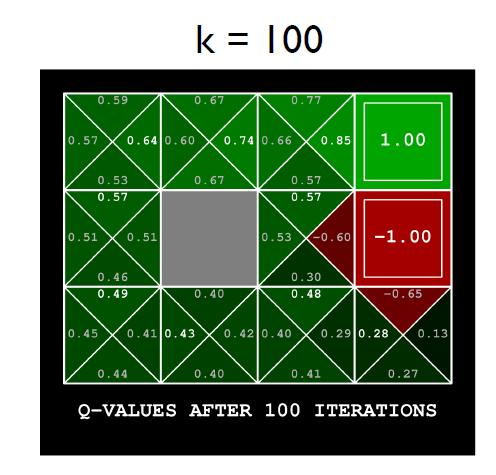
I used pygame for a reinforcement learning course assignment: I built a gridworld simulator where you can input a text file with the origin, goal and obstacles, and watch as an agent learns a policy using Q-learning. It's based on a visualization used in a Berkeley RL bootcamp: https://miro.medium.com/max/992/1*FnCKMEFZC9QRnxLWT3lSCA.png

I never got to open-sourcing it though

Post reply on HN