In the discussion of space junk, and kessler syndrome, there is a large bias that needs to be addressed. Most commentators operate under the impression that most of the stuff up there is "junk" from human activities, that space was essentially clean until we got there. It wasn't. It isn't. There are literally tons of natural rock falling onto earth every day. By some measurements over 100 metric tons per day. That is…
True, but generally most the "natural" debris are much smaller objects (micro-meteoroids). These are on the order of micrometers in size. Smaller micro-meteoroids are much more prevalent [0]. These do still cause damage to spacecraft but it is on a much smaller scale. The effects are typically things like cracked solar arrays, tears in multi-layer thermal insulation. This is still a a concern and when things like meteor showers occur some spacecraft will try and optimize the orientation of their solar arrays so that they are not normal to the ram direction (i.e. the solar arrays are facing in the direction of travel which gives a greater chance of hitting something at high velocity)
Larger debris does tend to come from satellites. And things such as satellite collisions cause a noticeable effect on the number of objects (of a size that we can track) [1].
[0] https://www.nap.edu/openbook/0309051258/xhtml/images/img0001...
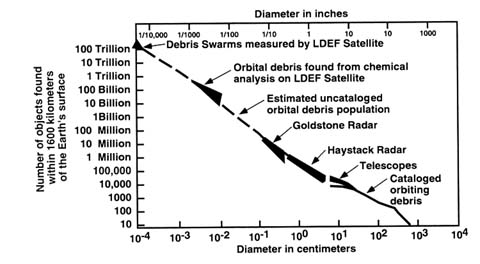
[1] https://en.wikipedia.org/wiki/Space_debris#/media/File:Space...
